Electrical
Ex installation and inspection — where compliance is actually won or lost
Certified equipment is the easy part. Glands, unused entries, flame paths, IS segregation and the inspection regime are where hazardous area compliance is genuinely decided.
Standards referencedIEC 60079-14IEC 60079-17IEC 60079-19
Hazardous area basics covered zones, gas groups and protection concepts — how equipment is selected. This page is about what happens after it arrives, which is where compliance is genuinely decided.
Cable entries: the most common failure
Every hole in an Ex enclosure is part of its certification.
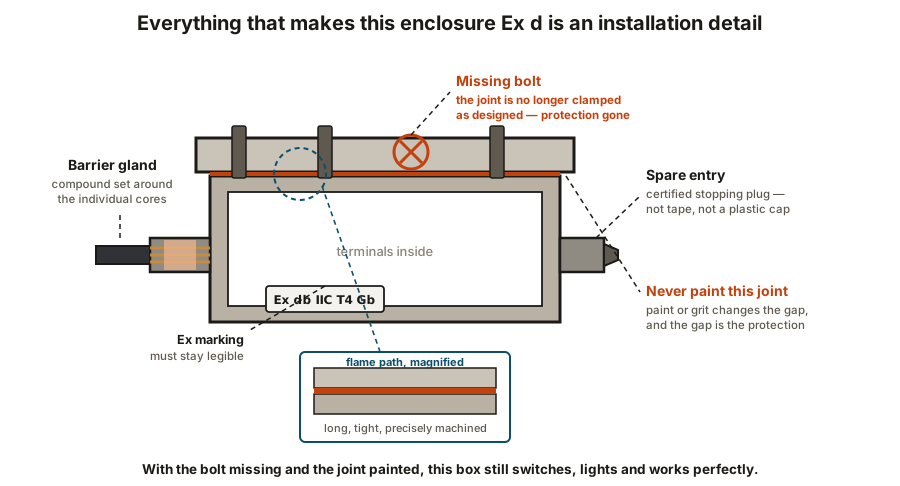
Glands must match both the enclosure’s protection type and the cable’s construction. On Ex d a barrier gland — filled with setting compound around the individual cores — is often required, because a cable’s own interstices would otherwise pipe an explosion along the cable. Whether a barrier gland is needed depends on the enclosure volume, the zone and the gas group, and it is stated in the certificate.
Unused entries need certified stopping plugs of the correct thread and type. A plastic blanking plug, a bolt, tape or compound is not a stopping plug, and it is one of the most frequent audit findings on any plant.

Thread engagement matters too — a specified minimum number of threads, correctly engaged. A gland that only just catches is not sealed against an internal explosion.
Flame paths
An Ex d enclosure works by containing an explosion and venting the gases through long, tight, precisely machined joints that cool them below the ignition temperature outside.
The protection is those gaps. Therefore:
- Never paint a flame path. Paint changes the gap dimension and traps material in it.
- Never scratch or dress one. A machining mark across a joint face is a leak path for flame.
- Every bolt goes back, of the correct grade. The joint only holds if it is clamped as designed.
- Protect them with the specified compound, not with whatever grease is on the shelf.
Intrinsic safety in practice
IS protects by limiting energy, which means the protection lives in the whole circuit, not in one device.
- Barriers or isolators at the safe-area end limit the energy entering the field.
- Cable parameters matter: the cable’s capacitance and inductance are part of the calculation, so length and type are constrained.
- Segregation keeps IS and non-IS wiring apart — separate enclosures, or defined separation and barriers within one.
- Light blue identifies IS cable and terminals, as noted in cables. Using blue for anything else destroys the guarantee.
- The IS earth is part of the certification, not general good practice — see earthing and bonding.
Mixing IS and non-IS wiring in one enclosure is a common and serious finding, because the energy limit that makes the circuit safe no longer holds.
The inspection regime
| Visual | Defects visible without tools or access equipment | Eyes only, from where you can stand | Missing bolts, obvious damage, corrosion, loose glands |
|---|---|---|---|
| Close | As visual, plus defects needing access equipment and a closer look | Ladder or platform, torch — but the equipment stays closed | Loose fixings, wrong labels, damaged seals, incorrect glands |
| Detailed | As close, plus defects only apparent with the enclosure opened | Equipment de-energised and opened, permit required | Terminal condition, internal damage, incorrect internal parts |
No rows match that filter.
The three grades differ by how far you take the equipment apart and what you are allowed to assume. A visual inspection is done walking past; a detailed one may need the equipment opened and de-energised. Grade, frequency and sample size all come from the plant's inspection strategy.
IEC 60079-17 sets three types of inspection:
- Initial — everything, before it is first energised.
- Periodic — on a defined interval, at a defined grade.
- Sample — a proportion of similar equipment, used to judge whether the whole population is degrading.
The interval and grade come from the plant’s inspection strategy, which weighs the environment, the zone and the equipment’s history. Harsh environments and Zone 1 get more attention than a sheltered Zone 2.
What inspections actually find
| Missing or wrong cover bolts | An Ex d enclosure relies on every bolt to contain an internal explosion | The full number, of the specified grade — not the nearest bolt that fits |
|---|---|---|
| Painted or damaged flame path | The machined joint is the protection; paint and scratches defeat it | Clean, undamaged, lightly greased with the specified compound |
| Unused entry blanked with tape or a plastic plug | The enclosure is no longer sealed or certified | A certified stopping plug of the correct thread and type |
| Wrong gland type | A barrier gland may be required to seal around the cable cores | The gland type the certificate and the cable construction call for |
| IS and non-IS wiring in the same enclosure | Energy can cross into the intrinsically safe circuit and defeat it | Separation, segregation, and the blue identification maintained |
| Incorrect lamp or component fitted | A replacement part changes the certified surface temperature | The exact part named in the certificate documentation |
| Corroded enclosure or seized fasteners | Water ingress, and an enclosure that cannot be properly reclosed | Sound housing with intact seals and serviceable fasteners |
| Ex certification label missing or unreadable | Nobody can confirm the equipment suits the zone it is in | Legible marking, matched against the hazardous area drawings |
| Equipment installed in the wrong zone | The area was reclassified, or the drawing was never checked | Equipment protection level appropriate to the current classification |
No rows match that filter.
Almost none of these are equipment failures. They are installation and maintenance defects — things done in good faith by people who did not know the certification depended on them. That is why competence, not just procedure, is the control.
Read the middle column. Almost none of these are equipment failures — they are installation and maintenance defects, done in good faith by people who did not know the certification depended on them.
The fitter who replaced a lamp with a physically identical one changed the certified surface temperature. The painter who sprayed a junction box did not know the joint face mattered. The electrician who blanked a spare entry with what was to hand solved the immediate problem.
Repair and modification
Repairing Ex equipment is governed separately by IEC 60079-19, and it is more restrictive than people expect. Machining a flame path, rewinding an Ex d motor or replacing internal components can invalidate the certification unless done by a facility approved for it and marked accordingly.
Drilling an extra cable entry into a certified enclosure on site is not a modification. It is the end of that enclosure’s certification.
What to take away
- Certified equipment plus a poor installation is a non-compliant installation.
- Every entry is part of the certification. Unused ones need certified stopping plugs.
- Flame paths are the protection. Never painted, never dressed, every bolt refitted.
- Ex defects give no symptom — the equipment works perfectly with its protection gone.
- IS protection lives in the whole circuit: barrier, cable parameters, segregation, earth.
- Inspection grades differ by how far you take it apart. Strategy sets grade and interval.
- Most findings are maintenance decisions made without knowing what they depended on, which is why competence is certified.
Check your understanding
10 questions. Nothing is recorded — this is just for you.