Electrical
Hazardous areas — zones, gas groups and Ex protection explained
Why a light fitting in a refinery costs ten times a normal one. Zones and divisions, gas groups, temperature classes, IP ratings, and how to read an Ex certification label.
Standards referencedIEC 60079-0IEC 60079-10-1IEC 60079-14IEC 60529ATEX 2014/34/EU
Walk into a refinery and every light fitting, junction box, motor and instrument looks overbuilt — heavy castings, bolted covers, warning labels. That is not over-engineering. It is because in most of that plant, an ordinary electrical spark would start a fire.
The three things fire needs
A fire needs fuel, oxygen and a source of ignition. In a hydrocarbon plant you cannot remove the fuel and you cannot remove the oxygen. So all the engineering effort goes into the third: making certain that no piece of electrical equipment can ever become the ignition source.
Everything below follows from that single objective.
Step one: classify the area
Before you choose any equipment, you decide how likely a flammable atmosphere is at each point in the plant. That study — area classification — divides the site into zones and produces a set of drawings that every discipline then works from.
| Zone 0 | Division 1 | Continuously, or for long periods, or frequently | Ga | Ex ia (intrinsic safety) only, in practice | Inside a fuel storage tank, above the liquid surface |
|---|---|---|---|---|---|
| Zone 1 | Division 1 | Likely to occur in normal operation, occasionally | Gb | Ex d, Ex e, Ex ib, Ex p, Ex m | Around a pump seal, a sample point, a vent outlet |
| Zone 2 | Division 2 | Not likely in normal operation, and short-lived if it happens | Gc | Ex n, Ex ic, plus anything accepted in Zone 1 | The wider area around a process unit, outside the Zone 1 radius |
| Zone 20 | Division 1 (dust) | Combustible dust cloud present continuously or for long periods | Da | Ex ia D, Ex ta | Inside a powder silo or a dust collector |
| Zone 21 | Division 1 (dust) | Dust cloud likely in normal operation | Db | Ex tb, Ex ib D, Ex pD | At a bag-dump station or a powder charging port |
| Zone 22 | Division 2 (dust) | Dust cloud not likely, and short-lived if it happens | Dc | Ex tc, Ex ic D | The general area of a pharmaceutical dispensing room |
No rows match that filter.
Equipment certified for a lower-numbered zone is always acceptable in a higher-numbered one — an Ex ia device rated for Zone 0 may be installed in Zone 1 or Zone 2. The reverse is never true.
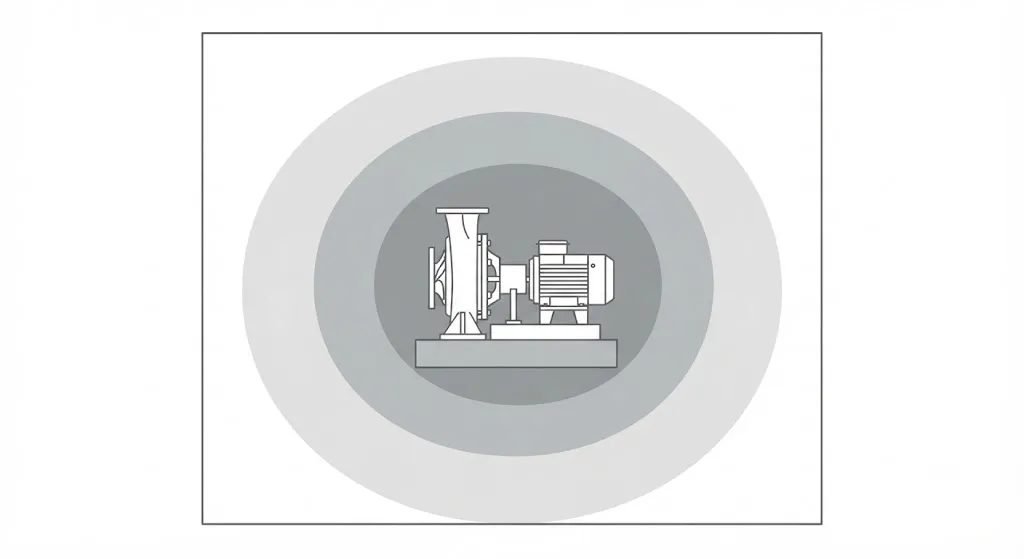
Two schemes exist and you will meet both:
- Zones (IEC / ATEX, used almost everywhere outside North America) — Zone 0, 1, 2 for gas; Zone 20, 21, 22 for dust.
- Divisions (NEC, North America) — Division 1 and 2, which map roughly onto Zone 0+1 and Zone 2 respectively.
Step two: know your gas
Not every flammable gas behaves the same. Two properties decide what equipment you need:
Gas group — how easily the gas ignites and how readily a flame passes through a narrow gap:
- IIA — propane, and most ordinary hydrocarbons. The least demanding.
- IIB — ethylene. More demanding.
- IIC — hydrogen and acetylene. The most demanding of all.
Equipment certified for IIC is acceptable in IIB and IIA areas, but never the reverse. For dusts the groups are IIIA (fibres), IIIB (non-conductive dust) and IIIC (conductive dust).
Temperature class — the ignition temperature of the gas sets the maximum surface temperature any equipment may reach:
| Class | Max surface temperature |
|---|---|
| T1 | 450 °C |
| T2 | 300 °C |
| T3 | 200 °C |
| T4 | 135 °C |
| T5 | 100 °C |
| T6 | 85 °C |
A hot surface ignites gas just as effectively as a spark. T6 equipment is the most restrictive and therefore acceptable everywhere T1–T5 would be.
Step three: choose a protection concept
Given the zone and the gas, you select equipment built to stop ignition. Each method has a letter:
Ex d — Flameproof. Accepts that an explosion may happen inside the enclosure, and contains it. The joints are long, precisely machined flame paths that cool escaping gas below its ignition temperature. Heavy cast housings. Used widely in Zone 1 for motors, junction boxes and lighting.
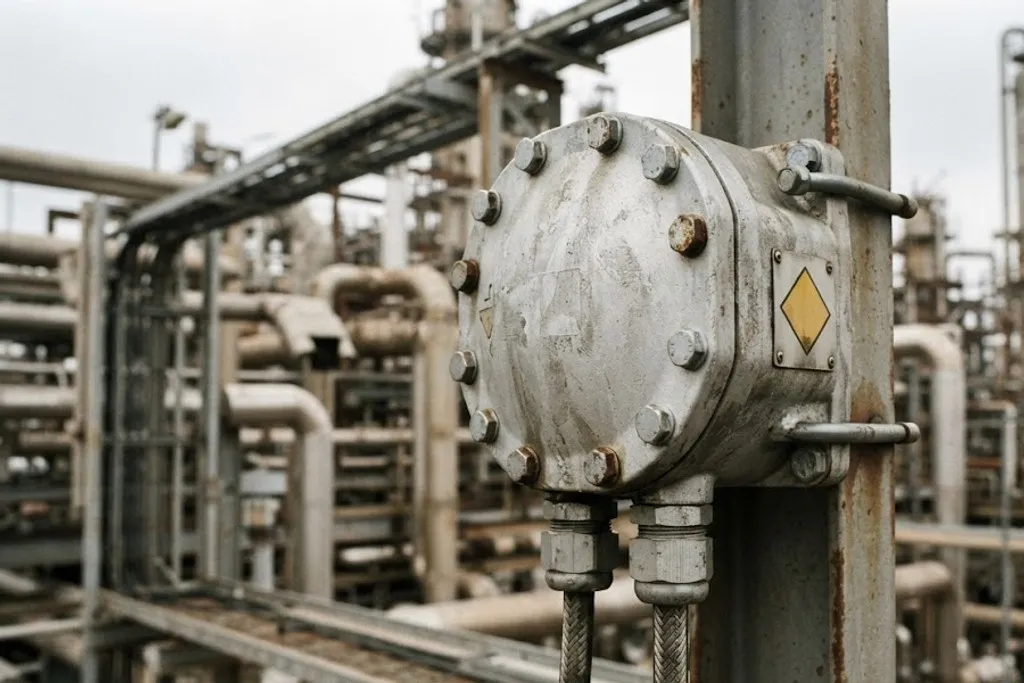
Ex e — Increased safety. Engineered so that arcs, sparks and hot surfaces cannot occur in the first place — generous creepage distances, high-quality terminals, no switching contacts. Lighter than Ex d, so often combined with it (Ex de).
Ex i — Intrinsic safety. Limits the electrical energy in the circuit so low that even a short circuit cannot release enough energy to ignite the atmosphere. Subdivided: ia (safe with two faults, acceptable in Zone 0), ib (one fault, Zone 1), ic (normal operation, Zone 2). This is the standard approach for instrument loops.
Ex p — Pressurisation. Clean air or inert gas is held at a slight positive pressure inside the enclosure, so flammable gas cannot get in. Used for large analyser houses and control cabinets. Needs a purge cycle before energising and an alarm if pressure is lost.
Ex n — Non-sparking. Zone 2 only. The equipment does not spark in normal operation. Lighter and cheaper, but offers no protection under fault.
Ex m — Encapsulation. Potting compound excludes the atmosphere from the live parts.
Reading the label
An Ex marking is a sentence. Take:
Ex db IIC T4 Gb- Ex — explosion protected
- db — flameproof, equipment protection level b (suitable for Zone 1)
- IIC — gas group, covers hydrogen and acetylene — so it covers everything
- T4 — maximum surface temperature 135 °C
- Gb — Gas, equipment protection level b, i.e. Zone 1
Equipment protection levels are the shorthand: Ga/Da → Zone 0/20, Gb/Db → Zone 1/21, Gc/Dc → Zone 2/22. Higher protection always works in a lower zone.
Under ATEX you will also see a category marking such as II 2 G — equipment group II
(surface industry), category 2 (Zone 1), G (gas).
IP rating is a different thing entirely
The Ex marking says the equipment cannot ignite the atmosphere. The IP rating says how well the enclosure keeps dust and water out. They are independent, and you need both.
| 0 | No protection | No protection |
|---|---|---|
| 1 | Objects over 50 mm — the back of a hand | Dripping water, vertical |
| 2 | Objects over 12.5 mm — a finger | Dripping water, enclosure tilted up to 15° |
| 3 | Objects over 2.5 mm — a tool | Spraying water up to 60° from vertical |
| 4 | Objects over 1 mm — a wire | Splashing water from any direction |
| 5 | Dust protected — ingress not fully prevented, but harmless | Water jets from a 6.3 mm nozzle |
| 6 | Dust tight — no ingress at all | Powerful water jets from a 12.5 mm nozzle |
| 7 | — | Temporary immersion to 1 m for 30 minutes |
| 8 | — | Continuous immersion, depth agreed with the manufacturer |
| 9 | — | High-pressure, high-temperature jets — washdown areas |
No rows match that filter.
Read the two digits separately. IP65 is dust-tight (6) and protected against water jets (5). A higher second digit does not always include the lower ones: IP67 (immersion) is not automatically proof against the pressure jets of IP65, which is why dual ratings like IP66/IP67 are marked separately.
A typical outdoor field enclosure is IP66. Washdown areas in pharma often demand IP69K. Note that a higher second digit does not automatically include the lower ones — which is why you see dual markings like IP66/IP68.
Dust is not a footnote
In pharmaceutical manufacturing, gas is rarely the hazard — combustible dust is. Fine organic powder suspended in air is genuinely explosive, and dust adds failure modes gas does not have: a settled layer insulates hot surfaces, and a primary explosion lifts settled dust into the air to feed a far larger secondary one.
Dust zones are 20, 21 and 22. Protection is mostly Ex t (protection by enclosure) and Ex i. Housekeeping stops being a tidiness issue and becomes a safety control.
What to take away
- Zone says how often a flammable atmosphere is present; it drives everything else.
- Gas group and temperature class say what the atmosphere needs; IIC and T6 are the most demanding and therefore the most widely acceptable.
- Protection concepts each stop ignition by a different mechanism — contain it (d), prevent it (e), starve it of energy (i), or exclude the atmosphere (p, m).
- Equipment for a lower-numbered zone is always acceptable in a higher-numbered one. Never the reverse.
- IP rating and Ex certification are separate requirements, and you need both.
Check your understanding
10 questions. Nothing is recorded — this is just for you.