Electrical
Cables — construction, selection and why sizing is never just about current
What the layers of a cable do, how power, control and instrument cables differ, the four things that decide a cable size, and why the published rating is never the rating you get.
Standards referencedIEC 60502IEC 60364-5-52IEC 60079-14IEC 61892
Cables are where a great deal of a plant’s cost and nearly all of its installation labour sits. They are also where a design that looked fine on paper meets a hot cable tray in direct sun with forty other cables on it.
What the layers do
Cut through a typical armoured plant cable and you find, from the middle outward:
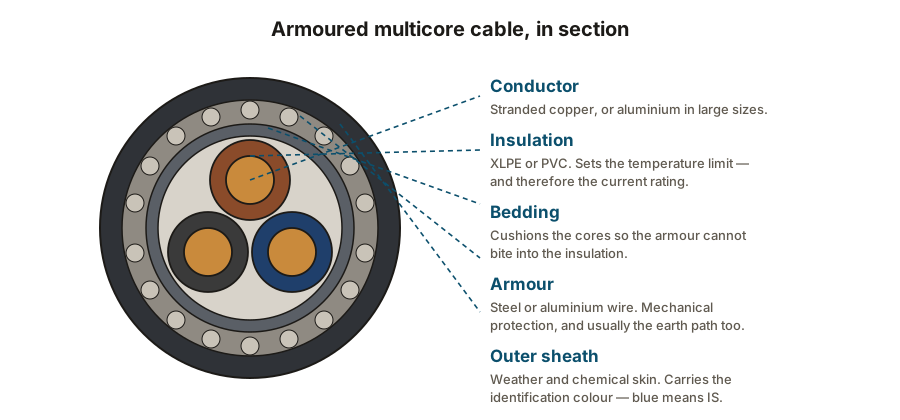
Conductor — stranded copper, or aluminium in large sizes. Copper conducts better and terminates more reliably; aluminium is cheaper and lighter for a given capacity, but needs larger sizes and careful termination because it creeps under pressure and oxidises.
Insulation — keeps each core apart from its neighbours and from earth. This is the layer that sets the temperature rating, and therefore the current rating.
Bedding — a cushioning layer so the armour does not bite into the insulation.
Armour — steel wire (SWA) or aluminium wire (AWA) for mechanical protection. On LV cables the armour usually doubles as the earth path. Aluminium armour on single-core AC cables avoids the heating that steel would suffer from the magnetic field.
Outer sheath — the weatherproof, chemical-resistant skin, and the surface that carries the identification colour.
| PVC | Insulation and sheath | 70 | 160 | Cheap and tough, but emits dense toxic smoke and acid gas in a fire |
|---|---|---|---|---|
| XLPE | Insulation | 90 | 250 | Higher rating and better fault withstand than PVC. The plant default. |
| EPR | Insulation | 90 | 250 | More flexible than XLPE; favoured offshore and for trailing cables |
| LSZH | Sheath | 90 | 250 | Low smoke, zero halogen — for enclosed and manned spaces |
| Silicone rubber | Insulation | 180 | 350 | High temperature duty; forms an insulating ash when burnt |
| Mineral (MICC) | Insulation | 250 | 1000 | Magnesium oxide in a copper sheath. Survives fire; needs sealed terminations. |
| PTFE | Insulation | 200 | 300 | Chemically inert, high temperature, expensive |
No rows match that filter.
The conductor temperature limit is what sets a cable's current rating. XLPE runs 20 °C hotter than PVC for the same size, which is why an XLPE cable of a given cross-section carries noticeably more current than the PVC equivalent.
The temperature column is the one doing the work. XLPE runs at 90 °C where PVC is limited to 70 °C, and that 20 °C is why an XLPE cable of a given size carries appreciably more current than the PVC equivalent.
Select for duty before size
| LV power | XLPE insulated, PVC bedded, steel wire armoured, PVC sheathed | No | 400/415 V supplies to motors, panels and heaters | The plant workhorse. Armour also serves as an earth path. |
|---|---|---|---|---|
| MV power | XLPE insulated, individually screened cores, armoured | Yes — per core | 3.3 kV to 33 kV distribution | Core screens control the electric field; termination kits are specialised |
| VFD / motor drive | XLPE, symmetrical cores, overall braid screen, armoured | Yes — overall braid | Inverter output to a motor | The screen must be bonded at both ends, unlike most instrument cable |
| Control | PVC or XLPE multicore, overall screen, armoured | Usually overall | Switching signals, interlocks, status feedback | Multicore with spare cores allowed for — always specify spares |
| Instrument, analogue | Twisted pair, individual and overall screens, armoured | Yes — pair and overall | 4–20 mA signals, RTD and thermocouple circuits | Twisting rejects magnetic pickup; the screen rejects electric pickup |
| Intrinsically safe | As instrument cable, with a light blue outer sheath | Yes | IS circuits from a barrier to a field device | Blue sheath is the identification convention — never use it for anything else |
| Fire resistant | Mineral insulated, or mica tape under XLPE, LSZH sheathed | Depends on duty | Emergency shutdown, fire pumps, emergency lighting | Must keep working during a fire, not merely resist spreading it |
| Thermocouple extension | Matched alloy conductors, twisted pair, screened | Yes | Thermocouple signals back to the marshalling cabinet | Conductors must match the thermocouple type — copper introduces an error |
No rows match that filter.
A cable is selected for its duty first and its size second. Putting a power cable on an instrument duty is not merely wasteful — the screening, capacitance and segregation requirements are different, and a 4–20 mA signal run alongside a motor feeder will pick up interference.
The distinction that matters most is power versus signal.
A 4–20 mA instrument signal is a few milliamps travelling hundreds of metres. A motor feeder is hundreds of amps switching on and off. Run them together and the motor cable induces noise into the signal — so instrument cable is defended twice over:
- Twisted pairs cancel magnetically induced interference, because the two conductors of a pair see opposing fields.
- Screens intercept electrostatically coupled interference and conduct it to earth.
These are two different mechanisms addressing two different problems, which is why good instrument cable has both, and why it has individual screens per pair and an overall screen.
Four checks decide the size
Sizing a cable on load current alone is the classic beginner error. There are four checks and the largest answer wins.
1. Current carrying capacity
Start with the load, then apply the derating factors for the actual installation.
| High ambient temperature | 0.7 – 0.95 | Less temperature difference available to shed heat | Desert and tropical sites bite hard here — 50 °C shade is not unusual |
|---|---|---|---|
| Grouping on a tray | 0.5 – 0.85 | Cables heat each other, and the ones in the middle cannot cool | Depends on the number of cables and the spacing between them |
| Direct burial | 0.8 – 1.0 | Depends entirely on soil thermal resistivity and depth | Dry sandy soil is a far worse heat path than moist clay |
| Buried in ducts | 0.7 – 0.9 | The air gap in the duct insulates rather than conducts | Worse than direct burial, and often overlooked |
| Direct solar radiation | 0.85 – 0.95 | Sun on the sheath adds heat the cable must also shed | Applies to exposed outdoor runs; a sunshade recovers most of it |
| Enclosed in conduit or trunking | 0.7 – 0.9 | Trapped air, no convection | Fill ratio matters as much as the enclosure itself |
| Harmonic content (VFDs, rectifiers) | 0.7 – 0.9 | Triplen harmonics add current in the neutral that the sizing ignored | The neutral can carry more than the phases on a harmonic-rich load |
No rows match that filter.
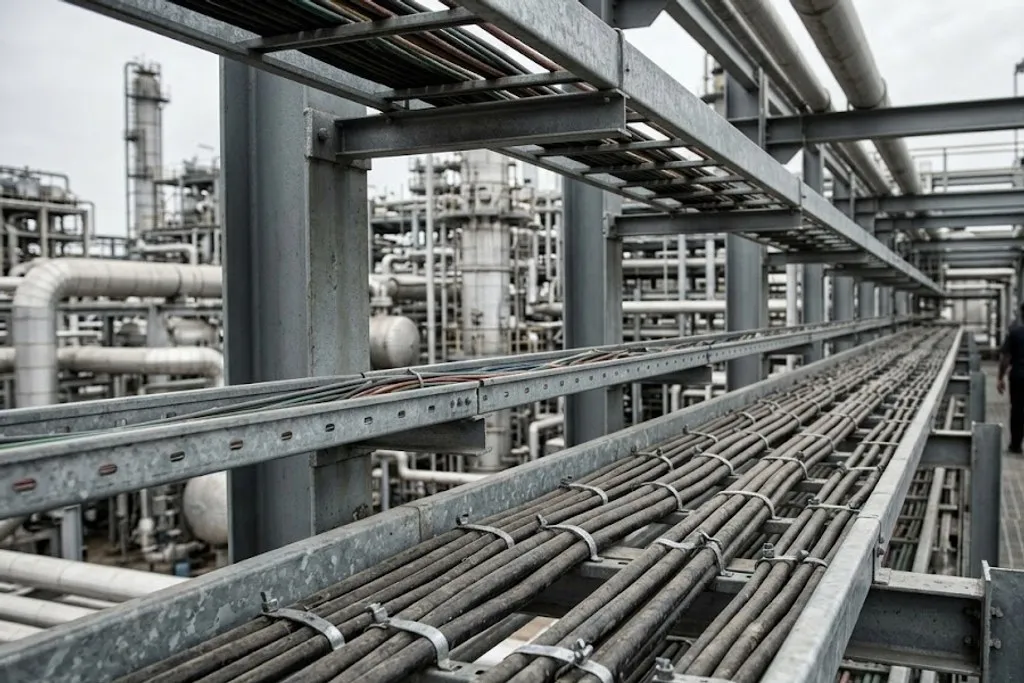
A published current rating assumes one cable, in free air, at a stated ambient. A real plant cable is bunched with others on a hot tray in the sun — and the factors multiply together. Three factors of 0.8 leave you with barely half the rating you started from.
2. Voltage drop
Volts are lost along the length of the cable. A motor at the far end of a long run may see meaningfully less than nominal voltage, and a motor starting on low voltage draws more current, gets hotter and may not start at all under load.
Typical limits are around 3% for lighting and 5% for power, measured at full load. On long runs — a remote wellhead, a distant pump house — voltage drop, not current, usually decides the size.
3. Short circuit withstand
During a fault the cable carries enormous current until the protection clears it. The conductor must survive that heating without the insulation being destroyed.
This check couples cable sizing to the protection settings, which is why cable schedules and protection studies have to agree. A faster breaker allows a smaller cable; a slow one demands a larger one.
4. Earth fault loop impedance
The protective device must see enough fault current to operate within its required time. Too high an impedance in the earth path and the breaker takes too long — leaving a fault live and metalwork dangerous.
Installation is where designs are lost
Segregation. Power, control and instrument cables are separated on trays, by distance or by an earthed barrier. Crossing at right angles rather than running parallel minimises coupling.
Bending radius. Every cable has a minimum bending radius, typically 6 to 12 times its outside diameter. Pulling a cable round a tighter bend damages the insulation invisibly, and it fails later.
Pulling tension. There is a limit, and exceeding it stretches conductors and displaces insulation. Long pulls need rollers, lubricant and planning.
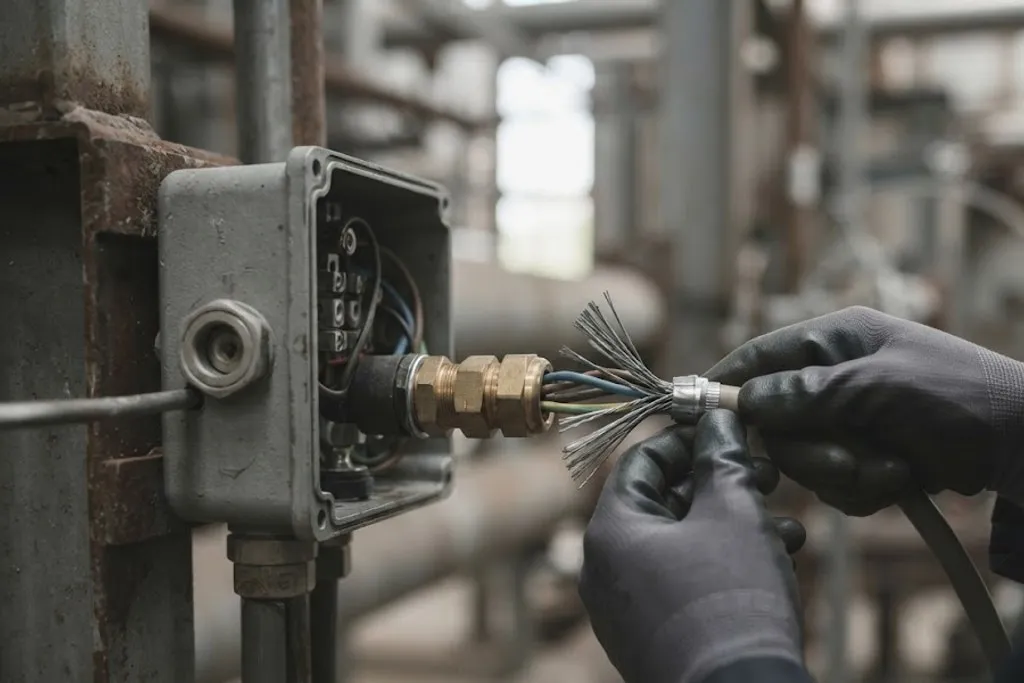
Glanding. The gland makes the mechanical seal, maintains the ingress rating and — on armoured cable — terminates the armour as an earth. In a hazardous area the gland is part of the certification, as covered in hazardous areas.
Fire performance: two different things
These get confused constantly, and they are not the same.
Flame retardant — the cable resists spreading fire along its length. It stops being a fuse leading fire from one area to another. Most plant cable is flame retardant.
Fire resistant — the cable keeps working while burning, for a defined period. This is required only for circuits that must survive a fire: emergency shutdown, fire pumps, emergency lighting, escape systems.
LSZH is a third and separate property: low smoke, zero halogen. Ordinary PVC produces dense black smoke and hydrogen chloride when it burns, which blinds and injures people trying to escape and corrodes equipment. LSZH is specified in enclosed and manned spaces — accommodation, control rooms, tunnels — where the smoke matters more than the flame.
What to take away
- Layers have jobs: insulation sets the temperature and therefore the rating, armour protects and often earths, the sheath keeps the weather out.
- Select for duty first. Power, control and instrument cables are different products, not different sizes of the same one.
- Twisting defeats magnetic pickup, screening defeats electrostatic pickup. Instrument cable needs both.
- Earth instrument screens at one end. Earth VFD screens at both. The reason differs.
- Four sizing checks — capacity, voltage drop, fault withstand, earth loop impedance — and the biggest answer wins.
- Derating factors multiply, and can halve a published rating.
- Flame retardant, fire resistant and LSZH are three different requirements.
Check your understanding
10 questions. Nothing is recorded — this is just for you.