Electrical
Switchgear, transformers and protection testing
Why secondary injection proves the relay and primary injection proves everything else, what a reversed CT does to differential and directional protection, why an open CT secondary is dangerous, what breaker timing feeds into, and why phase rotation is checked before anything is paralleled.
Standards referencedIEC 60255IEC 62271IEEE C57.12.00
Protection is the part of an electrical installation that does nothing at all until the worst moment, and then has to be right first time. It cannot be proved by inspection, so it is proved by testing — and the great majority of protection problems are not in the relay.
Each test proves less than its name suggests
| Insulation resistance | Insulation is not damaged or damp | Nothing about the protection or the connections | Before energisation, and after any work |
|---|---|---|---|
| Contact resistance (ductor) | Main contacts and bolted joints are sound | Anything about timing or the mechanism | Commissioning and major maintenance |
| Secondary injection | The relay operates at its setting and on its characteristic | CT ratio, CT polarity, and all the wiring outside the relay | Relay setting changes; routine testing |
| Primary injection | The whole chain — CT ratio, polarity, wiring, relay, trip | Little, which is why it is the definitive test | Initial commissioning; after CT or wiring changes |
| CT polarity / ratio | The current transformer is connected the way the scheme assumes | Relay behaviour | Commissioning, and any time a CT circuit is disturbed |
| Breaker timing | How long the contacts take to open and close | Whether the protection will call for it | Commissioning; feeds the arc flash study and discrimination |
| Trip circuit supervision check | The trip coil circuit is continuous and healthy | That the relay will issue the command | Commissioning; continuously monitored thereafter |
| Transformer ratio and vector group | Turns ratio at each tap and the phase relationship | Insulation condition | Before energisation, and before paralleling |
| Transformer oil dielectric strength | The oil will withstand voltage — moisture and contamination are low | Winding condition | Before energisation and periodically in service |
| Functional trip test | The breaker actually opens when the protection operates | Nothing in that chain — but it tests one point, not a characteristic | Commissioning, and after any change to the trip path |
No rows match that filter.
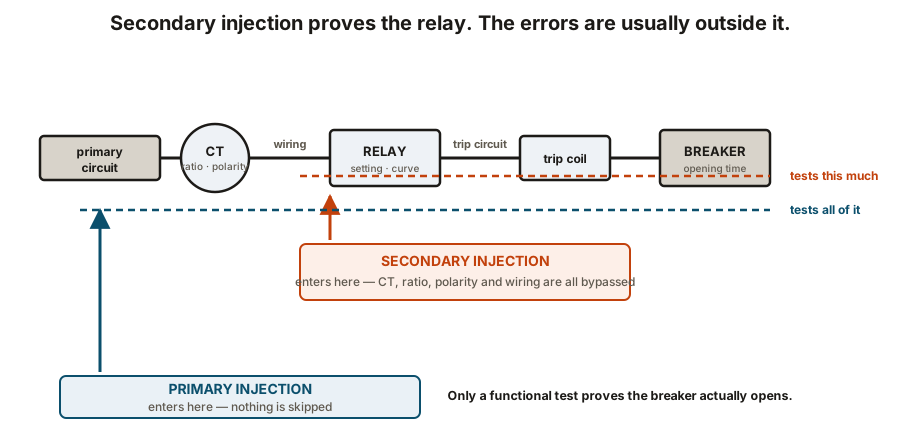
The pattern worth noticing: each test proves a narrower thing than its name suggests. Secondary injection proves the relay. Primary injection proves the relay AND everything around it. Only the functional test proves the breaker actually opens.
The pattern running through that table is worth holding onto, because it explains why a scheme that has passed several tests can still be wrong.
Secondary injection feeds current directly into the relay terminals. It proves the relay operates at its setting, on its characteristic, with its timing. It proves nothing whatever about what is connected to those terminals.
Primary injection puts real current through the primary circuit and lets the whole chain respond — current transformer, its ratio, its polarity, the wiring, the relay, the trip.
Current transformers
A CT reproduces a large primary current as a small secondary one, and two of its properties cause most of the trouble.
An open secondary is dangerous
A CT is a current source. It drives whatever current the ratio demands into whatever is connected, and it will raise the voltage as far as it needs to in order to do so.
Polarity is checked, never assumed
Differential protection compares currents entering and leaving a zone. Directional protection decides which way power is flowing. Both depend entirely on the phase relationship between currents.
Reverse one CT and the relay sees a difference where there is none, or none where there is one.
Circuit breakers
Contact resistance is measured with a ductor across the closed contacts. A high reading means poor contact or a poor bolted joint, and it will show up later as a hot spot on a thermographic survey — under load, because an unloaded connection stays cool however bad it is.
Timing measures how long the contacts take to open and close.
That number matters beyond the breaker. Fault clearance time is relay operating time plus breaker opening time, and clearance time is what sets the incident energy in the arc flash assessment and what protection discrimination is graded against. A slow breaker quietly raises the energy someone would be exposed to.
Interlocking is verified by attempting the operation it is meant to prevent. A key interlock scheme that works on the drawing and not in metal will be discovered by whoever tries to earth a live circuit.
Transformers
Ratio and vector group. Turns ratio at every tap position, and the phase relationship between windings. Both are checked before energisation, and the vector group matters enormously before paralleling — two transformers of different vector group connected in parallel is a short circuit through both.
Oil dielectric strength. Oil is insulation as well as coolant, and moisture and particulate reduce its breakdown voltage sharply. Transformers sit in transit and storage long enough to acquire both, so the sample is taken before energisation, not after.
Winding resistance across all phases. An imbalance points at a bad connection, a shorted turn or a tap changer problem — and the commissioning value is worth recording as a baseline, because these tests earn most of their value through comparison over years.
Buchholz on an oil-filled transformer responds to gas accumulating from a slow internal fault and to a surge from a violent one. Gas collected at the alarm stage can be analysed to say what kind of fault is developing.
Before the supply is connected
Phase rotation determines which way every three-phase motor turns. Get it wrong across a board and every pump and fan on it runs backwards, and many machines are damaged within seconds.
Core colours record an intention. A rotation meter records the fact, and only the fact matters when the next step is closing onto a live system.
Synchronising, where two live systems are joined, is checked for voltage, frequency and phase angle before the breaker is allowed to close. Closing out of synchronism imposes a shock comparable to a short circuit on both machines, which is why a check synchronising relay blocks the close rather than merely alarming.
What to take away
- Secondary injection proves the relay. Primary injection proves everything around it — and that is where the errors are.
- Never open a CT secondary while it is energised. Short it first.
- CT polarity is measured, not read. A reversal can hide in normal operation and appear at the worst moment.
- Breaker timing feeds the arc flash study and protection discrimination, not just the breaker’s own record.
- Verify interlocks by attempting the operation they prevent.
- Transformers: ratio, vector group, oil dielectric strength, winding balance — and check the breather desiccant.
- Phase rotation is verified with a meter before connecting to existing plant. Colours are an intention.
Check your understanding
6 questions. Nothing is recorded — this is just for you.