Electrical
Electrical commissioning and turnover — from dead to live
Why insulation testing needs electronic devices disconnected and readings corrected for temperature, what a functional test proves that a settings check cannot, why an inhibit register exists, why as-left settings are recorded, and what changes the moment a system is energised.
Standards referencedIEC 60364-6IEC 60079-14IEEE 81
Commissioning is where an installation that has been assembled becomes an installation that works, and it is the last point at which anything is cheap to fix. After energisation, every correction is permit-controlled work on a live plant.
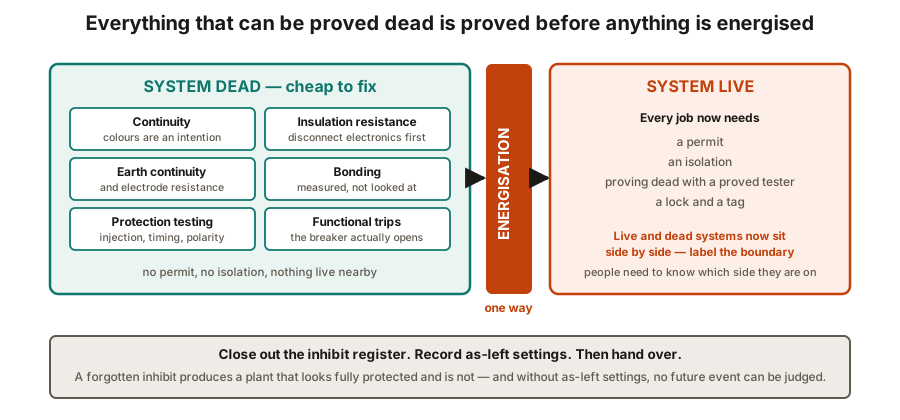
Dead testing comes first
Everything that can be proved with the system dead is proved before anything is energised, because the alternative costs far more.
Continuity. Every conductor goes where the drawing says. On a multicore this is the check that catches a transposition at a joint or a pull-through, and core colours are not evidence — they record an intention.
Insulation resistance. A high DC voltage applied between conductors, and between conductors and earth, to find damage, damp or contamination.
Earthing. Two different measurements, often confused:
- Earth continuity — a low-resistance path from equipment back to the main earth bar. This proves the whole path, including every intermediate joint. A bolted connection at each end is not the same as a proven path.
- Earth electrode resistance — the resistance of the electrode system to the general mass of earth, measured by fall of potential with the test electrodes properly spaced.
Equipotential bonding ties exposed and extraneous conductive parts together so they sit at the same potential during a fault. What injures somebody is the difference between two things they are touching at once, not the absolute potential of either — which is why bonding is verified by measurement rather than by looking at it. A connection can appear sound while paint, corrosion or a loose bolt gives it a high resistance.
Functional testing
A settings check confirms the relay is configured as intended. It does not confirm that anything happens when the relay decides to act.
Inhibits and overrides
Commissioning is impossible without temporarily disabling things. Trips are inhibited so a system can be run up, interlocks are overridden so a sequence can be tested out of order, alarms are suppressed while a loop is being proved.
All of that is legitimate. What matters is that it is temporary, and an applied inhibit is invisible.
As-left records
By the time commissioning finishes, protection settings have usually moved. A nuisance trip gets chased, a timer is lengthened, a pickup is raised to get a motor started.
Energisation changes the rules
The moment a system is live, everything about how work is controlled changes. All further work falls under permit and isolation control, and proving dead — with an approved tester that is itself proved before and after — becomes part of every job.
Turnover
A system turnover package is the evidence that a system is complete, tested and fit to operate: test records, certificates, as-builts, as-left settings, the inhibit register closed out, and the punch list with its status.
Punch items are categorised, and the categorisation is a safety decision rather than a filing one. Category A — anything affecting safety or the ability to operate — is cleared before start-up. Category B can follow. An Ex non-conformance is category A by definition: the protection concept either holds or it does not, and an open flame path or an uncertified gland is a live ignition risk rather than an item of finishing work.
Compiling the package as work proceeds, rather than at the end, is not administrative tidiness. A missing test found today can be repeated while the system is still dead. The same gap found at handover means remobilising and re-isolating part of a live plant.
What to take away
- Do every dead test first. Afterwards it is permit-controlled live work.
- Disconnect electronics before megger testing, correct readings for temperature, let long cables settle, and discharge and earth afterwards.
- Earth continuity and electrode resistance are different measurements. High-resistivity desert soil makes the second hard, and it is seasonal.
- Bonding is verified by measurement — a sound-looking joint can be a high-resistance one.
- A functional test proves the breaker opens. A settings check never does.
- Keep an inhibit and override register, and close it out. A forgotten inhibit looks like full protection.
- Record as-left settings, or no future event can be judged.
- Energisation changes how all work is controlled, and the live boundary must be obvious on the ground.
Check your understanding
6 questions. Nothing is recorded — this is just for you.