
Civil & Structural
Steel metallurgy and weldability
What the chemistry on a mill certificate actually controls, why carbon equivalent decides whether a joint needs preheat, what the heat-affected zone is and why its coarse-grained band is the weakest part of a good weld.
Standards referencedAWS D1.1ASTM A6ASTM A370ASTM E23ASTM A572IS 2062
Structural steel covered what the sections are and why steel is used above ground. This topic is about the material itself — because once a structure is in service, almost every decision an inspector makes about welding it, repairing it or judging a crack in it comes back to chemistry and microstructure.
The short version: the mill certificate tells you how the steel will behave when you weld it, and most people never read it that way.
What is actually in structural steel
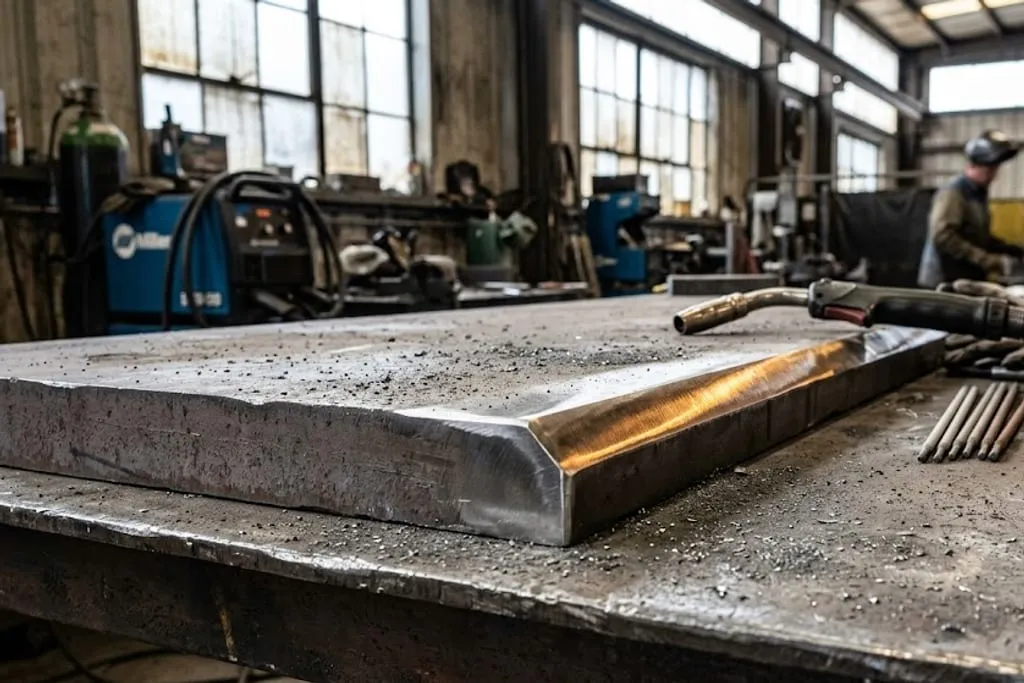
Iron and carbon, plus a controlled list of everything else. The quantities look trivial — tenths and hundredths of a percent — and they decide everything.
| Element | What it does | Why you care |
|---|---|---|
| Carbon (C) | The main strengthening element | Raises strength, wrecks toughness and weldability |
| Manganese (Mn) | Deoxidises, ties up sulfur, refines grain | Raises strength and toughness — the useful one |
| Silicon (Si) | Deoxidiser | Makes the steel “killed”, i.e. sound |
| Phosphorus (P) | Impurity | Embrittles at low temperature. Capped, typically ≤ 0.035 % |
| Sulfur (S) | Impurity | Hot cracking in welds. Capped, typically ≤ 0.035 % |
| V, Nb, Ti | Micro-alloying | Fine grain, so strength and toughness together |
| Cr, Ni, Mo, Cu | Alloying | Hardenability, toughness, weathering resistance |
Carbon is the trap. It is the cheapest way to make steel stronger, and every increment costs you ductility, impact toughness and weldability. Modern structural grades go the other way: keep carbon low and buy the strength from grain refinement instead.
Carbon equivalent: the number that decides preheat
You cannot judge weldability from carbon alone, because manganese, chromium, molybdenum and the rest all contribute to hardenability too. The industry rolls them into one figure. The International Institute of Welding formula is the common one:
CE(IIW) = C + Mn/6 + (Cr + Mo + V)/5 + (Ni + Cu)/15For modern low-carbon micro-alloyed steels the IIW formula is pessimistic, and the Ito–Bessyo parameter is used instead:
Pcm = C + Si/30 + (Mn + Cu + Cr)/20 + Ni/60 + Mo/15 + V/10 + 5B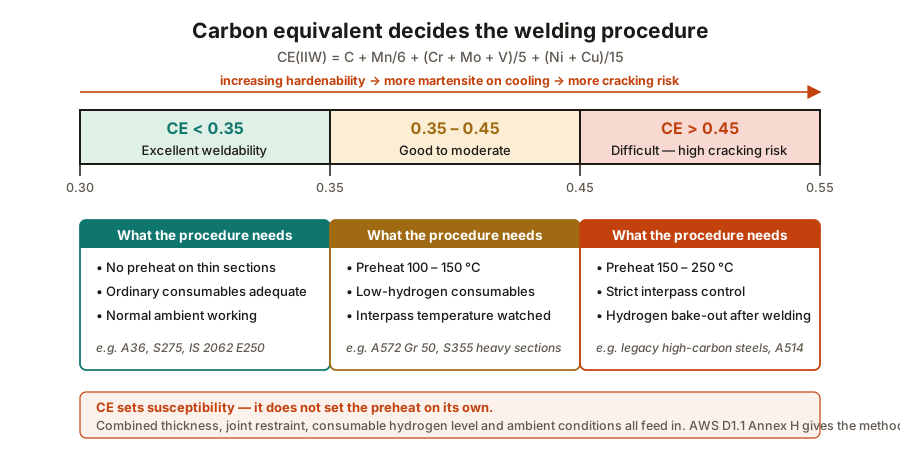
| CE (IIW) | Weldability | What the procedure needs |
|---|---|---|
| < 0.35 | Excellent | No preheat on thin sections; low cracking risk |
| 0.35 – 0.45 | Good to moderate | Preheat 100–150 °C, low-hydrogen consumables |
| > 0.45 | Difficult | Preheat 150–250 °C, interpass control, hydrogen bake-out |
The heat-affected zone
Welding is a very localised, very severe heat treatment that nobody designed. The weld metal itself is cast and usually fine. The problem is the parent metal beside it, which was never melted but was cooked — the heat-affected zone.
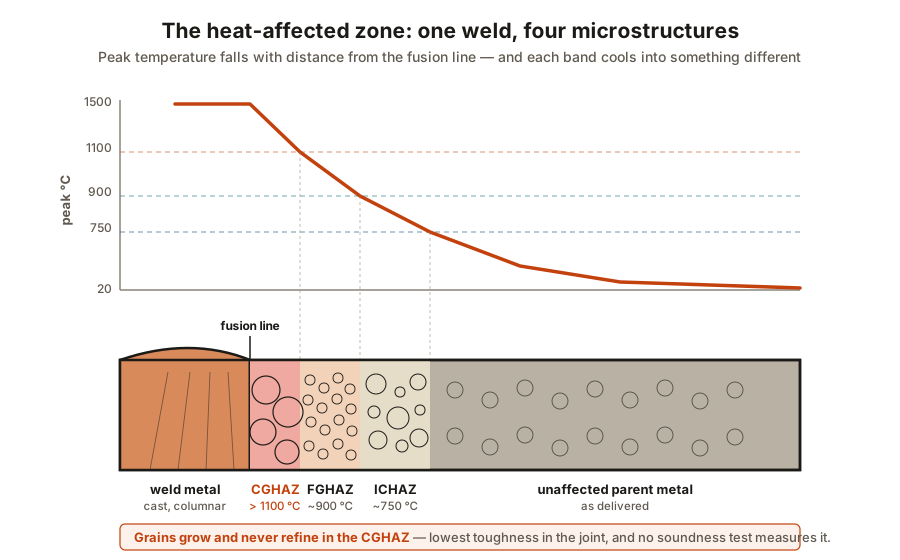
Working outwards from the weld:
- Coarse-grained HAZ (CGHAZ) — above roughly 1100 °C. Grains grow large and stay large. Lowest toughness in the joint. This narrow band, often a millimetre or two wide, is where brittle fracture and cold cracking start.
- Fine-grained HAZ (FGHAZ) — around 900 °C. Effectively normalised. Refined grain, good toughness. The best-behaved part of the joint.
- Intercritical HAZ (ICHAZ) — around 750 °C. Only partly transformed, giving a mixed structure with local brittle zones. In multi-pass welds these can be re-heated into something worse still.
- Unaffected parent metal — as delivered.
The phases, briefly
You do not need to be a metallurgist, but four names come up constantly in inspection reports and failure investigations:
| Phase | Structure | Character |
|---|---|---|
| Ferrite | Body-centred cubic | Soft, very ductile, low strength, absorbs impact well |
| Pearlite | Layered ferrite + cementite | Provides hardness and tensile strength |
| Bainite | Fine acicular | Strong and reasonably tough — a good outcome |
| Martensite | Body-centred tetragonal | Very hard, heavily strained, brittle |
Martensite is the one that matters. It forms when austenite is cooled too fast to transform any other way, which is exactly what an unpreheated weld on a thick, high-CE section does to its own heat-affected zone.
Hydrogen-induced cold cracking needs three things at once:
- A susceptible microstructure — martensite in the HAZ.
- Dissolved hydrogen — from damp electrodes, damp flux, oil, rust or humidity.
- Tensile restraint stress — from the joint geometry and the weld’s own shrinkage.
Remove any one and it does not happen. Preheat attacks the first and helps the second by giving hydrogen time to diffuse out. Low-hydrogen consumables, properly stored in a heated quiver, attack the second directly.
Mechanical properties, and where they come from
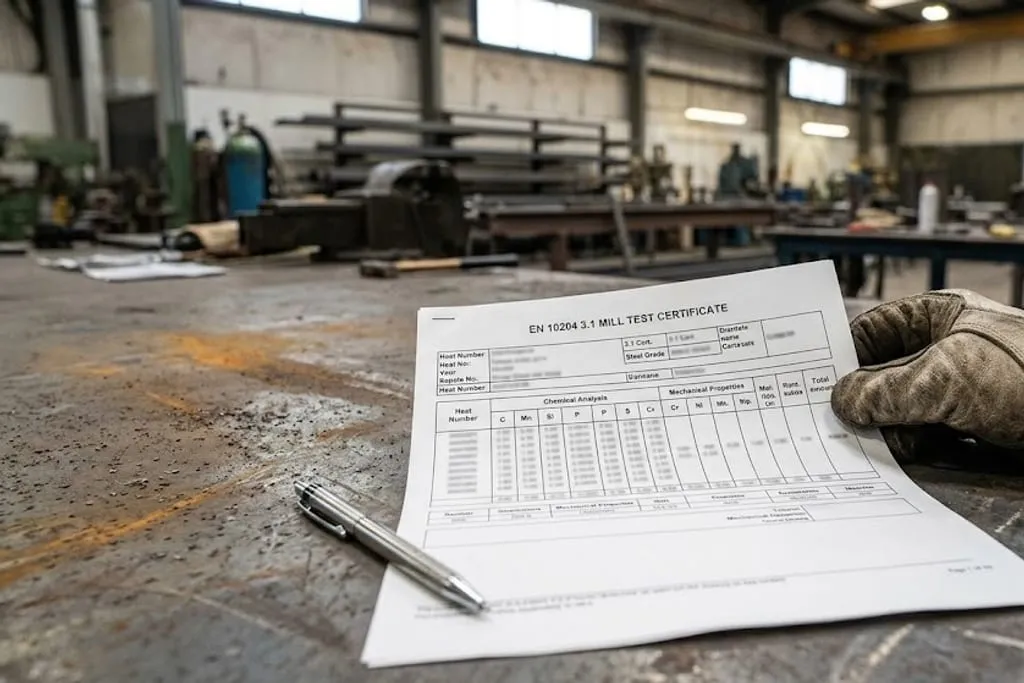
Assessed to ASTM A370 and ASTM E8, reported on the mill certificate:
- Yield strength (Fy) — where permanent deformation starts. A36 is 250 MPa (36 ksi); A572 Gr 50 and S355 are about 345–355 MPa. Steels without a sharp yield point use the 0.2 % offset method.
- Ultimate tensile strength (Fu) — the maximum before necking. The gap between Fy and Fu is the reserve past first yield, and it is what lets a redundant structure redistribute load instead of unzipping.
- Ductility — percentage elongation and reduction of area. This is the property that turns a sudden collapse into a visible sag that somebody reports.
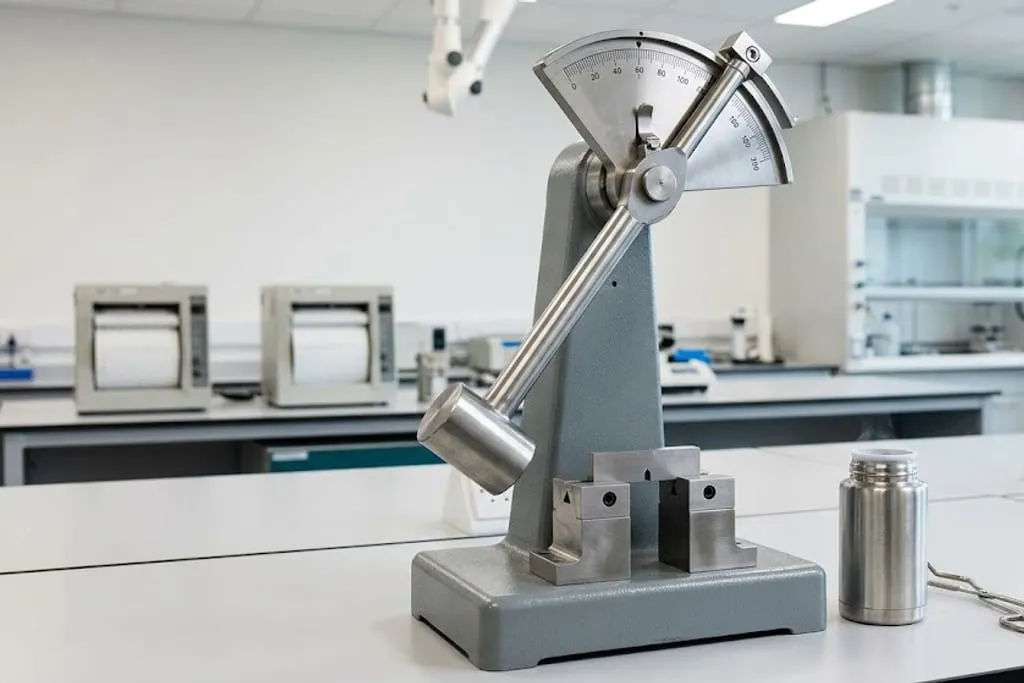
- Charpy V-notch impact energy — to ASTM E23. Joules absorbed at a stated temperature.
What an inspector does with all this
When you pick up a mill test report on an existing structure or an incoming delivery:
- Grade and standard — does it match the drawing and the specification?
- Chemistry — compute the carbon equivalent yourself. Do not assume the grade implies it; two heats of the same grade can differ enough to change the preheat.
- Mn/S ratio — low manganese with high sulfur is a hot cracking risk.
- Impact test temperature — against the real minimum service temperature.
- Heat number traceability — does it tie back to the marking on the actual member?
On an older structure with no certificate, that information does not exist and cannot be assumed. Pre-1970s steels are often higher in carbon, sulfur and phosphorus, with poor and untested toughness. This is exactly why bolted repairs are frequently preferred over welded ones on legacy steelwork — a subject taken up in repair and strengthening.
What to take away
- Carbon equivalent, not carbon, is the weldability number — and it decides preheat.
- The coarse-grained HAZ beside the fusion line is the weakest part of a good weld, and no soundness test will find it.
- Cold cracking needs a hard microstructure, hydrogen and restraint together. Break any one.
- A low-hydrogen electrode stops being one the moment it gets damp.
- Impact energy without a test temperature is not a specification.
- No mill certificate means no assumptions. Treat legacy steel as unknown until tested.
Check your understanding
10 questions. Nothing is recorded — this is just for you.