Civil & Structural
Structural steel — sections, connections and why it must be fireproofed
How to read a steel section designation, what makes each shape good at its job, bolted versus welded connections, and why unprotected steel fails in a hydrocarbon fire in about ten minutes.
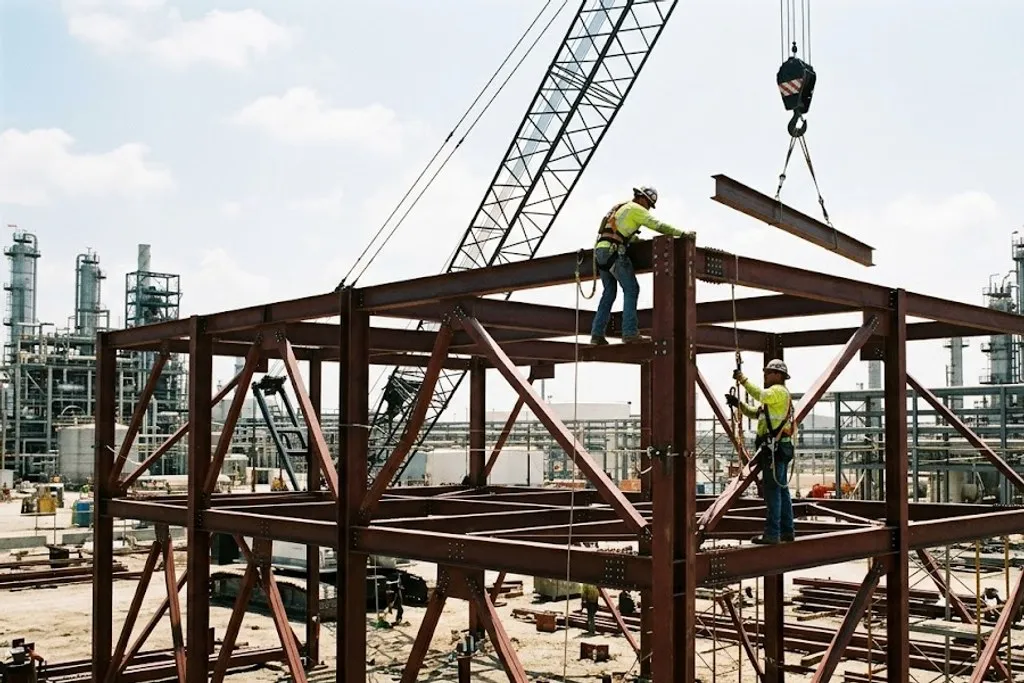
The foundations topic put load into the ground and concrete covered the material that does it. Above ground in a process plant, most of what you see is steel — pipe racks, platforms, stairs, equipment supports, structures.
Why steel above ground
- Strength for its weight, so long spans need less material.
- Speed — members are fabricated in a shop while foundations are still being poured, then bolted together on site.
- Predictability — it is manufactured to tight tolerances, unlike concrete cast in a hole in the ground.
- Reversibility — it can be unbolted, modified and extended, which matters enormously on a plant that will be revamped repeatedly over forty years.
Its weaknesses are exactly two, and both are addressed by coatings: it rusts, and it loses strength in a fire.
Reading a section designation
UB 457 × 191 × 67
│    │     │     │
│    │     │     └── mass, kg per metre
│    │     └──────── nominal width, mm
│    └────────────── nominal depth, mm
└─────────────────── Universal Beam
Two sections of the same depth and width can have different masses, because the flange and web thicknesses differ. The mass is how you tell them apart, and it is what you are billed for.
Regional naming varies for the same thing: UB/UC in British practice, W-shapes in
American (W18×40 — depth in inches, mass in lb/ft), IPE/HE in European, ISMB/ISHB in
Indian.

| Universal beam (I-section) | UB 457×191×67, W18×40, ISMB 450 | Bending about its major axis | Twisting, and bending the weak way | Floor beams, pipe rack transverse beams, crane runways |
|---|---|---|---|---|
| Universal column (H-section) | UC 254×254×73, W14×90, ISHB 250 | Axial compression — stocky in both directions | Long spans in bending | Building and pipe rack columns |
| Channel | PFC 200×90, C10×20, ISMC 200 | Edge members, bracing, framing openings | Bending — it twists because the shear centre is off the web | Stair stringers, platform edges, trimmers |
| Angle | L 100×100×10 | Tension members and light bracing | Compression over any length | Bracing, ladder frames, small trusses, cleats |
| Square/rectangular hollow (SHS/RHS) | SHS 150×150×8, RHS 200×100×8 | Torsion, compression, and clean appearance | Bolted connections — you cannot reach inside | Architectural steelwork, handrails, light columns |
| Circular hollow (CHS) | CHS 168.3×8 | Torsion, and low wind drag | Connections — every joint needs profiling | Offshore structures, flare stacks, exposed trusses |
| Plate girder | Fabricated from plate | Very long spans and very heavy loads | Cost — it is fabricated, not rolled | Long-span pipe bridges, heavy crane girders |
| Castellated / cellular beam | Fabricated from a UB | Deep span with services passing through the web | Concentrated point loads over an opening | Long spans where ducts and pipes must pass through |
No rows match that filter.
Sections are shaped to put metal where the stress is. An I-shape carries bending efficiently because the flanges are far from the neutral axis; a hollow section resists twisting because it is a closed loop. Choose the shape for the action, then size it.
Connections decide the cost
Steelwork cost is driven far more by connections than by tonnage. A simple beam is cheap; a heavily stiffened moment connection is not.
Bolted connections dominate site work — no power, no weather protection, no inspection delay, and immediately load-bearing. Two kinds:
- Bearing type. The bolt shank bears against the hole. Ordinary structural bolting, and the default.
- Slip-critical (HSFG). Bolts are tensioned to a defined high value so that friction between the plates carries the load. Used where slip cannot be tolerated — crane girders, vibrating machinery supports, fatigue-loaded joints. The faying surfaces must be prepared and left unpainted, and the tension has to be verified.
Bolt grades are marked on the head: 8.8 and 10.9 in metric practice, A325 and A490 in American.
Welded connections are stiffer and cleaner, and are mostly done in the shop where conditions are controlled and inspection is easy. Site welding is slower, needs weather protection and access, and carries all the procedure and qualification requirements covered in welding.
By restraint, connections are either:
- Simple (shear) — transfers vertical load, allows rotation. Cheap, and the norm.
- Moment — transfers bending too, so the frame itself resists sway. Necessary where bracing cannot be fitted, and considerably more expensive.
Corrosion protection
Steel in a humid, salt-laden or chemical atmosphere corrodes. ISO 12944 classifies environments from C1 (heated indoor) to CX (offshore, severe chemical), and the paint system follows from that class.
- Galvanising — hot dip zinc, excellent for handrails, gratings, small members. It is sacrificial, so minor damage still gets protected.
- Paint systems — typically a zinc-rich primer, an epoxy intermediate coat and a polyurethane topcoat. Most of the performance comes from surface preparation, not from the paint.
- Weathering steel — forms a stable protective rust layer, but only where it can wet and dry properly. Rarely suitable in a process plant.
Fireproofing: buying time, not immunity
Steel keeps most of its strength to about 300 °C. By 550 °C it has lost roughly half, and that is the temperature at which a loaded member starts to sag and fail.
In a hydrocarbon pool fire, an unprotected member can reach that in around ten minutes.
| Cementitious spray | 60 – 240 minutes | Cheap per square metre, thick, robust against radiant heat | Rough finish, heavy, traps moisture and can hide corrosion | Pipe rack and structure legs in process areas |
|---|---|---|---|---|
| Intumescent coating | 30 – 180 minutes | Thin, paint-like, keeps the steel profile visible | Costly, thickness must be verified, damaged easily before it swells | Exposed steel where appearance matters, retrofits |
| Concrete encasement | 120 – 240 minutes | Very durable, needs no maintenance, resists impact | Heavy — it loads the foundations, and it is slow to build | Column bases, blast-exposed areas, vessel skirts |
| Board systems | 30 – 240 minutes | Clean dry installation, consistent thickness | Awkward around complex connections and bracing | Indoor structures, switchrooms, escape routes |
| Flexible jacket | 30 – 120 minutes | Removable for inspection, good on irregular shapes | Needs fixings maintained; can be left off after maintenance | Valves, actuators and equipment needing periodic access |
No rows match that filter.
Steel loses roughly half its strength by about 550 °C, and an unprotected member in a hydrocarbon fire can reach that in ten minutes. Fireproofing does not make steel fireproof — it buys time for people to escape and for the fire systems to work.
Fire ratings are quoted against a fire curve, and there are two very different ones:
- Cellulosic (ISO 834, BS 476) — an ordinary building fire of wood, paper and furnishings. It heats up relatively slowly.
- Hydrocarbon (UL 1709) — a pool fire, reaching over 1000 °C in around five minutes.
A product rated 120 minutes on the cellulosic curve does not give 120 minutes in a hydrocarbon fire. Specifying to the wrong curve is a serious and not-uncommon error.
What gets fireproofed is decided by a fire risk assessment: typically structural steel within a defined radius and height of a credible leak source, supports for vessels holding significant inventory, escape routes, and the supports of the fire and emergency systems themselves.
What civil needs from the other disciplines
Same story as foundations, one level up:
- Piping — rack loads, anchor and guide forces, where lines route through the structure, and future expansion allowances.
- Mechanical — equipment weights and maintenance access, lifting beams and laydown areas.
- Electrical and instrumentation — cable tray routes and loads, lighting and junction box supports.
- Process and safety — which areas require fireproofing, and to which curve.
What to take away
- Section designation is depth × width × mass per metre. Mass is what distinguishes similar sections.
- Shape follows the action: I-sections for bending, H for compression, hollow sections for torsion, angles for tension.
- Connections drive cost more than tonnage. Simple shear connections are the cheap default.
- Slip-critical bolting carries load by friction, so surface preparation and verified tension are the whole point.
- Steel has lost about half its strength by 550 °C and gets there in ten minutes in a hydrocarbon fire.
- Hydrocarbon and cellulosic fire curves are not interchangeable.
- Never site-drill, flame-cut or weld to existing steel without approval.
Check your understanding
10 questions. Nothing is recorded — this is just for you.