Civil & Structural
Structural steel connections — bolting, pretension and erection
The difference between a bearing connection and a slip-critical one, what pretension actually does and why it needs hardened washers, how a tension control bolt tells you it is done, why slotted holes exist and what they must not be used for, and what to check before a crane lifts anything.
Standards referencedAWS D1.1ASTM F3125AISC 360RCSC Specification
Structural steel arrives as separate pieces and becomes a structure at the connections. Almost everything that is inspected on a steel job is a connection, because that is where the load actually passes from one member to another.
Two ways a bolted connection works
The distinction decides how the bolt is installed, and it is not visible afterwards.
Bearing connection. The plies are allowed to slip slightly until the bolt shank bears against the side of the hole. Load then transfers through the bolt in shear. The bolt needs to be tight enough to hold everything together — “snug tight” — and no tighter.
Slip-critical connection. The bolt is tensioned hard enough that friction between the clamped faces carries the load, and the plies never slip at all. The bolt is a clamp, not a pin.
Pretension, and what defeats it
Pretensioning stretches the bolt so it clamps with a known force, typically around 70 % of its minimum tensile strength. That is a very large force.
Four common methods:
- Turn-of-nut — snug tight, mark the position, then rotate a specified further amount. The rotation stretches the bolt by a known extent, so it is measuring extension rather than torque.
- Calibrated wrench — torque to a value verified daily against a tension measuring device. Torque is an indirect measure and lubrication changes it, which is why the verification is daily rather than annual.
- Tension control (TC) bolts — a splined end designed to twist off at the right tension.
- Direct tension indicators — washers with bumps that flatten to a measurable gap.
TC bolts deserve a note of their own. The sheared spline is a completion signal visible from the ground, which makes inspecting a large connection fast — but it says only that the bolt reached tension. It says nothing about what the surfaces under it were like.
Holes, and what not to cut
Holes are made to the size the connection type allows: standard, oversized, or slotted — short or long, and oriented as the designer specified.
Slots exist to allow fabrication tolerance and thermal movement at chosen locations. Their orientation matters as much as their presence, because a slot running the wrong way lets movement happen in a direction the design did not intend.
Welded connections
Site welding follows AWS D1.1 for structural steel, and three things are checked before an arc is struck:
- An approved procedure (WPS) covering the material, thickness, position and process.
- A qualified welder, current, for that process, position and material range. Position is the usual gap — a welder qualified flat is not qualified overhead, and site work is where awkward positions appear.
- Consumables of the right type, correctly stored. Low-hydrogen electrodes that have sat in a damp site store will put hydrogen into the weld, and hydrogen cracking appears days later.
Preheat, where the procedure calls for it, is a requirement and not a cold-weather courtesy. It slows cooling so the heat-affected zone does not harden and crack, and it matters most on thick sections and higher-carbon steels.
Erection
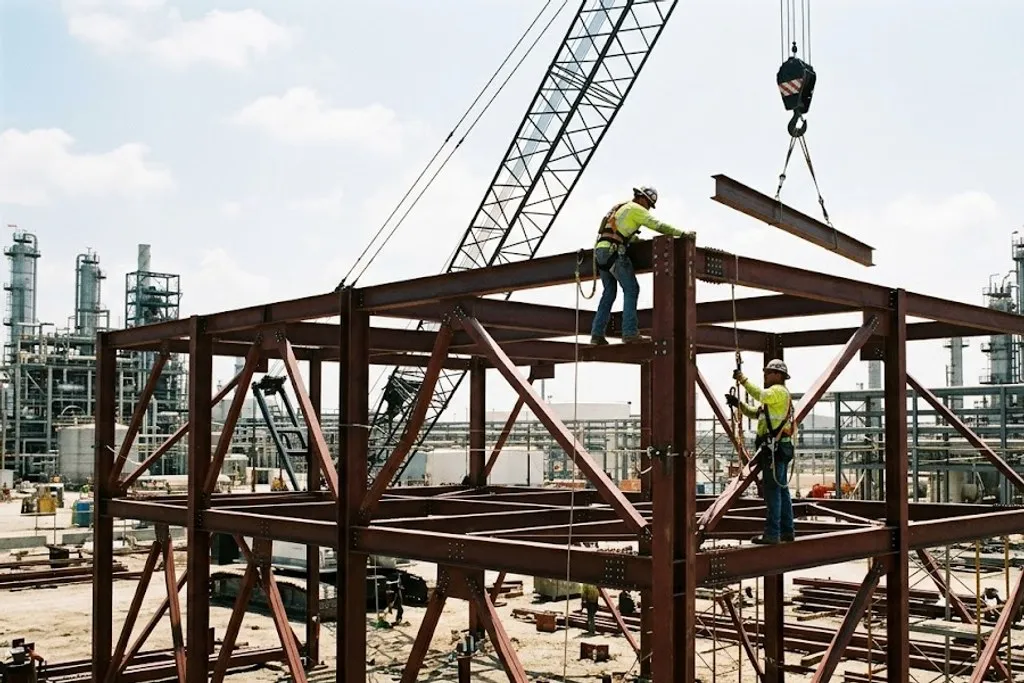
Before anything is lifted: check the piece mark against the erection drawing, confirm the lifting points are the designed ones, and confirm the baseplate level and holding-down bolt positions are right. Discovering a bolt group is out of position with the column hanging from a crane is an expensive way to find out.
Bolts are then fitted and snug tightened to bring the plies into contact, the frame is plumbed and aligned, and only then is final pretensioning done — because tensioning a frame that is still out of plumb locks the distortion in permanently.
What to take away
- Bearing transfers load through the bolt; slip-critical transfers it through friction. Same bolts, different installation and different surface requirements.
- Pretension needs hardened washers, or the nut embeds and the tension relaxes.
- A sheared TC spline means tension was reached. It says nothing about the surfaces underneath.
- Paint, oil or scale on faying surfaces ruins a slip-critical connection however well the bolts are tightened.
- Slots are placed and oriented deliberately. Cutting one on site is a non-conformance, not a fix.
- Welding needs an approved WPS, a currently qualified welder for that position, and properly stored consumables.
- A partly erected frame relies on temporary bracing. The erection sequence is engineering.
- Snug first, plumb the frame, then pretension — or you lock the distortion in.
Check your understanding
6 questions. Nothing is recorded — this is just for you.