
Automotive
Laser welding and brazing
Keyhole and conduction welding compared, why laser welds are narrow and fast and distort little, what a tailor welded blank buys, and why laser brazing exists for the one joint a customer actually looks at.
Standards referencedISO 13919-1ISO 15609-4ISO 11145ISO 9013ISO 13919-2
A spot weld is a point. An arc weld is a wide, hot, slow line. A laser weld is something else again — a line so narrow and so fast that the surrounding metal barely notices, which is precisely why it goes where distortion cannot be tolerated. The price is paid in fit-up, and it is paid in full.

Two modes, one beam
The difference between the two ways a laser joins metal is power density, nothing else.

| Conduction mode | Keyhole mode | |
|---|---|---|
| Power density | Lower | Above roughly 1 MW/cm² |
| Weld shape | Wider than deep | Deep and narrow |
| Heat input | Moderate | Low per unit length |
| Used for | Thin sheet, cosmetic seams | Structural welds, thick stacks |
In keyhole mode the beam vaporises a narrow capillary into the metal, and vapour pressure holds it open. The beam then reflects down the walls of that channel, delivering energy along its whole depth. That is the source of the characteristic deep, narrow, parallel-sided weld.
Focus position is what sets the density, by setting the spot size at the surface. Move the focal point and the process moves between the two modes. It is also the quiet failure mode in production: a protective cover glass that is dirty or hot shifts the focus, and a qualified process slowly stops working while every programmed number still reads correctly.
Distortion, and why that is the real selling point
Distortion is caused by the volume of metal that gets hot and then shrinks. A narrow weld made at high speed heats a small fraction of what an arc weld heats over the same length, so the shrinkage forces are proportionally smaller.
That single fact is why laser welding appears on gearbox components, on seat structures, on body sides — anywhere the assembly has to come out of the fixture the same shape it went in. Compare the effort described in welding distortion and fixturing: the laser reduces the problem rather than correcting it.
Coated steel and the vapour problem
The other metallurgical consequence is hardness. The heat affected zone is narrow — good — but it is quenched by the cold mass surrounding it. On a hardenable grade that produces a hard, brittle line. Whether that matters depends entirely on where it sits relative to the stress, which is the same argument made about parting lines in forging and grain flow.
Tailor welded blanks
Weld the sheets together before pressing, and the part can have thick or high strength material only where it is needed.
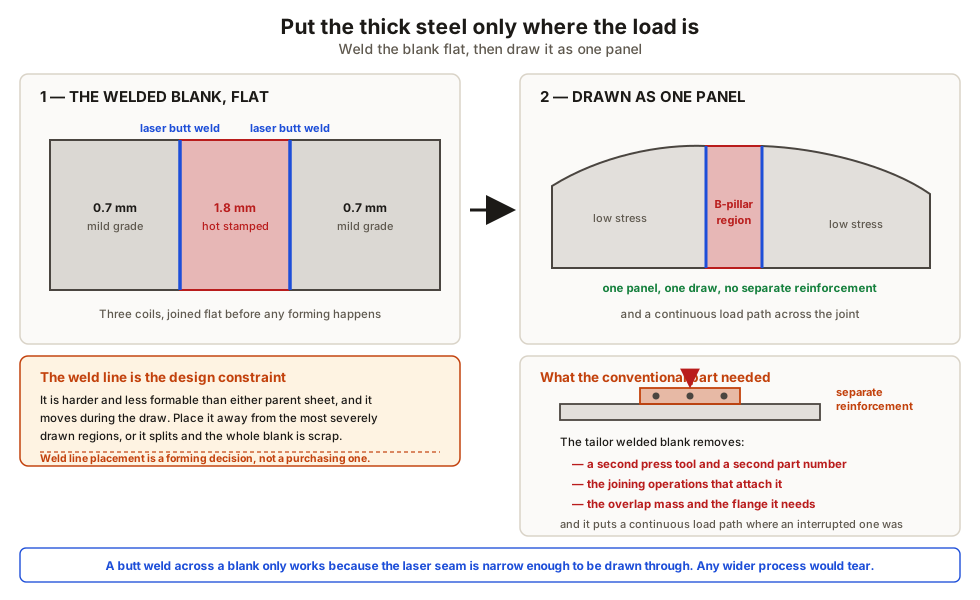
The gain is a reinforcement panel deleted, with its tooling, its handling and its joining operations. The constraint is that the weld line has to be formable: a butt weld dragged through a severe draw will tear, so its position is settled against the forming limits discussed in deep drawing and stamping before it is settled against the load path.
Laser brazing, for the joint people see
On the roof-to-bodyside seam, the requirement is not strength. It is appearance — that seam is on the outside of the car and a customer runs a hand along it.
Laser brazing feeds a filler wire, usually a copper-silicon alloy, and melts only the filler. The parent sheets are wetted, not fused. The result is a smooth continuous fillet that goes straight through the paint shop and needs no trim moulding over it.
| Laser welding | Laser brazing | |
|---|---|---|
| Parent metal | Melted | Not melted |
| Filler | Usually none | Always |
| Chosen for | Strength, stiffness, low distortion | Cosmetic seam, sealing |
| Typical joint | Overlap, butt | Visible exterior seam |
Remote welding, and where the time actually goes
A robot arm takes a second or more to travel between weld positions. Scanner mirrors take milliseconds. Remote laser welding puts the optics well back from the part and steers the beam across a working field, so stitches are placed in quick succession without the robot moving.
The productivity comes from deleting travel time, not from welding faster — the same insight that makes a progressive die faster than a series of single-station presses in press tools and die design.
Stitches rather than a continuous seam are the norm, for the same reasons spot welds have a pitch: weld where the load transfers, and leave the rest alone to save time and heat.
What to take away
- Power density alone separates conduction mode from keyhole mode.
- The keyhole is a vapour channel the beam travels down — that is where deep narrow welds come from.
- Focus position sets the density, and a dirty cover glass moves it without warning.
- Low heat input over a narrow zone means little distortion. That is the main reason to use it.
- Fit-up is the constraint. A 0.5 mm gap against a 0.4 mm spot welds nothing.
- On galvanised steel, a deliberate gap vents the zinc vapour that would otherwise be porosity.
- The narrow heat affected zone is quenched hard on hardenable grades.
- Tailor welded blanks delete a reinforcement, provided the weld line can be drawn.
- Laser brazing melts only the filler, to leave a paintable cosmetic seam.
- Remote welding wins by removing robot travel between stitches, not by welding faster.
Check your understanding
10 questions. Nothing is recorded — this is just for you.