
Automotive
Threaded fasteners and torque
What a bolt actually does, how property classes 8.8, 10.9 and 12.9 are defined, why most of the torque you apply never reaches the joint, and why angle and yield control exist at all.
Standards referencedISO 898-1ISO 898-2ISO 68-1ISO 965-1ISO 16047
A bolt is not a pin and it is not a rivet. It is a spring that has been deliberately stretched, and everything useful about a bolted joint comes from that stretch. Get it wrong and the joint either loosens over months or fails on the first load — and in both cases the bolt will look perfectly fine.
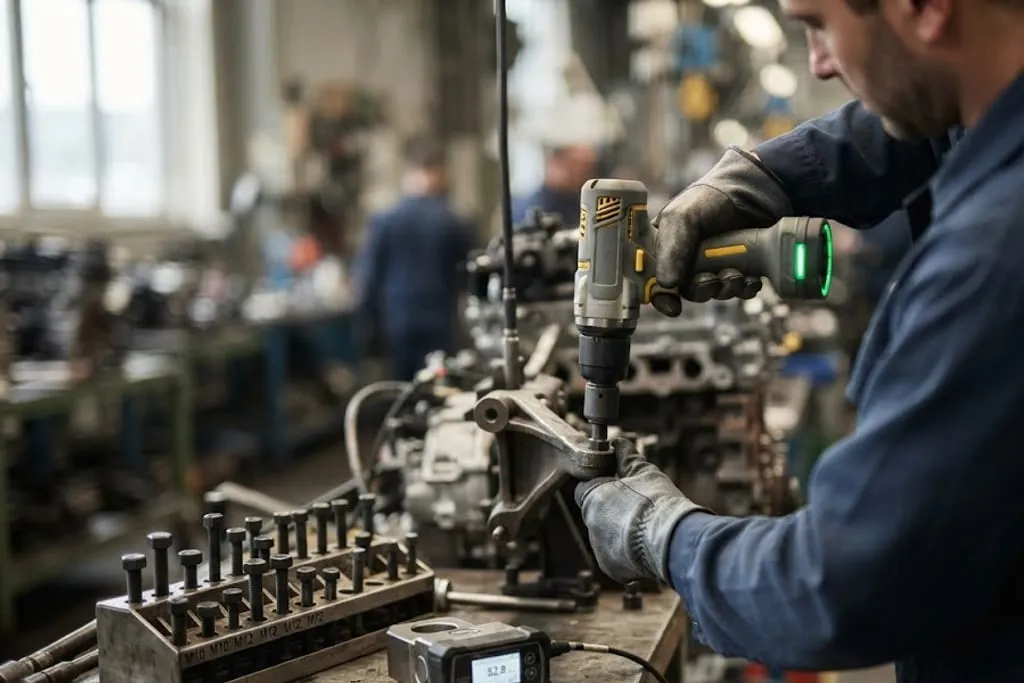
What the bolt is actually doing
In a well designed joint the bolt does not carry the load. It clamps the two faces together hard enough that friction between those faces carries it.
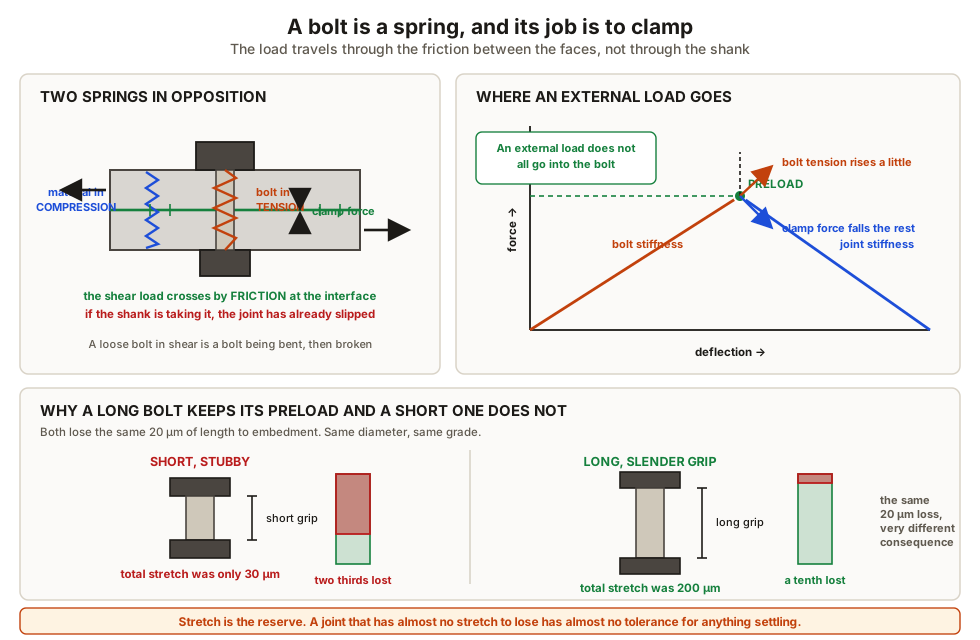
That has three consequences that catch people out:
- Preload matters more than bolt strength in most joints. A strong bolt at low preload gives a joint that moves.
- An external load does not all go into the bolt. It divides between raising bolt tension and reducing clamp force, in proportion to the two stiffnesses.
- A longer bolt is a better bolt, other things equal. It is a softer spring, so the small permanent losses — embedment, gasket creep, paint settling — eat a smaller fraction of the stretch. Short stubby bolts are the ones that go slack.
Property classes
The marking on the head is not a grade in a vague sense. It is two numbers with exact definitions, set by ISO 898-1.
| Class | Tensile strength | Yield | Typical use |
|---|---|---|---|
| 8.8 | 800 MPa | 640 MPa (80 %) | General structural and chassis work |
| 10.9 | 1000 MPa | 900 MPa (90 %) | Suspension, engine mounts, brackets |
| 12.9 | 1200 MPa | 1080 MPa (90 %) | Highly stressed, compact joints |
The first number is the nominal tensile strength in hundreds of megapascals. The second is the yield-to-tensile ratio in tenths — so 10.9 yields at 90 % of 1000 MPa.
Where the torque goes
This is the part that surprises everyone the first time they see the numbers.

Typically about half the applied torque is consumed by friction under the bearing face, about a third in the threads, and only the remaining 10 to 15 per cent actually stretches the bolt.
Three ways to control the tightening
| Method | What it controls | Scatter in preload | Where used |
|---|---|---|---|
| Torque | Applied torque only | Wide, ±25 % or worse | Non-critical joints |
| Torque + angle | Rotation past a snug point | Much tighter | Safety-related joints |
| Torque to yield | The bolt’s own yield plateau | Tightest | Head bolts, main bearings |
Angle control works because once the joint is snug, further rotation corresponds to bolt elongation through the thread pitch — geometry, not friction. Measuring the angle measures the stretch, more or less directly.
Torque to yield goes one step further and tightens into the plateau where the bolt starts to yield. The bolt itself now sets the limit, so friction barely matters. The bolt has been permanently stretched, which is exactly why cylinder head and main bearing bolts are replaced, never reused.
Threads in aluminium
A nut can be chosen to outmatch the bolt. A tapped hole cannot — it is whatever the parent material happens to be.
- In steel, thread engagement of roughly 1 × diameter is usually enough.
- In aluminium, roughly 2 × diameter, because the material is weaker.
- Where the depth is not available, a steel insert carries the thread instead.
Applying the steel torque figure to a tapped aluminium hole strips it. The weaker material always sets the limit, and the fastener catalogue does not know what it has been screwed into. The same logic governs the fits and engagement lengths in fits, limits and clearances.
Practical points that decide whether a joint holds
- Hardened washers spread the bearing load and give a consistent friction surface. Substituting a plain washer changes both.
- Clean, undamaged threads. A damaged thread reads as high torque long before the joint is tight, so the tool signs off a joint with no preload in it.
- Tightening sequence on multi-bolt joints — cross pattern, in stages — because each bolt relieves its neighbours as the joint settles.
- Grip length, so the plain shank rather than the thread sits in the shear plane where shear is unavoidable.
What happens to that preload over the following months is a separate subject, covered in bolted joint loosening and locking.
What to take away
- A bolt is a stretched spring; the clamp force it generates is what carries the load.
- An external load splits between bolt tension and lost clamp force.
- A longer bolt loses proportionally less preload to settlement.
- 8.8, 10.9, 12.9 — tensile strength in hundreds of MPa, then yield ratio in tenths.
- Nut class is chosen so the bolt breaks before the thread strips.
- Only 10 to 15 % of applied torque becomes preload; friction takes the rest.
- A torque figure without a friction condition is an incomplete specification.
- Angle control measures stretch through the thread pitch, so friction stops mattering.
- Torque to yield bolts are single use. Replace them.
- Tapped aluminium needs about twice the engagement of steel, or an insert.
Check your understanding
10 questions. Nothing is recorded — this is just for you.