
Automotive
Forging and grain flow
Open die, closed die and upset forging compared, why a forged component outperforms a machined or cast one of the same steel, what flash and the parting line are for, and how grain flow decides where a part fails.
Standards referencedEN 10243-1ASTM A788ISO 683-1ISO 4885ISO 6892-1
Take three connecting rods of the same steel — one machined from a billet, one cast, one forged — and load them until they break. They will not break at the same load, and they will not break in the same place. The difference is not the material. It is what happened to the material.
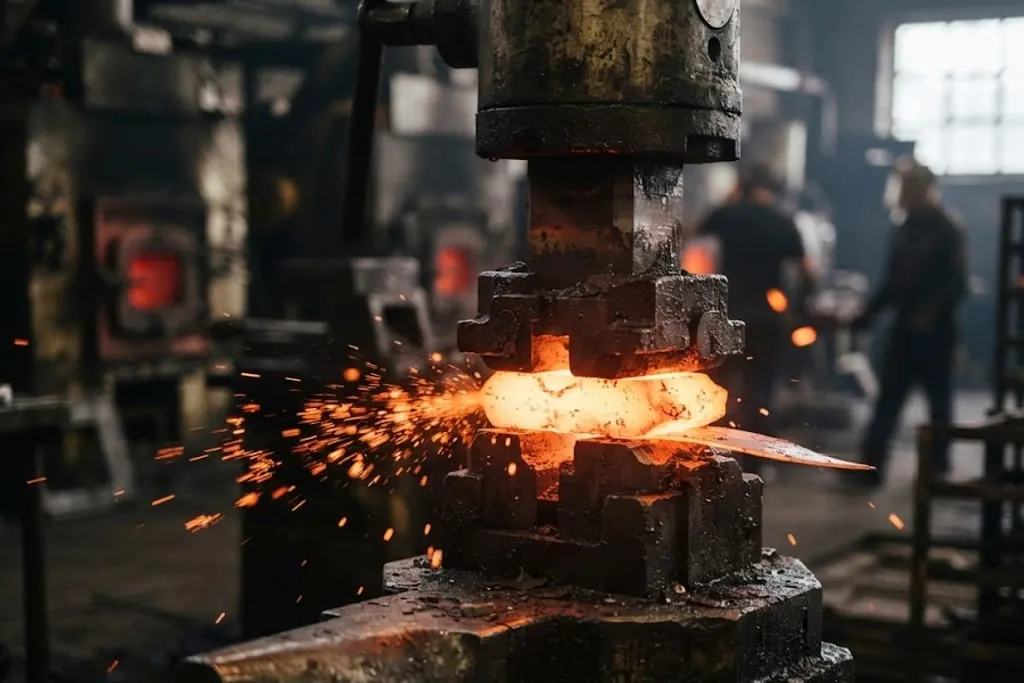
Grain flow is the whole argument
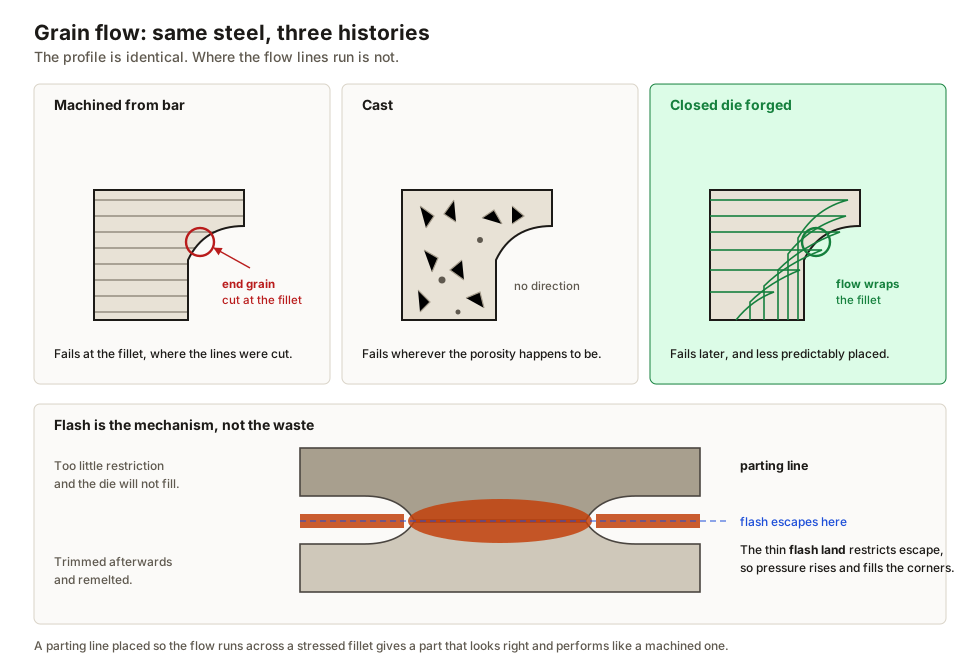
Wrought metal has flow lines: elongated grains and inclusions left by rolling and by every subsequent deformation. In a good forging those lines are made to wrap the contours of the part.
| Route | Grain structure | Where it fails |
|---|---|---|
| Machined from bar | Straight lines, cut through by the profile | End grain at the fillet |
| Cast | No directional flow; dendritic | Wherever the porosity is |
| Forged | Continuous, following the contour | Later, and less predictably placed |
A machined part cuts the flow lines off wherever the profile crosses them, and it does so at fillets and shoulders — which are exactly the highest-stressed features on the part.
Three ways to forge
| Method | Tooling | Suits | Tolerance |
|---|---|---|---|
| Open die | Flat or simple shaped dies | Very large shafts, rings, small quantities | Loose; heavy machining after |
| Closed die (impression) | Part-specific die set | Volume production, near net shape | Moderate |
| Upset | Heading tools | Bolt heads, shaft flanges | Good, especially cold |
Open die needs no part-specific tooling, so it is the practical route for a very large shaft or a rolled ring. The shape comes from manipulation rather than from an impression, and a great deal of machining follows.
Upset forging gathers material instead of cutting the rest away — which is why a cold headed bolt has grain flow running up into the head rather than across it, and why it is stronger than a head machined from bar.
Hot or cold
Above the recrystallisation temperature, the metal reforms its grain structure as fast as it is deformed, so it stays soft and can be worked heavily without cracking. That is hot forging: large shape change, modest forces, scale and thermal contraction to contend with.
Below it, the metal work hardens instead. Cold forging buys close tolerance, a good surface and a stronger part, at the cost of much higher forces, limited deformation per blow and often an intermediate anneal. The link between what the deformation does to the structure and what the furnace does to it is the subject of heat treatment of steels.
Where forgings go wrong
Three geometry rules prevent most of it, and they are the same three every time:
- Generous radii — metal will not turn a sharp corner under pressure, and the corner cracks the die as well
- Draft, a few degrees, so the forging releases
- A parting line placed so the flow runs around the stressed features, not across them
Getting the parting line wrong does not produce an obviously bad part. It produces a part that looks right and has thrown away the main reason for forging it.
What to expect dimensionally
Die wear, thermal contraction and billet variation all feed into the tolerance, and forging grades widen with size. So the normal route is to forge near net shape and machine only what has to be accurate — bearing seats, threads, sealing faces — exactly as with castings in sand casting and gravity die casting.
What to take away
- Grain flow is what forging buys. Continuous lines around a fillet beat cut end grain.
- A machined part cuts the flow lines precisely where the stress is highest.
- Open die needs no part tooling; closed die gives near net shape; upset gathers material.
- Flash builds the back pressure that fills the die. It is the mechanism, not the waste.
- Hot forging recrystallises as it deforms; cold forging work hardens and holds tolerance.
- A lap is a folded, unbonded surface — a crack forged into the part.
- Radii, draft and parting line position prevent most forging defects.
- A badly placed parting line gives a part that looks right and performs like a machined one.
- Forge near net shape, then machine only the features that need accuracy.
Check your understanding
10 questions. Nothing is recorded — this is just for you.