
Rotating Equipment
Machinery testing and commissioning — proving it before it matters
What a mechanical run test proves and what it cannot, why a performance test needs a witnessed curve rather than a duty point, what a string test is for, and why flushing the lube oil system decides whether the bearings survive the first year.
A machine arrives on site having already passed tests at the works. Those tests proved specific things and not others, and most commissioning problems live in the gap between what was tested and what was assumed.
Works testing: three different tests
They are routinely confused, and they answer different questions.
Mechanical run test
The machine runs at speed, usually on air or water rather than the process fluid, for a defined period. What it proves is the machine’s own behaviour: rotor balance, vibration amplitude, bearing metal temperatures, seal integrity, lube oil system function.
Performance test
The machine is run against measured conditions and its output recorded — head and flow for a pump, pressure ratio and throughput for a compressor — usually across several points, not one.
String test
The complete train — driver, gearbox, driven machine — run together.
Individual machines can each pass and still misbehave when assembled, because torsional response, lateral behaviour through the coupling and control interaction only exist in the train. A torsional natural frequency sitting near running speed is invisible in any component test.
It is expensive, needs a test facility able to absorb the full power, and is therefore specified for critical unspared trains rather than routinely.
Getting the machine ready on site
Flushing, which is not a formality
Alignment, after the pipework
Alignment itself is covered in vibration and alignment. The commissioning point is one of sequence.
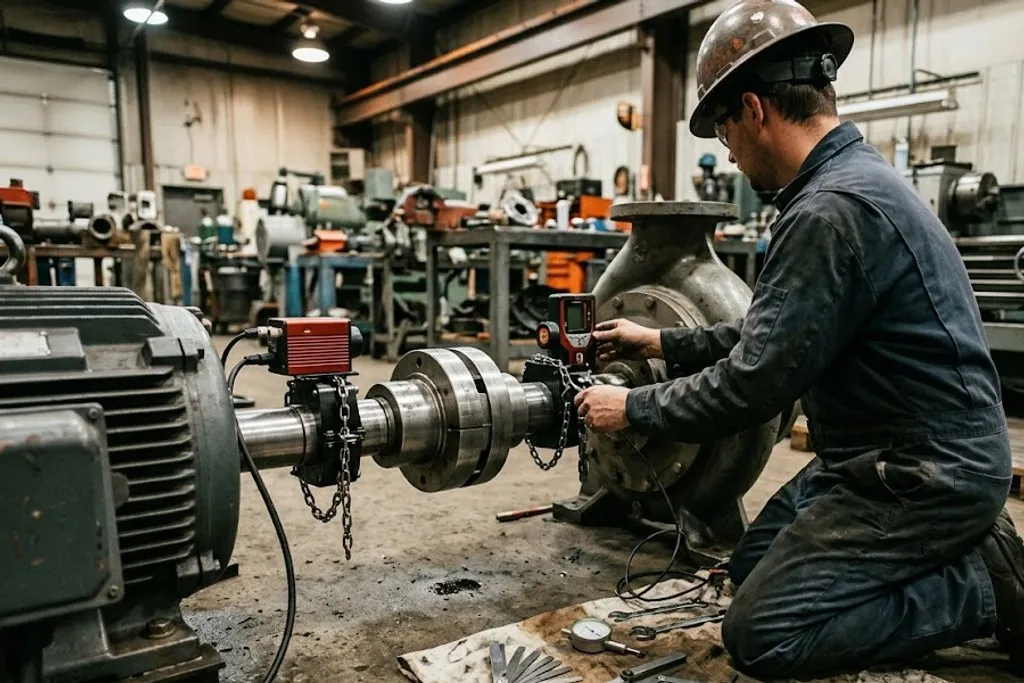
Machines that run hot grow. A hot alignment allowance offsets the cold setting so the shafts come into line at operating temperature, which means the machine is deliberately misaligned while it is standing still.
Solo run before coupled run
Baselines
The readings taken when a machine is new and known-good are worth recording carefully, because everything afterwards is judged against them.
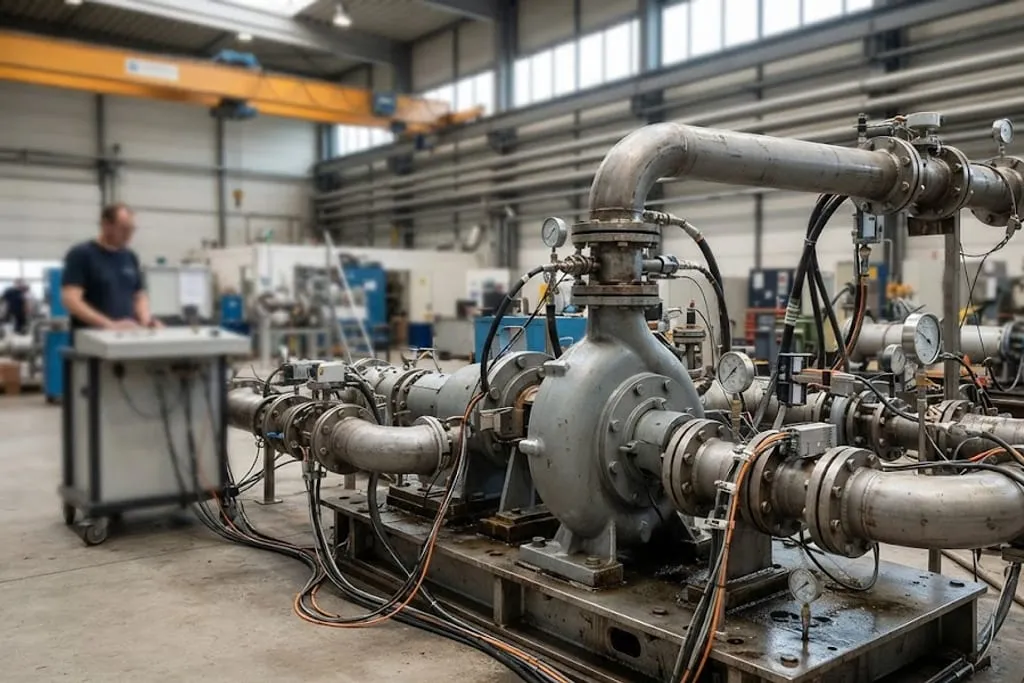
Why site problems appear after a clean works test
The works test bed is massive, rigid and free of connected pipework. Site is none of those things.
- The foundation and grout may be flexible, or the grout may contain voids
- Pipework may be pulling on the casing
- Suction conditions are the real ones, so NPSH problems no water test would reveal appear now — see pumps
- The process fluid has a different density, viscosity and temperature
- The electrical supply may sag on start, so the motor accelerates differently
None of these are failures of the machine, and all of them get reported as one.
What to take away
- Mechanical run, performance and string tests answer different questions. Passing one says nothing about the others.
- A performance test needs the curve, not the duty point, because the plant will not sit at duty.
- Flush the lube system properly. Fabrication debris goes straight to the bearings otherwise.
- Align after the pipework, watch the indicators as bolts are tightened, and allow for thermal growth.
- Run the driver uncoupled first. Reverse rotation destroys machines in seconds.
- Record baselines at commissioning. They can be captured only once, and condition monitoring depends on them.
- A clean works test does not predict site behaviour, because the foundation, pipework and fluid are all different.
Check your understanding
7 questions. Nothing is recorded — this is just for you.