Rotating Equipment
Vibration and alignment — reading a spectrum and getting the shaft straight
Why 1X usually means unbalance and 2X usually means misalignment, what a proximity probe sees that a casing accelerometer cannot, why hot alignment differs from cold, what resonance does to an otherwise healthy machine, and why a coast-down tells you something a steady run never will.
A rotating machine tells you what is wrong with it, continuously, in a language of frequencies. Learning to read a little of that language is the difference between replacing bearings repeatedly and finding out why they keep failing.
Amplitude says how much, frequency says what
An overall vibration reading is a single number — useful for trending, useless for diagnosis. It says the machine is rougher than it was. It says nothing about why.
A spectrum splits that vibration into its frequencies, and because different faults produce forces at different rates, the frequency is what identifies the fault.
Everything is expressed as a multiple of running speed: 1X is once per revolution, 2X is twice, and so on.
| 1X running speed | Unbalance — the commonest single cause | Radial | Amplitude steady with load; phase steady around the shaft |
|---|---|---|---|
| 1X, high axial | Bent shaft, or a cocked bearing | Axial as much as radial | Axial phase difference across the bearing |
| 2X running speed | Misalignment, or looseness | Radial and axial | High axial 2X points strongly at misalignment |
| Multiple harmonics (3X, 4X, 5X…) | Mechanical looseness — a loose baseplate, a soft foot, a cracked pedestal | Radial, direction-dependent | Raised noise floor; the pattern changes when bolts are checked |
| Number of vanes × speed | Vane pass — flow-related, worse off the best efficiency point | Radial | Amplitude tracks flow rate rather than speed |
| Bearing defect frequencies | Rolling element bearing damage — race, ball or cage | Radial | Non-synchronous, and rises in the high-frequency envelope first |
| Below 1X (sub-synchronous) | Oil whirl or whip in a journal bearing; unstable running | Radial | Typically around 0.4–0.48X; needs proximity probes to see properly |
| Broadband, no clear peak | Cavitation, or turbulence | Radial | Changes with suction condition rather than with speed |
No rows match that filter.
These are starting points, not diagnoses. The same frequency can arise from more than one cause, and the phase relationship between measurement points is often what separates them. A spectrum narrows the possibilities; it rarely closes the question on its own.
Where the sensor sits changes what you can see
An accelerometer on the bearing housing measures how much the casing moves. It is cheap, portable and right for most general-purpose machines, where the casing is light enough to respond to what is happening inside.
A proximity probe watches the shaft itself, through the oil film, and reports how far the shaft is moving relative to the bearing.
Resonance: a good machine behaving badly
Every structure has natural frequencies. Excite one and the response is amplified, sometimes enormously.
A coast-down test is the standard way to find them. As the machine slows, it passes through every speed on the way down, and a natural frequency shows as a peak the machine passes through rather than one that follows speed. A steady run at one speed never reveals this.
Alignment
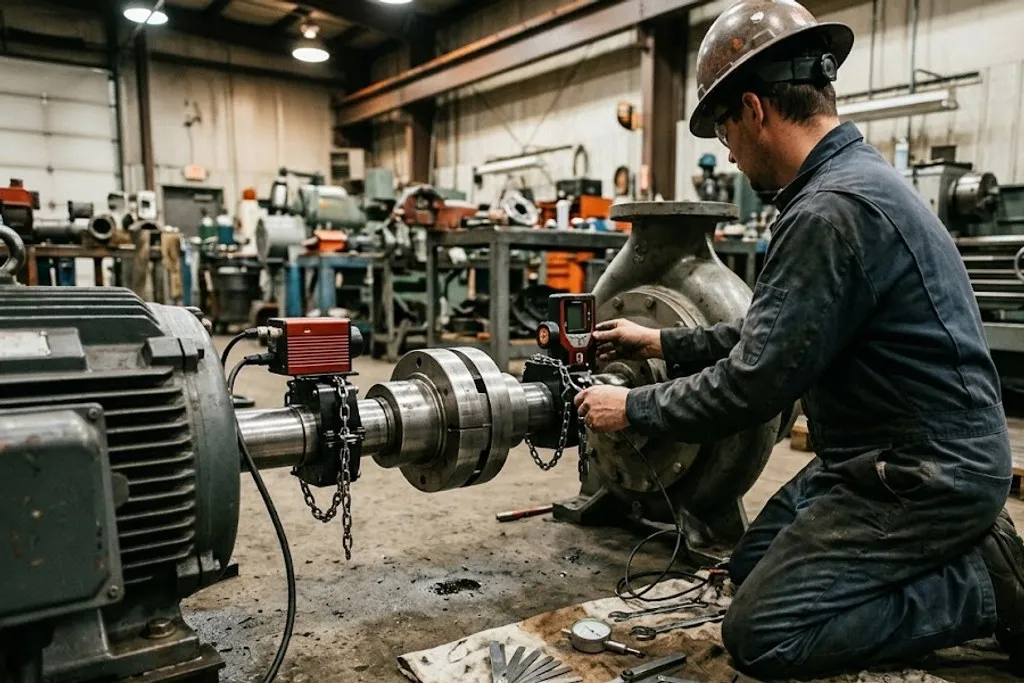
Misalignment is the second great cause of rotating machinery trouble and, unlike unbalance, it is almost entirely an installation matter.
There are two components: offset, where the shaft centrelines are parallel but not coincident, and angularity, where they are not parallel. Real misalignment is both, in both planes, and laser alignment tools measure all four.
Soft foot comes first
Cold alignment anticipates hot running
Machines grow when they warm up, and they do not all grow by the same amount. A pump handling hot product rises considerably; its motor barely moves.
So the machine is aligned deliberately offset when cold, by a calculated amount, so that thermal growth brings it into alignment at running temperature. Aligning it perfectly cold guarantees it is misaligned hot — which is when it matters.
The growth figures come from the vendor, and API 686 covers the practice. On a critical machine they are confirmed by measuring hot alignment once, rather than being trusted indefinitely.

Pipe strain undoes good alignment
A perfectly aligned machine can be pulled out of alignment by the pipework bolted to it. If a flange has to be dragged into position, that force ends up in the casing and the bearings.
The check is simple and it is worth insisting on: mount the alignment instrument, then slacken the suction and discharge flanges and watch whether anything moves. Movement beyond a small tolerance means the pipework is doing work on the machine.
Balancing
Balancing corrects an uneven mass distribution by adding or removing weight.
Single-plane balancing suits a narrow rotor — a fan, a thin impeller — where the unbalance can be treated as a single heavy spot. Two-plane balancing is needed on a longer rotor, where unbalance at one end and the other produce a couple that a single correction cannot fix.
It is worth saying plainly: balancing corrects unbalance. It does nothing for misalignment, looseness, resonance or a bearing defect, and a machine that keeps needing rebalancing is usually telling you it was never unbalanced.
What to take away
- Amplitude says how much; frequency says what. A single overall number cannot diagnose.
- 1X radial is usually unbalance. 2X with high axial is usually misalignment. Both are starting points, and phase often decides.
- A proximity probe sees the shaft; a casing accelerometer sees the casing. On heavy machines with journal bearings those are very different things.
- Resonance amplifies a healthy machine’s vibration. Change the support or avoid the speed — more balancing will not help. Find it with a coast-down.
- Check soft foot first. Otherwise the machine’s shape changes as you work.
- Align cold with a calculated offset so it comes true hot.
- Check for pipe strain by slackening flanges and watching for movement.
Check your understanding
6 questions. Nothing is recorded — this is just for you.