Rotating Equipment
Bearings, seals and lubrication — the parts that actually fail
How a hydrodynamic journal bearing carries load on a film of oil, why babbitt is deliberately soft, what a mechanical seal is really sealing, why the seal chamber environment decides seal life, and what an API 682 flush plan is doing.
Nearly every rotating machine failure shows up at a bearing or a seal. That is not because they are the weakest parts — it is because they are where everything else’s problems are expressed.
Bearings: two quite different families
Rolling element bearings — balls or rollers between hardened races. They carry load through small contact patches, they need little oil, and they have a calculable fatigue life. They are what you find on general-purpose pumps and motors.
Hydrodynamic journal bearings — a plain shell with the shaft turning inside it, carrying load on a film of oil. They are found on large, high-speed and critical machines: turbines, big compressors, large motors.
How a journal bearing works
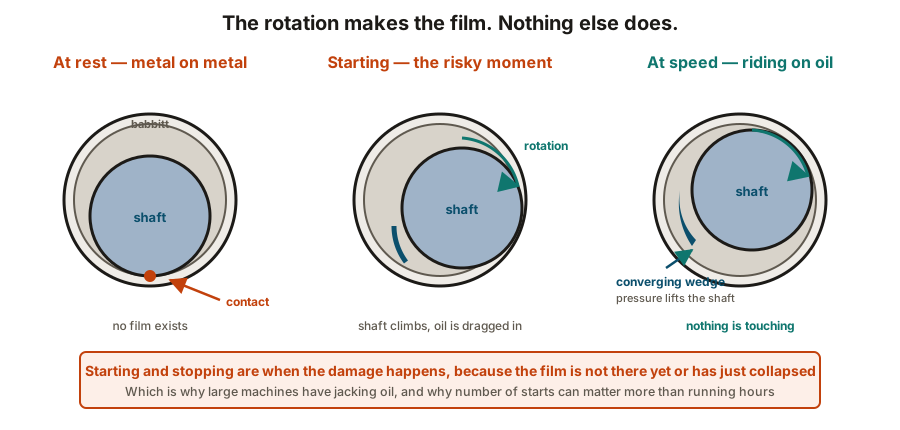
The shaft does not run centred. It sits slightly off to one side, and as it turns it drags oil into the narrowing gap. That converging wedge generates pressure, and the pressure lifts the shaft.
The film is thin — measured in tens of microns — and the shaft is not touching anything while it runs.
Why babbitt is soft
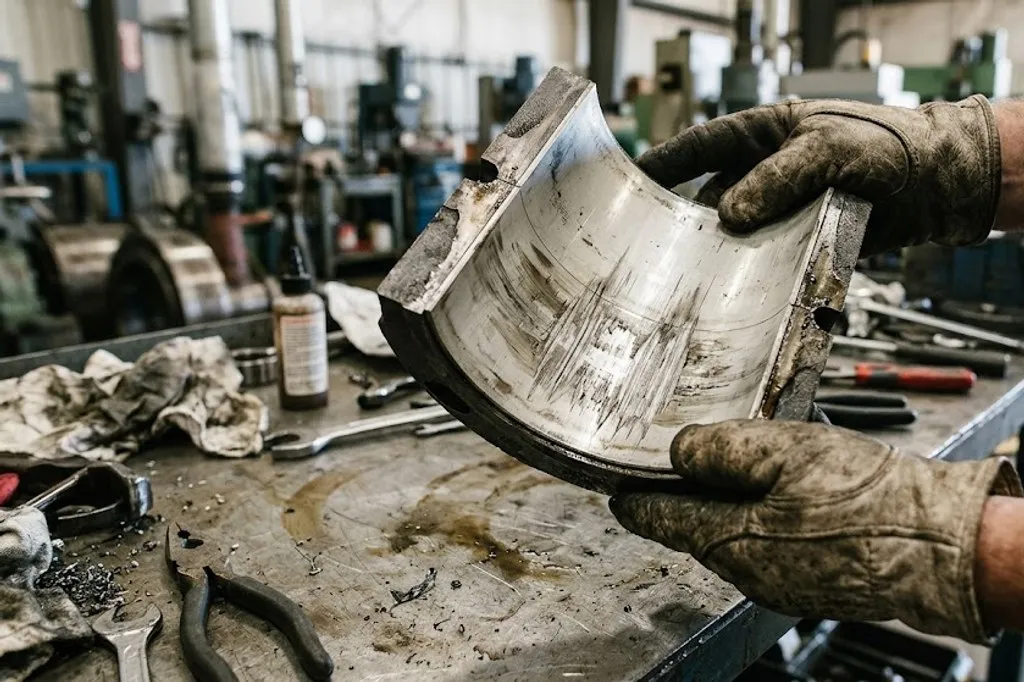
The bearing shell is lined with babbitt, a soft white metal alloy, and its softness is deliberate.
- Hard particles that get into the oil become embedded in the babbitt instead of circulating and scoring the journal. The lining absorbs the damage.
- If contact does occur, the soft lining is sacrificed before the hardened shaft. A bearing is cheap and a rotor is not.
Which is why a wiped bearing is bad news but recoverable, and why the particles found in it are worth examining rather than washing away.
Reading a failed rolling element bearing
Bearings are usually the messenger. Before condemning the bearing, look at the pattern:
- Load zone wear spread evenly — normal, old age.
- A load pattern in the wrong place — misalignment or a cocked bearing.
- Fluting, evenly spaced marks across the race — electrical discharge, almost always shaft currents on a drive-fed motor.
- Brinelling, indentations at rolling element spacing — impact, or a stationary machine vibrating while its shaft never turned.
- Overheating discolouration — over-greasing as often as under-greasing.
Lubrication
The oil does more than reduce friction. It carries heat away, it flushes debris out, and in a journal bearing it is the load-carrying element.
Small machines use grease or a simple oil bath with a constant-level oiler. Large machines have a lube oil system — a reservoir, pumps, coolers, filters and instrumentation — which is a system in its own right with its own protection, and losing lube oil pressure trips the machine long before anything else notices.
Two failure modes worth knowing:
- Too little grease starves the bearing.
- Too much grease fills the cavity so it cannot move, churns, and overheats. Over-greasing destroys more bearings than under-greasing, and it feels like diligence at the time.
Water in the oil is the other quiet killer — it displaces the film and corrodes. A milky sample is an urgent finding rather than a routine one.
Mechanical seals
A pump has to let a shaft through a casing containing pressurised fluid. Packing did that job for a century by deliberately leaking a little. A mechanical seal does it with two very flat faces pressed together — one rotating with the shaft, one stationary in the housing.
Between them sits a film of fluid a fraction of a micron thick. That film lubricates and cools the faces.
Flush plans
API 682 numbers the arrangements that control the seal chamber environment. The common ones:
- Plan 11 — flush taken from the pump discharge, through a restriction orifice, into the seal chamber. The default: simple, and it both flushes and cools.
- Plan 13 — flow from the seal chamber back to suction. Used on vertical pumps where Plan 11 would trap vapour.
- Plan 23 — recirculates from the chamber through a cooler and back, driven by a pumping ring. Far more effective on hot service, because it cools a small closed loop rather than continuously cooling hot product.
- Plan 32 — clean fluid injected from an external source. Used when the process fluid is dirty or abrasive, and it dilutes the product, which has to be acceptable.
- Plan 52 — an unpressurised buffer fluid between the seals of a dual arrangement. Leakage goes outward into the buffer, which is monitored.
- Plan 53 — a pressurised barrier fluid, held above process pressure, so any leakage is barrier fluid inward rather than process outward. Used where the product must not escape at all.
Seals on compressors
Centrifugal compressors handle gas, so there is no liquid to form a film.
Labyrinth seals are non-contacting: a series of close-clearance teeth that make leakage difficult rather than impossible. They leak by design and they never wear out.
Dry gas seals use two faces with grooves that pump a gas film between them, so the faces run without touching. They leak very little and they are intolerant of contamination.
What to take away
- A journal bearing rides on a wedge of oil created by rotation, so starting and stopping are the damaging moments.
- Babbitt is soft on purpose — debris embeds in it, and it is sacrificed before the shaft.
- A repeatedly failing bearing is a symptom. Look at alignment, balance, pipe strain and shaft currents.
- Over-greasing destroys more bearings than under-greasing. Water in oil is urgent.
- A mechanical seal runs on a film of the fluid it is sealing. Dry running kills it in seconds.
- The flush plan controls the seal chamber, and its number tells you what the designer was worried about.
- On compressors, labyrinths leak by design; dry gas seals need separation gas to keep lube oil out.
Check your understanding
6 questions. Nothing is recorded — this is just for you.