
Rotating Equipment
Condition monitoring — knowing before it breaks
Why oil analysis finds things vibration cannot, what a rising bearing temperature actually means, how performance monitoring catches fouling that no sensor on the machine will show, and why the trend matters more than any single reading.
A machine that fails without warning is almost always a machine that was giving warnings nobody was reading. Condition monitoring is the practice of collecting those warnings early enough to act on them while the plant is still running.
The point is the trend, not the number
This is the single idea that makes the rest work.
This is also why consistency matters more than precision. The same measurement point, the same instrument, the same load condition — because what you are comparing is today against last quarter, and a change of method produces a step in the data that looks exactly like a developing fault.
Vibration: covered separately, and not sufficient alone
Vibration and alignment covers what amplitude and frequency tell you, and it is the technique most people mean when they say condition monitoring.
It is also blind to a great deal. Vibration responds to mechanical change — imbalance, misalignment, looseness, a bearing that has degraded far enough to move. It responds late to wear, not at all to chemistry, and not at all to a machine that is simply no longer achieving its duty.
Oil analysis: the earliest warning available
A lubricant is in contact with everything that wears, and it carries away the evidence.
Wear metals. Spectrographic analysis reports parts per million of iron, copper, chrome, tin, lead and the rest. Each points somewhere: copper and lead suggest a bearing, chrome a ring or a shaft coating, iron almost anything. Again, the concentration matters less than the rate of rise.
Contamination. Water, dirt, fuel, coolant, or the wrong oil added by mistake.
Condition of the oil itself. Viscosity, acid number, oxidation, and whether the additive package is still present. Oil does not last forever, and an oil that has degraded stops protecting long before it looks different.
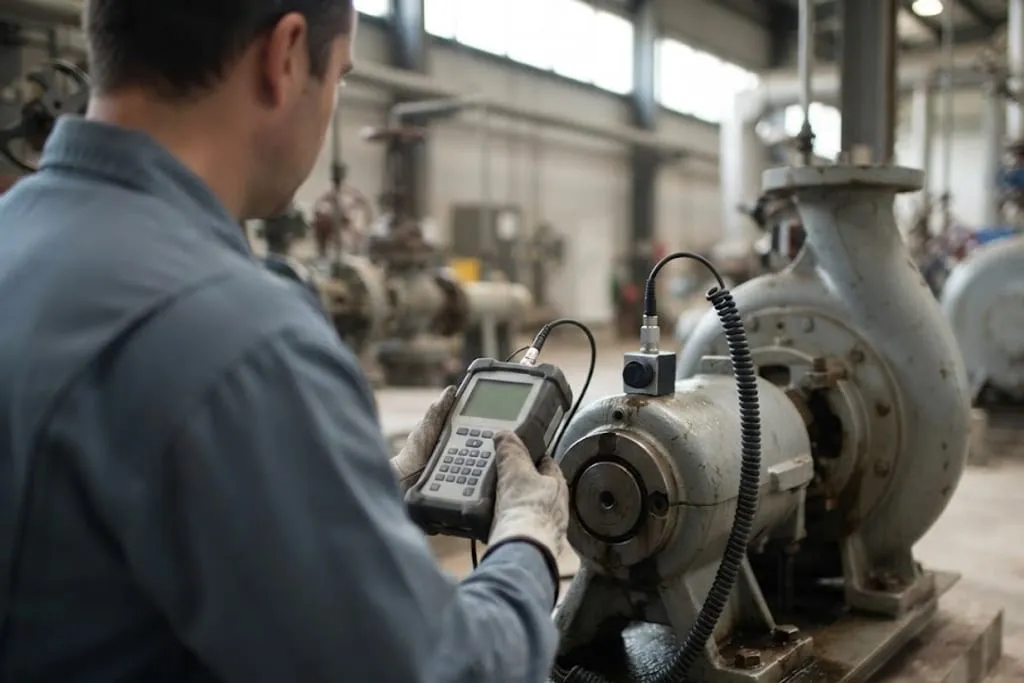
Sampling technique decides everything. A sample drawn from a dead leg, or from the bottom of a reservoir where sludge collects, describes that spot rather than the system. Take it from the same point, in the same way, with the machine at operating temperature and circulating.
Temperature and thermography
Bearing and winding temperatures are usually monitored continuously, and the trend rules apply: a rise at constant load and ambient means friction is producing more heat than it was.
Thermography — an infrared camera — extends this to everything that is not instrumented, and it is at its most valuable on electrical equipment.
It works on mechanical equipment too: a hot coupling, a blocked cooler, a bearing housing running warm on one side, insulation that has broken down internally.
Performance monitoring: is it still doing its job?
Everything above describes the machine’s condition. Performance monitoring asks a different question: is it still delivering what it is supposed to?
For a pump, that means head, flow, power and the efficiency implied by them, compared against its curve. For a compressor, pressure ratio and power. For an exchanger, the approach temperature.
Motor current signature analysis
The current drawn by a motor carries information about what it is driving. Broken rotor bars, eccentricity and some mechanical faults in the driven machine all leave a signature in the current spectrum.
Its appeal is access: the measurement is taken at the switchgear, not at the machine, which matters when the machine is in a hazardous area, buried in insulation or otherwise awkward to reach.
Building something that works
| Vibration | Imbalance, misalignment, looseness, late-stage bearing and gear damage | Chemistry, contamination, loss of duty | Weeks to months, depending on the fault |
|---|---|---|---|
| Oil analysis | Wear metals, water, dirt, oil degradation | Anything not in contact with the lubricant | Months — usually the earliest available |
| Temperature trending | Lubrication problems, changed loading, cooling faults | Anything that does not generate heat | Days to weeks |
| Thermography | Loose electrical connections, blocked coolers, failed insulation | Internal mechanical condition | Weeks to months on electrical joints |
| Performance monitoring | Fouling, wear ring clearance, erosion — loss of duty | Mechanical condition; a failing bearing shows nothing | Months, and often the only indication at all |
| Motor current signature | Broken rotor bars, eccentricity, some driven-machine faults | Faults that do not reach the motor load | Weeks to months; measured at the switchgear |
| Operator rounds | Noise, leaks, heat, smell — the unexpected | Anything slow enough to become normal | Immediate, but only for what is noticeable |
No rows match that filter.
No single technique sees everything. The value comes from choosing two or three that fail blind in different directions, and applying them to the machines whose failure actually costs something.
Not every machine deserves the same attention. The effort goes where failure costs most — unspared machines, long lead-time spares, anything whose failure stops the plant or releases hydrocarbon. A spared pump with a shelf full of spares may reasonably be run to failure, and saying so openly is better than pretending to monitor it.
Interval against failure speed. Monthly readings catch something degrading over months. A bearing that fails in a fortnight develops and fails entirely between two visits — which is the argument for continuous monitoring on critical machines, and for operators who walk past every day and notice that something sounds different.
What to take away
- Trends beat absolute readings. Same point, same instrument, same load — a change of method looks exactly like a developing fault.
- Oil analysis is the earliest warning, because wear metal reaches the oil long before anything moves enough to change the vibration.
- A milky sample is urgent, and the leak matters as much as the oil change.
- Thermography finds loose electrical connections through a closed panel with the plant running.
- Performance monitoring catches what condition monitoring cannot — a machine in good health that is no longer doing its duty.
- Confirm a surprising reading before acting on it, and never by raising the alarm threshold.
- A finding that produces no work order is worse than no programme, because it buys the belief without the protection.
Check your understanding
7 questions. Nothing is recorded — this is just for you.