Rotating Equipment
Pumps — head, NPSH and why cavitation is a suction problem
Centrifugal versus positive displacement, what a pump curve tells you, why NPSH decides whether a pump survives, and why most pump failures are really piping failures.
Standards referencedAPI 610API 682API 674ASME B73.1
A pump adds energy to a liquid so it can go somewhere it would not go by itself. Most of a plant’s rotating equipment is pumps, and most pump problems are not really pump problems.
Head, not pressure
A centrifugal pump adds head — energy per unit weight of liquid, measured in metres.
The same pump at the same speed produces the same head whatever it is pumping. What changes is the pressure that head represents, because pressure depends on density. Eighty metres of head is about 7.8 bar on water and about 5.5 bar on a light hydrocarbon.
That is why a pump curve is drawn in metres, and why a pump tested on water behaves differently in service.
The two families
| Centrifugal, single stage | Centrifugal | Falls as discharge pressure rises | Most plant duties — clean liquids, high flow, moderate head | Cavitation if suction conditions are poor |
|---|---|---|---|---|
| Centrifugal, multistage | Centrifugal | Falls as pressure rises; each stage adds head | High head duties — boiler feed, pipeline injection | Long shafts are sensitive to misalignment |
| Vertical can / sump | Centrifugal | As centrifugal | Low available suction head — sumps, condensate, drains | The pit depth is what provides the NPSH |
| Reciprocating (piston, plunger) | Positive displacement | Fixed volume per stroke, whatever the pressure | High pressure, low flow — injection, chemical dosing | Pulsating flow; needs dampeners and careful piping |
| Gear, screw, lobe | Positive displacement | Fixed volume per revolution | Viscous liquids — lube oil, heavy fuel, polymers | Close clearances — solids destroy them |
| Diaphragm / metering | Positive displacement | Fixed and precisely adjustable | Accurate chemical dosing, no leak path to atmosphere | Low flow, and the diaphragm is a wear item |
| Progressive cavity | Positive displacement | Fixed volume per revolution, gentle | Slurries, sludges, shear-sensitive fluids | Running dry destroys the stator within minutes |
No rows match that filter.
The first question is always centrifugal or positive displacement. A centrifugal pump delivers a flow that depends on the resistance it meets; a positive displacement pump delivers the same volume per revolution regardless — which is why one can be throttled and the other must never be.
The distinction that matters:
- A centrifugal pump’s flow depends on the resistance it meets. Close the discharge and flow falls to zero — the pump churns and heats up, but nothing bursts.
- A positive displacement pump delivers a fixed volume per revolution regardless of pressure. Close its discharge and pressure rises until something fails.
The pump curve
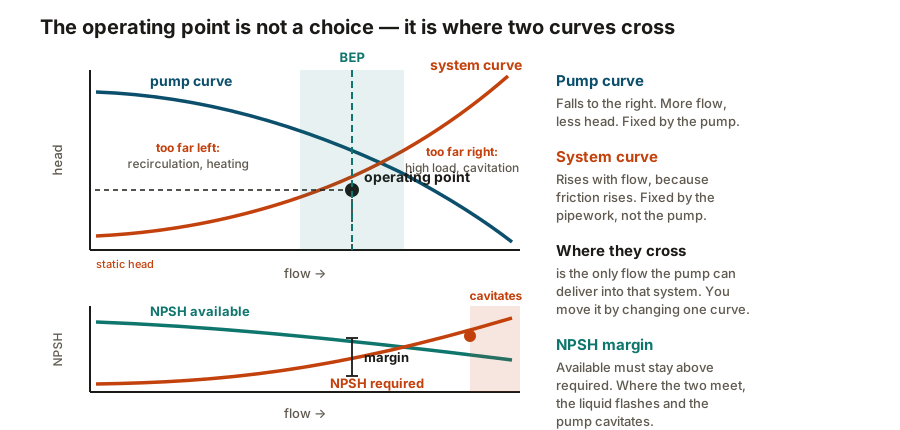
A centrifugal pump’s curve plots head against flow. It falls to the right: more flow, less head.
Where the pump actually runs is where its curve crosses the system curve — the resistance of the pipework, which rises with flow. That intersection is the operating point.
Three things to know about it:
- The best efficiency point (BEP) is where the pump is designed to run. Efficiency is highest and the hydraulic forces on the impeller are balanced.
- Running far left of BEP (low flow) causes recirculation, vibration and heating.
- Running far right (high flow) causes high load, vibration and often cavitation.
A pump living a long way from BEP will wear out regardless of how well it is maintained, and no amount of maintenance fixes a sizing decision.
NPSH: the number that decides whether a pump survives
This is the single most important concept for a pump, and it is entirely about the suction side.
- NPSHa (available) — how much pressure above vapour pressure the system delivers to the pump suction. Set by the liquid level, the suction line, the temperature and the pressure above the liquid.
- NPSHr (required) — how much the pump needs at that flow to avoid the liquid flashing inside it. Taken from the pump curve.
NPSHa must exceed NPSHr, with margin. When it does not, pressure at the impeller eye falls below vapour pressure, the liquid boils, and the bubbles collapse violently as pressure recovers — cavitation. It sounds like gravel in the casing and it pits the impeller.
Seals
The shaft has to pass out of a pressurised casing without leaking.
- Gland packing — rope packing compressed around the shaft. It is meant to drip slightly for lubrication. Cheap, simple, unacceptable for hydrocarbons or anything toxic.
- Mechanical seal — two very flat faces, one rotating with the shaft and one static, held together with a microscopic lubricating film between them. The standard for process duty.
API 682 defines standard seal arrangements and seal support plans — the auxiliary piping that flushes, cools or quenches the seal faces. Those plan numbers (Plan 11, Plan 52, Plan 53) appear on the datasheet and on the P&ID, and they exist because a seal without the right support fails early.
Drivers and alignment
Most pumps are driven by an electric motor, occasionally by a steam turbine where reliability during a power failure matters.
The motor and pump shafts are joined by a coupling, and they must be aligned to within a few hundredths of a millimetre. Laser alignment is normal practice; straight-edge alignment is not adequate for process duty.
Alignment is checked cold and again hot, because the pump and driver grow by different amounts as they warm up.
When something goes wrong
| Rattling, like gravel in the casing | Cavitation — vapour bubbles forming and collapsing on the impeller | Suction pressure, strainer blockage, liquid temperature, NPSH available |
|---|---|---|
| No flow, but the motor runs happily | Lost prime, or a vapour pocket in the suction line | Suction line venting, reducer orientation, valve alignment |
| Repeated mechanical seal failures | Misalignment, or pipe strain pulling the casing out of true | Nozzle loads, pipe supports near the pump, coupling alignment |
| Bearings running hot or failing early | Running far from the best efficiency point, or misalignment | Actual duty against the pump curve; alignment record |
| Motor overload trips on startup | Running out too far on the curve, or wrong rotation | Discharge valve position at start, motor rotation direction |
| Vibration that rises with flow | Operating well right of the best efficiency point | Flow against the curve; the control valve may be oversized |
| A positive displacement pump bursts its discharge piping | Discharge throttled or blocked with no relief fitted | That a relief valve exists and is set correctly — this is a design fault |
No rows match that filter.
Most pump failures are not pump failures. They are suction problems, piping problems or alignment problems that the pump merely reports. Replacing the pump without finding the cause buys a few months at most.
What to take away
- A pump adds head, not pressure. Pressure follows from density.
- Centrifugal flow depends on resistance; positive displacement flow does not. A PD pump must have a relief valve.
- The operating point is where the pump curve meets the system curve. Living far from BEP wears the pump out.
- NPSHa must exceed NPSHr. Cavitation is a suction-side problem with suction-side fixes.
- Alignment is measured, cold and hot. Repeated seal failures usually mean pipe strain.
Check your understanding
10 questions. Nothing is recorded — this is just for you.