
Automotive
Problem solving and 8D
The eight disciplines in order, why containment is not corrective action, the difference between occurrence and escape root cause, and why a corrective action closed without verified effectiveness is not closed.
Standards referencedIATF 16949AIAG CQI-20ISO 9001VDA 6.3AIAG-VDA FMEA Handbook
Two things make an 8D work or fail, and neither is the format. The first is defining the problem so precisely that you could tell whether it had stopped. The second is refusing to close the report until the action has been shown to work — not shown to have been done.
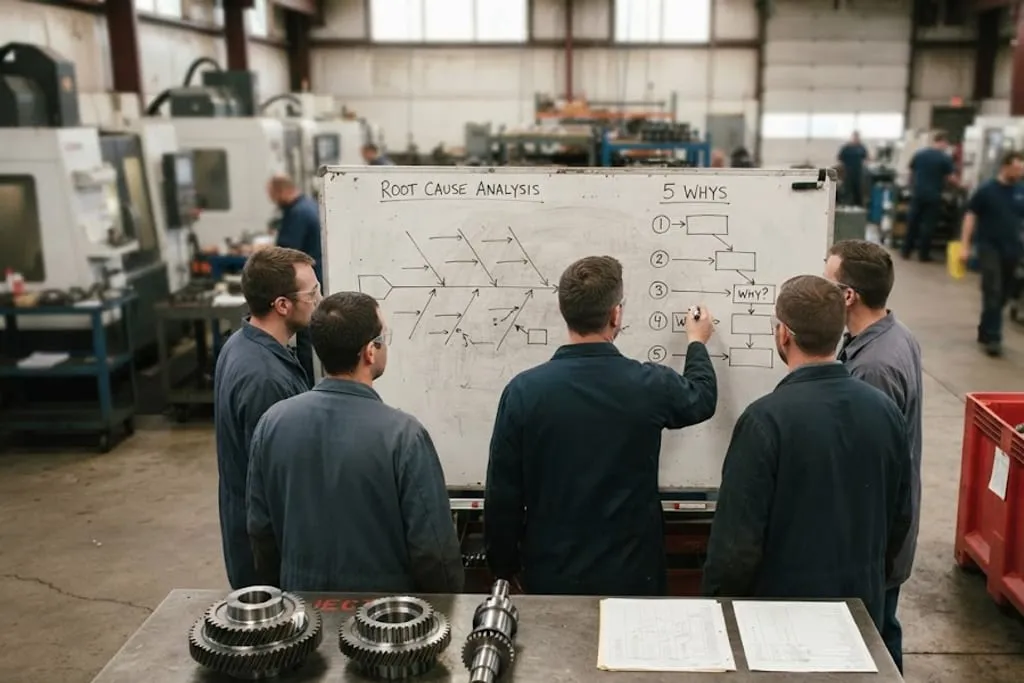
The eight disciplines
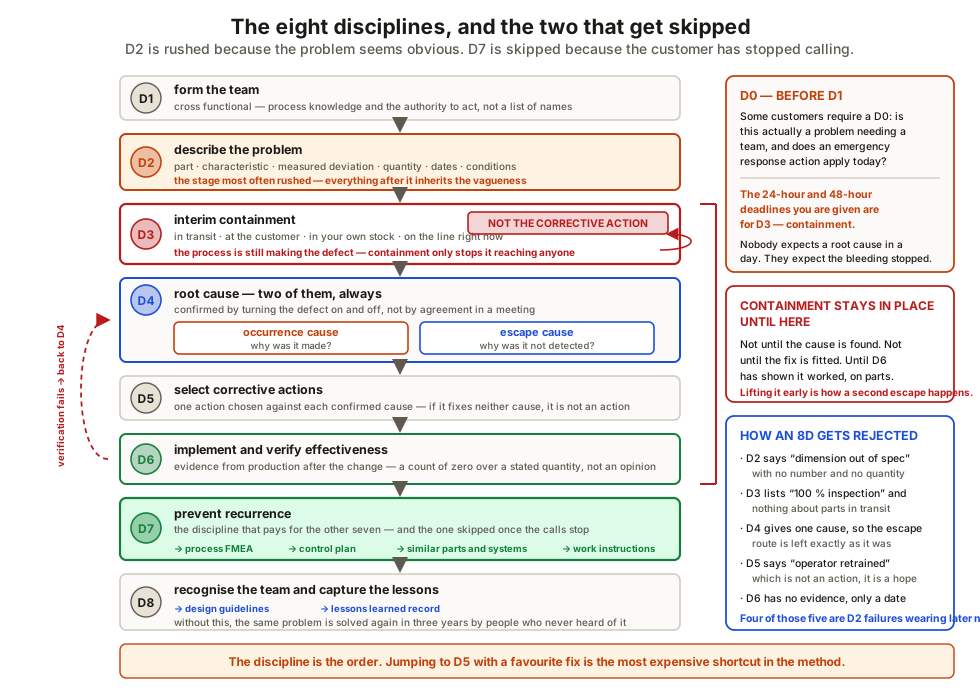
| Discipline | The trap | |
|---|---|---|
| D1 | Form the team | No authority to change anything |
| D2 | Describe the problem | Rushed, and not quantified |
| D3 | Interim containment | Mistaken for the fix |
| D4 | Root cause | One cause instead of two |
| D5 | Select corrective actions | Actions not tied to the confirmed cause |
| D6 | Implement and verify effectiveness | Closed on implementation |
| D7 | Prevent recurrence | Not fed back into the FMEA |
| D8 | Recognise and capture learning | Skipped entirely |
D2: quantify, or investigate the wrong thing
“Noise complaint” gives no basis for ever knowing whether it stopped. State the part, characteristic, measured deviation, quantity, dates and conditions — and a surprising amount of the time the act of quantifying it eliminates most of the candidate causes before anyone opens a toolbox.
D3: containment is not corrective action
D4: two root causes, not one

A defect reaching a customer is two failures:
- Occurrence cause — why was it made?
- Escape cause — why did the controls not catch it?
The escape cause almost always lands on a control plan entry that was inadequate, absent, or simply not being performed. Fix only the occurrence and the detection system stays exactly as blind for the next, different defect.
D6: implemented is not verified
| Proves | |
|---|---|
| Implemented | Something was done |
| Verified effective | It worked |
Verification means data from the running process over a meaningful period, under the conditions that produced the problem. Not a statement that the change was made.
And if verification fails, the flow goes back to D4 — because the cause was wrong.
D7: apply it everywhere it applies
The same tool, material, method or design feature is shared across several parts. A cause found on one is present on the others, so fixing only the part that generated the complaint guarantees a reappearance under a different part number in about eight months.
D7 also closes the loop backwards. A confirmed failure mode the PFMEA did not anticipate — or ranked too low — is direct evidence that the analysis was wrong, and it must be fed back. An organisation whose FMEAs never change after launch is not learning from its own failures.
D8: lessons that stay in the report are not lessons
Push the learning into work instructions, FMEA libraries, design guidelines, checking fixture standards and a lessons learned record that the next programme actually reads. Skip it and the same problem gets solved independently by three departments over five years.
What to take away
- Quantify the problem — part, characteristic, deviation, quantity, dates, conditions.
- Containment is not corrective action, and it covers transit, customer, stock and WIP.
- Containment stays until D6 verification, not until the report is typed.
- Find two root causes: why it was made, and why it escaped.
- The escape cause usually lands on a control plan entry.
- “Operator error” is not a root cause — ask what allowed it and let it through.
- Verify each why against evidence; ideally reproduce the defect.
- Implemented ≠ verified effective. Close on data, over time, under the real conditions.
- Failed verification sends you back to D4.
- Apply the action to every part sharing the cause.
- Feed the confirmed failure mode back into the FMEA.
- A recurrence means the analysis was wrong. Reopen it; do not add inspection.
Check your understanding
10 questions. Nothing is recorded — this is just for you.