
Automotive
Error proofing and traceability
Poka-yoke that prevents rather than detects, why a torque tool that only beeps is not error proofing, what broaching and part marking are for, and how traceability turns a recall into a contained one.
Standards referencedIATF 16949ISO 9001ISO 15459-1AIAG B-4ISO 12100
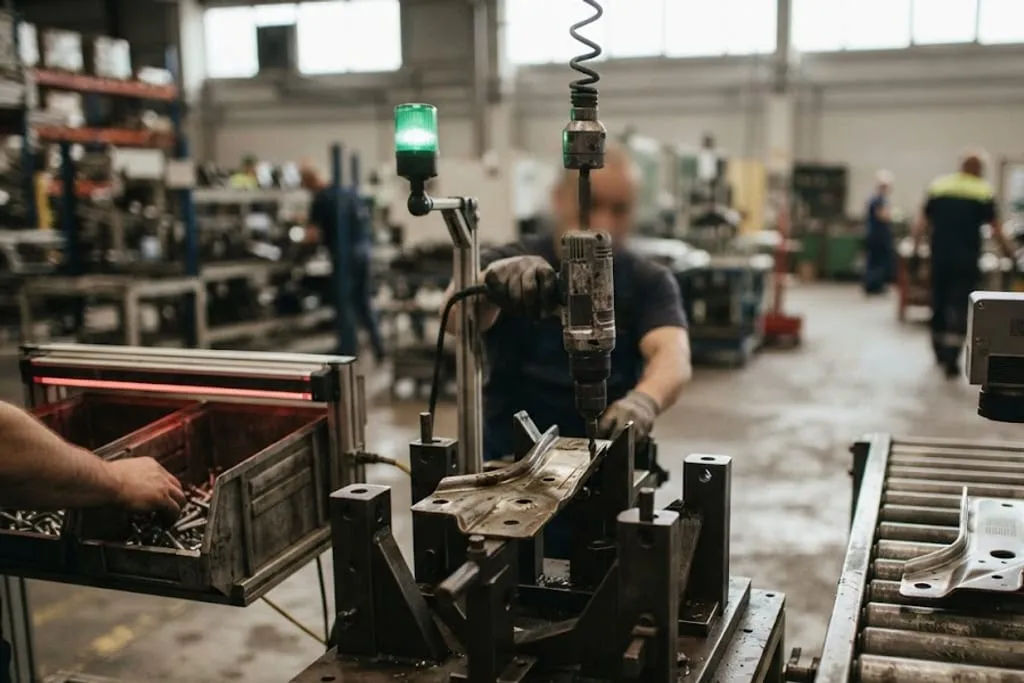
Every assembly error has already been thought of by somebody. The question is whether the response was a sign asking people to be careful, or a pin moved four millimetres so the part physically will not go in backwards. Those two responses cost about the same to design and differ completely in whether they work.
Prevention beats detection, always

| Level | Example | Depends on |
|---|---|---|
| Instruction | A sign, a work instruction | Attention, every time |
| Awareness | Colour coding, visual aid | Attention, but assisted |
| Detection | Sensor, alarm, lamp | Someone responding correctly |
| Interlock | Part cannot be released until verified | The device working |
| Prevention | Asymmetric feature — wrong way will not fit | Nothing |
This is why a torque tool that beeps is weak error proofing. The fault has been created, the part can still move on, and the chain now depends on the operator hearing the beep, understanding it and acting on it — at the end of a shift, with noise, under cycle time pressure. Interlock the tool with the station so the part cannot be released until the right number of correct fastenings has been recorded, and the human response drops out of the chain entirely.
Verifying the device itself
That expectation is written into automotive quality systems rather than left to good practice, and it is one of the things an auditor will ask to see records of — see IATF 16949 and the quality system.
Traceability, and what it is actually for
Traceability does not prevent a single defect. Its entire value appears after something has gone wrong.

Knowing the material batch, the furnace charge, the tool, the machine, the shift and the recorded torque for a specific part turns an open-ended recall into a defined population. The difference in cost between “every vehicle built in eighteen months” and “the four hundred parts from one heat treatment batch” dwarfs the cost of the system that made the distinction possible.
Which requires the part to carry a permanent mark — laser etched, dot peened, or a data matrix code. Without one, the chain depends on which container the part happened to be in, and that is lost the first moment anything is rehandled.
| Mechanism | What it bounds |
|---|---|
| Part marking | The individual part, back to its full build record |
| Batch / lot control | A group sharing one material or process condition |
| First off / last off | The run, between two verified good checks |
| Torque and process data logging | The specific operation on the specific part |
First off and last off deserves more credit than it usually gets. If both ends of a run are correct, everything between them is far more credible; and if the last one is wrong, the suspect population is bounded by the previous good check rather than being everything ever made. It is the same containment logic as traceability, achieved with a bench gauge.
Record the device, or lose it
An error proofing device that is not written into the control plan will be removed at the next line rebalance, because nobody remembers which failure mode it was there for.
The control plan entry ties the device back to the FMEA that justified it and states two more things the device itself cannot: how it is verified, and what happens when it triggers. Those relationships are the subject of control plans and process flow and FMEA — design and process.
A device with no reaction plan is a device that will eventually be bypassed by somebody who needed to keep the line running and had no instruction telling them not to.
What to take away
- Prevention makes the error impossible; detection allows it and then catches it.
- A device that beeps depends on a human response. An interlock does not.
- Asymmetry is the cheapest error proofing there is — do it on the drawing.
- Nearly symmetric parts are the dangerous ones; they load wrongly and feel right.
- Error proofing devices fail silently. Challenge test them every shift with a master defect.
- Traceability prevents nothing. It bounds the population when something is wrong.
- A permanent part mark is what the whole chain hangs from.
- First off and last off bounds a run with nothing more than a bench gauge.
- Record every device in the control plan, with its verification and reaction plan.
- An undocumented device gets removed at the next line rebalance.
Check your understanding
10 questions. Nothing is recorded — this is just for you.