
Automotive
Engine cycles and architecture
What the four strokes actually cost and earn, why compression ratio is the single number that sets efficiency and why knock caps it, how bore, stroke and swept volume are related, and why a four cylinder shakes in a way a straight six does not.
An engine is an air pump with a fire in it. Almost everything that decides how much torque it makes, how efficient it is and how smoothly it runs comes down to two questions: how much air it can trap in a cylinder, and how much of the heat released in that air it can turn into useful work before the rest goes out of the exhaust pipe or into the coolant.
The four strokes, and what each one costs
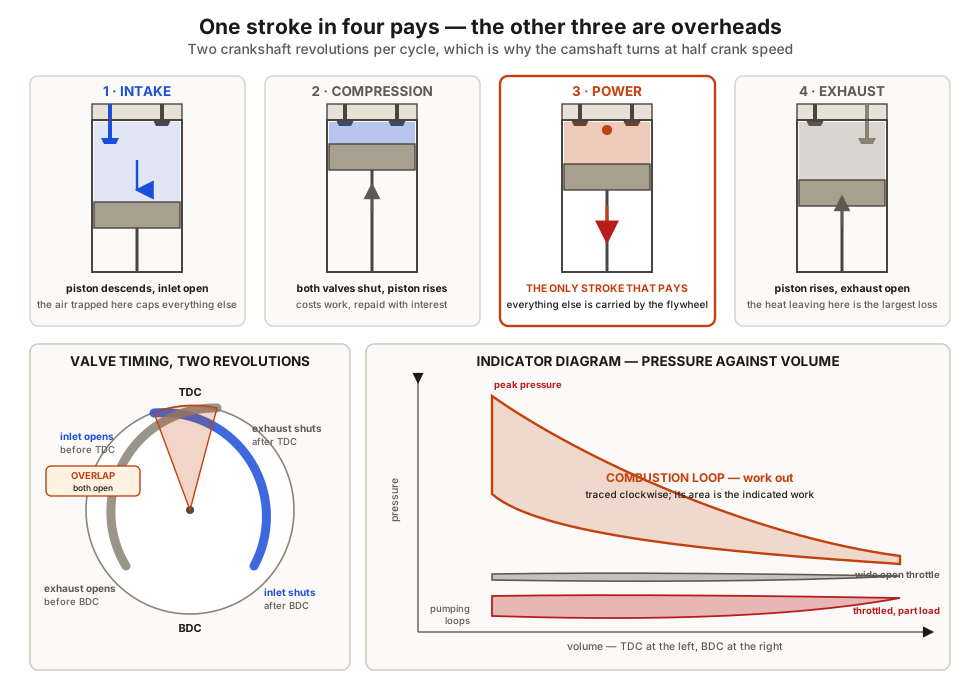
Intake. The piston descends with the inlet valve open and draws in air, or air and fuel. This is the stroke that sets the ceiling on everything else: whatever mass of air ends up trapped is the most fuel that can be burnt, so every intake, cam, turbocharger and exhaust decision is an attempt to trap more of it.
Compression. Both valves shut and the piston rises, squeezing the charge into a small volume. Compressing costs work, but it is repaid with interest, because a charge that starts hot and dense burns faster and expands through a larger ratio.
Power. Combustion raises the pressure and drives the piston down. This is the only stroke that pays.
Exhaust. The piston rises and pushes the burnt gas out. The heat still in that gas is the single largest loss in the engine — larger than friction, larger than the coolant.
Compression ratio, and the wall it runs into
Compression ratio is the total volume above the piston at bottom dead centre divided by the volume left at top dead centre:
CR = (swept volume + clearance volume) / clearance volume
It is the closest thing an engine has to a single efficiency number. Raise it and the charge expands through a bigger ratio, so more of the heat becomes work. Petrol engines would like to run 14 or 15 to 1. They cannot, because of knock.
This is why a diesel is different in kind, not just in degree. It compresses air alone and injects fuel at the moment combustion is wanted, so there is no premixed charge sitting there waiting to autoignite. Compression ratios of 15 to 18 to 1 are normal, and the limit is set by peak pressure and mechanical strength rather than by knock.
| Petrol, spark ignition | Diesel, compression ignition | |
|---|---|---|
| Compression ratio | 9.5 to 12 naturally aspirated, 9 to 10.5 turbocharged | 15 to 18 |
| What is compressed | Air and fuel, in port injection | Air only |
| Combustion starts | Spark, then a travelling flame front | Autoignition at the injected spray |
| Load controlled by | Throttling the air, mixture held near stoichiometric | Fuel quantity, air unthrottled |
| Limited by | Knock | Peak pressure, and soot against nitrogen oxides |
| Part load efficiency | Poor, because throttling costs pumping work | Good, because there is little to throttle |
That last row is the practical one. A petrol engine at light load is working against its own closed throttle, and the anticlockwise pumping loop on the indicator diagram grows large. A diesel does not throttle, which is most of why it uses less fuel in traffic.
Bore, stroke and the shape of the numbers
Swept volume of one cylinder is the bore area multiplied by the stroke:
V = (π/4) × bore² × stroke
Capacity is that figure times the number of cylinders. The ratio of bore to stroke then sets the engine’s character:
- Oversquare, bore larger than stroke. More room in the head for large valves, and lower mean piston speed at a given engine speed, so it revs. The chamber is wide and shallow, which is slightly worse for knock and for heat loss.
- Undersquare, stroke larger than bore. Longer crank throw gives more leverage, so torque arrives low down. Piston speed limits revs. The chamber is compact, which suits knock resistance and is why most diesels are long stroke.
Mean piston speed, roughly 2 × stroke × rpm, is the figure that actually limits engine speed.
Production engines live around 15 to 20 m/s at peak power, and that number has barely moved in
decades, because it is set by ring friction and by the inertia loads on the rod.
Cylinder layout, firing order and why smoothness is geometry
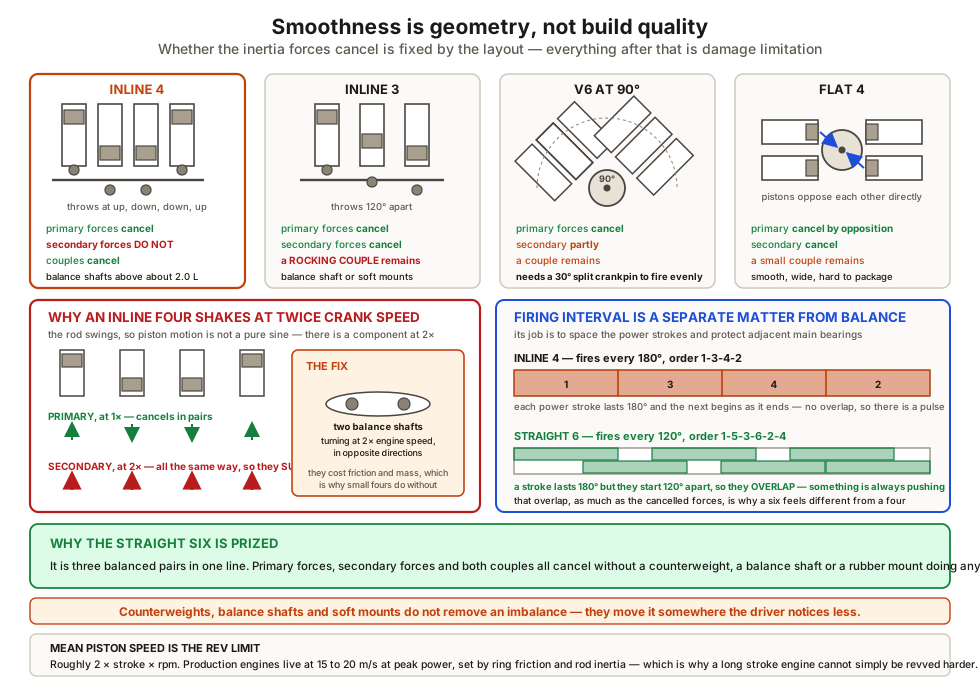
The piston does not move sinusoidally, because the connecting rod swings. Decompose the motion and there is a primary component at crank speed and a secondary component at twice crank speed. Whether those sum or cancel across the cylinders is fixed by the geometry, and no amount of manufacturing quality changes it.
| Layout | Primary forces | Secondary forces | Couples | In practice |
|---|---|---|---|---|
| Inline 4 | Cancel | Do not cancel | Cancel | Shakes vertically at 2× rpm; balance shafts above about 2.0 litres |
| Inline 3 | Cancel | Cancel | Rocking couple | Needs a balance shaft or soft mounts; uneven feel is inherent |
| Inline 6 | Cancel | Cancel | Cancel | Inherently balanced, and the reason it is prized |
| 90° V6 | Cancel | Partly | Couple present | Needs a 30° split crankpin for even firing |
| 60° V6 | Cancel | Partly | Couple present | Even firing without a split pin; narrower |
| Flat 4 | Cancel by opposition | Cancel | Small couple | Smooth, wide, and hard to package |
| V8, 90° | Cancel | Cancel | Cancel with a cross plane crank | Smooth; the uneven bank firing is what makes the noise |
Firing order is a separate matter from balance. Its job is to spread the power strokes evenly around the crank and to avoid loading adjacent main bearings in succession. An inline four fires every 180° of crank rotation, usually 1-3-4-2 or 1-2-4-3, so there is a gap between power strokes. A straight six fires every 120°, and because a power stroke lasts 180° the strokes overlap — there is always at least one cylinder pushing. That overlap, not just the force cancellation, is why a six feels different.
The two stroke, and the rotary
The two stroke completes its cycle in one revolution, so in principle it makes twice the power for the same capacity and speed. The catch is scavenging: fresh charge and exhaust have to share the cylinder during the same brief window near bottom dead centre, so they mix at the boundary and some fresh fuel goes straight out. In a crankcase scavenged engine the oil is burnt with the fuel. It is a good cycle for a chainsaw and an impossible one for a modern emissions limit.
The Wankel rotary has excellent power density and almost no reciprocating imbalance, but its combustion chamber is long and thin with a high surface to volume ratio, so heat loss and hydrocarbon emissions are high, and the apex seals live a hard life. Its remaining role is as a range extender turning a generator at one fixed speed, where those weaknesses matter least.
Reading a spec sheet honestly
Two terms separate what happened in the cylinder from what arrived at the shaft:
- Indicated work is what the gas did on the piston — the area of the combustion loop on the indicator diagram.
- Brake work is what is left at the output shaft after friction and pumping losses, measured
on a dynamometer.
SAE J1349andISO 1585exist to fix the correction factors and accessory load so that two published figures can be compared at all.
BMEP, brake mean effective pressure, is brake torque normalised by capacity, and it is the honest way to compare engines of different sizes. A naturally aspirated petrol engine sits around 10 to 12 bar BMEP; a modern turbocharged one reaches 20 to 25 bar. BSFC, brake specific fuel consumption in grams per kilowatt hour, is the efficiency number, best around 200 to 210 g/kWh for a good diesel and 230 to 250 for petrol.
And the relationship that governs everything downstream of the flywheel:
Power = torque × angular speed
Torque is what the engine achieves per combustion event. Revs are how often it gets one. This is why two engines with identical peak torque can be three times apart in power, and why the answer to almost every mismatch between them is a gearbox.
What to take away
- An engine is an air pump; trapped air mass sets the ceiling on everything else.
- One stroke in four makes work, and the camshaft turns at half crank speed.
- Compression ratio is the efficiency lever, and knock is the wall it hits.
- A diesel escapes that wall by compressing air alone and injecting at the moment of combustion.
- A petrol engine’s part load penalty is pumping work against its own throttle.
- Oversquare revs, undersquare pulls; mean piston speed is the real rev limit.
- An inline four cannot cancel its secondary forces; a straight six cancels everything.
- Firing order spreads the power strokes and protects the bearings — it is not balance.
- The two stroke loses on scavenging, the rotary on surface to volume ratio.
- BMEP compares engines of different capacity; BSFC is the efficiency figure.
Check your understanding
10 questions. Nothing is recorded — this is just for you.