
Automotive
Control plans and process flow
How the process flow, PFMEA and control plan must agree line for line, what a reaction plan is and why a control without one is useless, and why the control plan is the only one of the three that reaches the operator.
Standards referencedIATF 16949AIAG APQPAIAG-VDA FMEA HandbookAIAG PPAPISO 9001
Three documents, one analysis. The process flow says where the operations are, the PFMEA says what could go wrong at each, and the control plan says what is done about it. They are meant to be read across, line for line — and an auditor’s favourite move is to pick one operation and follow it through all three.

The three documents, and where the chain breaks
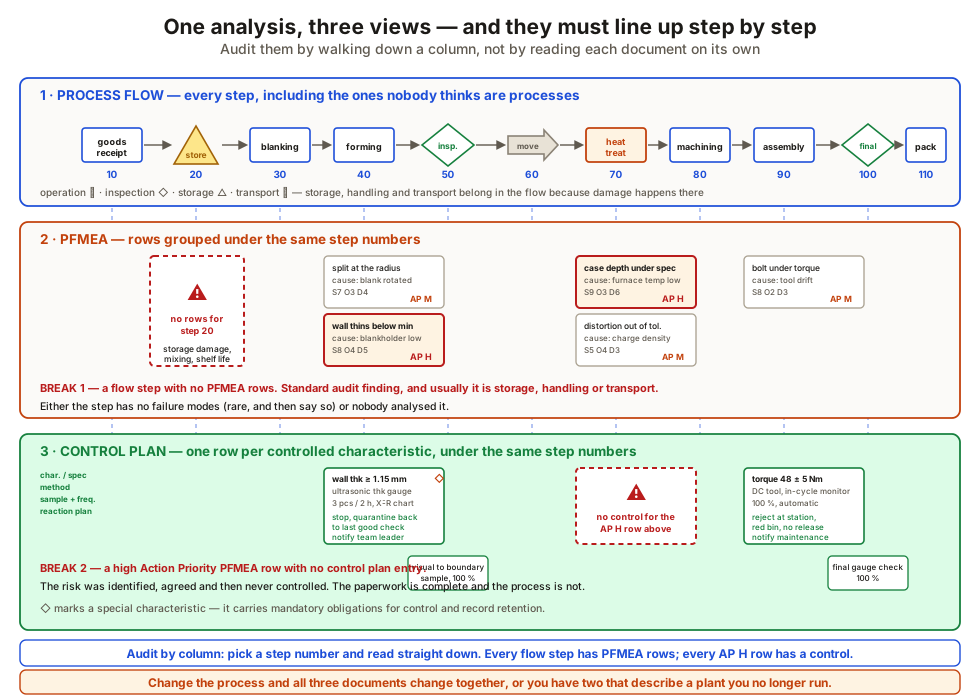
| Document | Answers |
|---|---|
| Process flow | Where are the operations, and everywhere the product is handled? |
| PFMEA | What could go wrong at each, and which matters? |
| Control plan | What do we do about it, how often, and what if it triggers? |
The two breaks that get raised as findings are always the same:
- An operation in the flow with no PFMEA rows — the risk at that step was never analysed.
- A high priority PFMEA failure mode with no control plan entry — the risk was identified and nothing was done.
The flow has to include the boring steps
A process flow that lists only value-adding operations misses most of the interesting failure modes. Storage, transport, handling and inspection are where parts get mixed, dropped, corroded and left past their shelf life. No value is added there, which is precisely why they are forgotten.
A flow diagram is also not a work instruction. The flow exists to find every point at which the product could be affected; a work instruction tells one operator how to do one operation, and cannot show risk that enters between stations.
Anatomy of a control plan row
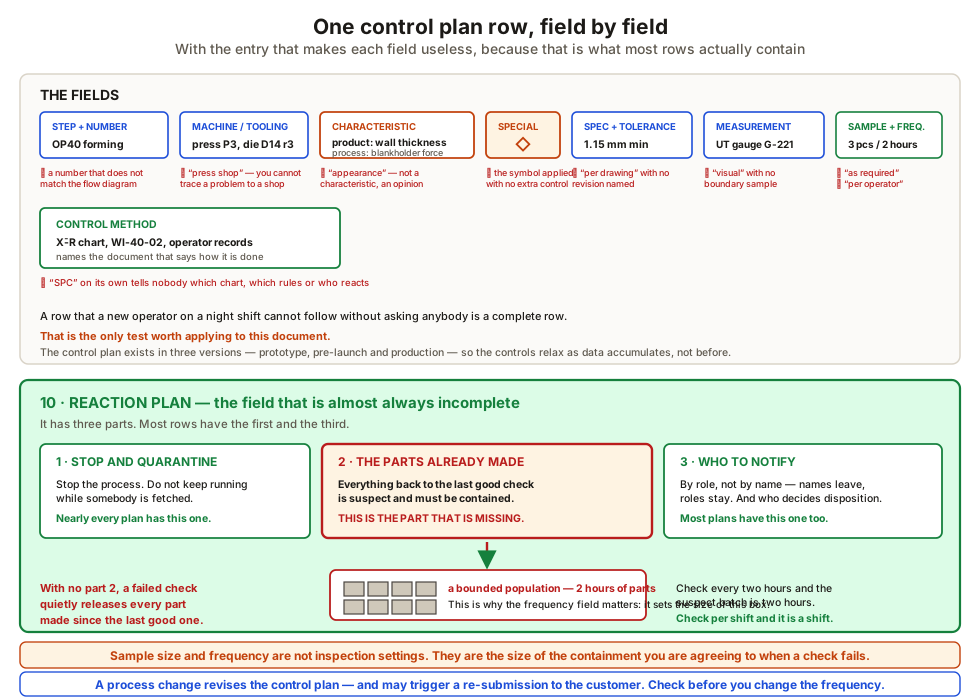
| Field | A bad entry |
|---|---|
| Characteristic | “Appearance” |
| Specification | “To drawing” |
| Measurement method | “Visual” — against what standard? |
| Sample size | blank |
| Frequency | “As required” |
| Control method | “Operator check” |
| Reaction plan | blank |
A control described as inspect or check is unusable: two operators will do two different things and neither can be shown to be wrong. The entire value of the document is in the completeness of those fields.
Special characteristics
Where the FMEA identifies a characteristic whose variation significantly affects safety, fit, function or regulatory compliance, it arrives here with a symbol attached.
The symbol is not decoration. It triggers obligations — mandatory capability study, traceability, sometimes 100 % verification, and restrictions on who may approve a change. It is the visible link back to FMEA for design and process, and it is what makes the risk analysis have consequences on the floor.
Why the control plan is the one that reaches the operator
The flow describes the route. The FMEA explains the reasoning. Neither tells anyone what to do.
The control plan is written as instructions, which is why it is the document posted at the station and referenced by the work instruction. It is also why it is the one that must be revision controlled to the floor — a control plan revised in the quality office and not reissued at the station means the approved process and the actual process have diverged, and only one of them is making parts.
Three versions, on purpose
| Version | Character |
|---|---|
| Prototype | Heavy dimensional and material verification |
| Pre-launch | Tighter and more frequent than production |
| Production | Reduced, with capability data to justify it |
Before capability exists, the process is protected by inspection. Afterwards the inspection is reduced with the data as the justification. The sequencing is part of APQP and new part introduction.
Change control
The control plan describes an approved process. Change the process without changing it and the approved state no longer exists anywhere except on paper.
So a process change revises the PFMEA and the control plan together, and many changes also trigger a PPAP re-submission — which is why engineering change control and the control plan are the same conversation. What requires notification and what requires re-submission is set out in PPAP and the submission package.
What to take away
- Flow, PFMEA and control plan are one analysis in three views, aligned step by step.
- The two findings: a flow step with no PFMEA rows, and a PFMEA risk with no control.
- Put storage, transport and handling in the flow — that is where parts get mixed and damaged.
- A control plan row needs method, sample size, frequency and reaction plan, not just a tolerance.
- “Visual” and “as required” are not controls.
- A reaction plan must say what happens to the parts made since the last good check.
- Special characteristic symbols carry mandatory obligations, not emphasis.
- The control plan is the document that reaches the operator — so revise it at the station.
- Three versions exist so controls are relaxed with data behind the decision.
- Too many controls get silently dropped, leaving the real control state unknown.
- A process change revises the control plan, and may require re-submission.
Check your understanding
10 questions. Nothing is recorded — this is just for you.