
Process
Water, mixing and flash set — making the material on site
Why water content decides what a castable lining becomes, the water quality limits and why stainless steel tightens the chloride one, what a dirty mixer does, how flash set happens, and the temperature window installation has to sit inside.
Standards referencedAPI 936
Of everything that happens between the bag and the wall, water does the most damage and gets the least attention.
It is the one ingredient added on site, by hand, continuously, often by eye. And its effect is invisible on the day — a wet mix looks better than a correct one.
The water window
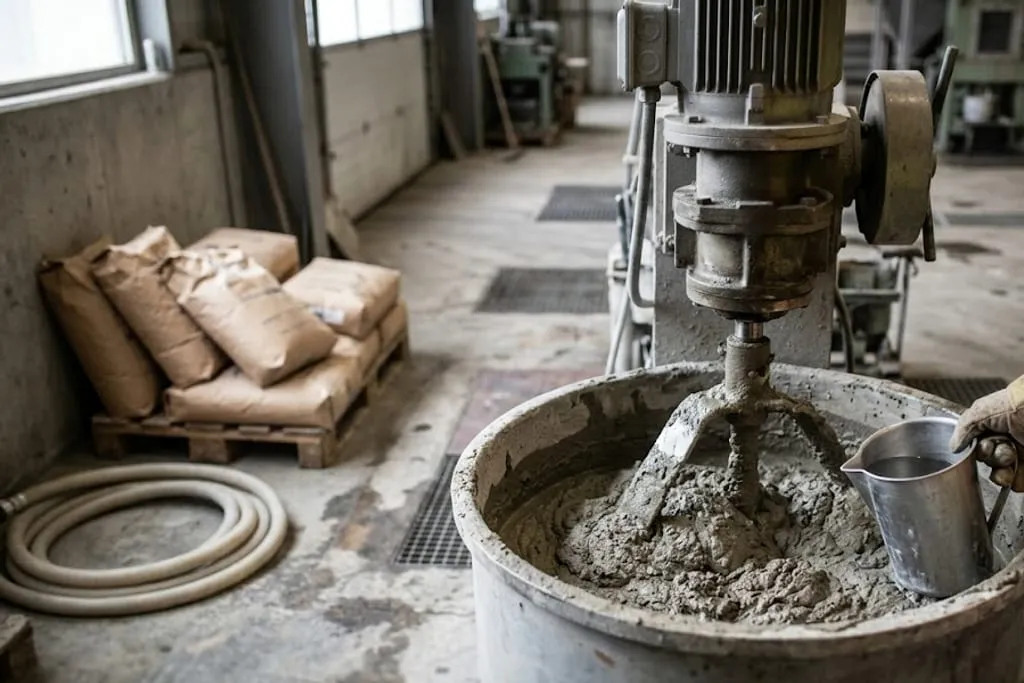
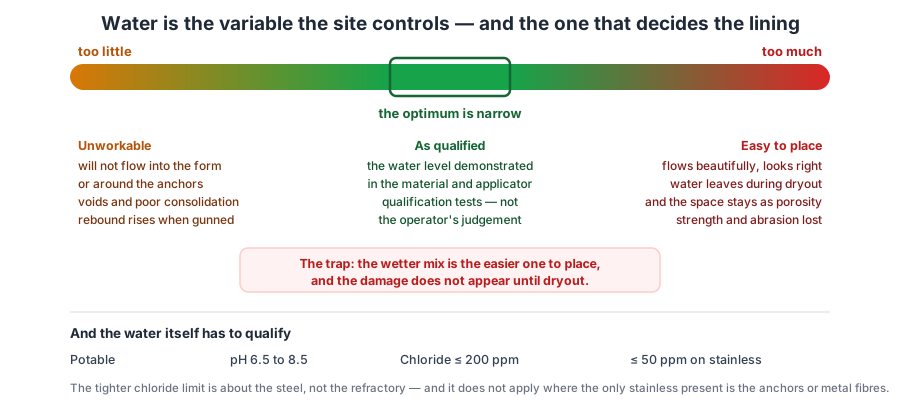
Too little water and the material will not flow into the form or pack around the anchors. You get voids, poor consolidation, and — if gunning — more rebound, because dry material bounces.
Too much water and everything goes easily. The mix flows, the form fills, the surface finishes nicely. Then the lining is dried out, the water leaves, and the space it occupied stays behind as porosity. Strength falls, abrasion resistance falls, and the lining that was specified is not the lining that is installed.
That asymmetry is the whole problem: the error that makes the day easier is the one that ruins the lining, and it does not show up until dryout at the earliest.
The water itself has to qualify
Mixing water is an ingredient, and it is specified like one:
- Potable — fit to drink is the baseline.
- pH between 6.5 and 8.5.
- Chloride not exceeding 200 ppm.
- Chloride not exceeding 50 ppm where refractory is installed on stainless steel surfaces.
The tighter chloride limit is worth understanding rather than memorising, because it is not about the refractory at all. Chlorides crack austenitic stainless steel, and a lining holds moisture against the steel for as long as it takes to dry. The limit protects the substrate.
That also explains the exception: where the only stainless present is the anchoring system or metal reinforcing fibres, the 50 ppm figure does not apply. Those are small, replaceable and not the pressure boundary.
Material that has already met water
Two rules, and both are absolute rather than graded:
- A container showing evidence of water contamination is discarded.
- Any individual container containing hard lumps — ones that cannot easily be broken by hand — is discarded.
The reasoning is that cement hydrates once. If water reached the material in storage, part of its bonding capacity has already been spent on lumps in a bag, and nothing done later recovers it. Screening the lumps out does not help, because what remains is a mix whose cement is partly consumed and whose grading has changed.
The mixer
Mixing time matters at both ends. Under-mixed material has not developed its bond uniformly; over-mixed material can begin to set in the mixer and loses workability before it is placed. Again, the figure comes from the manufacturer and the qualification, not from the operator.
Mixer cleanliness is a bigger deal than it sounds, because it causes flash set.
Flash set
A flash set is the material stiffening almost immediately, far ahead of its normal working time — before it can be placed, consolidated or finished.
The classic cause is contamination of the mixing equipment with lime, plaster or Portland cement. Remnants of those left in a drum induce the flash set, and they lower the refractoriness of the material into the bargain. So the consequence is twofold: the batch cannot be placed properly, and if any of it is placed it is a material with a lower service temperature than the one specified.
It is a housekeeping failure with a metallurgical outcome, which is exactly why mixer cleanliness is inspected rather than assumed. A mixer that has been used for construction concrete and given a rinse is not a clean mixer.
Temperature
Installation sits inside a window: the air and shell temperature must be between 10 °C and 32 °C (50 °F and 90 °F), during installation and for 24 hours afterwards.
The twenty-four hours is the part people miss. Hydration continues after the crew has gone home, and it is temperature-sensitive at both ends — too cold and it stalls, too hot and it runs away, taking the working time with it.
Holding the window is a practical business:
- Cold weather — heating, external insulation, or both, to stay above the minimum.
- Hot weather — shading, water spraying the unlined surface, or air conditioning, to stay below the maximum.
- Always — shading and enclosure against sun, wind and rain, because an exposed lining loses water to the weather as well as to the chemistry.
Temperature limits for the refractory itself and for the mix water follow the manufacturer’s requirements, which may be tighter than the ambient window.
Check your understanding
7 questions. Nothing is recorded — this is just for you.