
Process
Curing and dryout — the two jobs that destroy linings when rushed
Why curing and dryout are opposite tasks in sequence, why a hydraulic bonded castable is kept wet and a chemical setting one kept dry, what steam spalling is, and why thermocouple placement decides whether a dryout schedule means anything.
Standards referencedAPI 936
A lining can be specified correctly, mixed correctly and placed correctly, and still be ruined in the week after the applicator leaves site.
Curing and dryout are where that happens. They look like waiting, they are usually on the critical path, and the pressure to shorten them is constant.
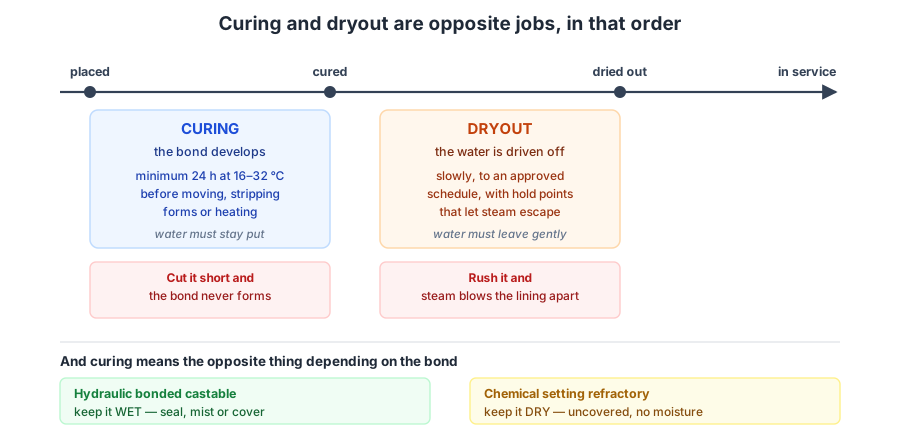
They are opposite tasks
Curing is the period in which the bond develops. For a hydraulic castable that is a hydration reaction, and hydration needs water — so the water that was mixed in has to stay there long enough to be used.
Dryout is the removal of that water, under control, by heat.
Do them in the wrong order, or let one bleed into the other, and the lining suffers from both directions: a bond that never fully formed, then heated before it was ready.
The baseline is a minimum of 24 hours at 16 °C to 32 °C (60 °F to 90 °F) — or whatever the manufacturer requires — before the piece is moved, the forms are stripped, or any heat is applied. All three of those are ways of asking the lining to carry load or lose water before it is able to.
Keep it wet, or keep it dry
This is the part that catches people, because the requirement reverses depending on the bond.
Hydraulic bonded castables must be sealed or kept wet, by one of:
- A manufacturer-approved membrane curing compound, applied to all exposed surfaces before the surface is dry to the touch, with no part allowed to air dry for more than about an hour first. The compound must be nonflammable, nontoxic, and pigmented so that coverage can be inspected visually — and it burns off at a low temperature, around 65 °C to 95 °C (150 °F to 200 °F), early in the heat-up.
- Misting the exposed surfaces with a fine water spray soon after installation and then at roughly two-hourly intervals, keeping every surface wet to the touch throughout — without washing out or dislodging the material.
- Covering with polyethylene or damp cloth within about an hour, in contact with the surface but not sticking to it, and kept damp if cloth is used.
Chemical setting refractories do the opposite: the surface stays uncovered and free from contact with moisture throughout curing. They do not bond by hydration, and moisture interferes rather than helps.
Plastic refractories need no air curing at all. They are simply kept dry and protected from freezing until dryout.
Steam spalling, which is what dryout is defending against
A freshly cured lining is full of water. Heat it and the water turns to steam, which occupies far more volume and has to escape through the material.
If it is generated faster than the lining can pass it, pressure builds inside the refractory. Refractory is weak in tension. The pressure wins, and pieces of the hot face let go — sometimes explosively.
That is steam spalling, and the entire architecture of a dryout schedule exists to prevent it:
- Slow heating rates, so vapour is generated no faster than it can migrate out.
- Hold points, where the temperature stops climbing and the lining is given time to pass what is already in it. This is why a schedule is a staircase, not a ramp.
- Dryout fibres in some formulations, which melt out at low temperature and leave capillaries behind for the steam to travel through.
The dryout procedure itself is submitted by the contractor and approved by the owner, and it has to accommodate the manufacturer’s requirements. Where the manufacturer states none, the standard’s own minimum schedules apply.
Measuring it
A schedule is only worth what it is measured against, and this is where dryouts quietly fail.
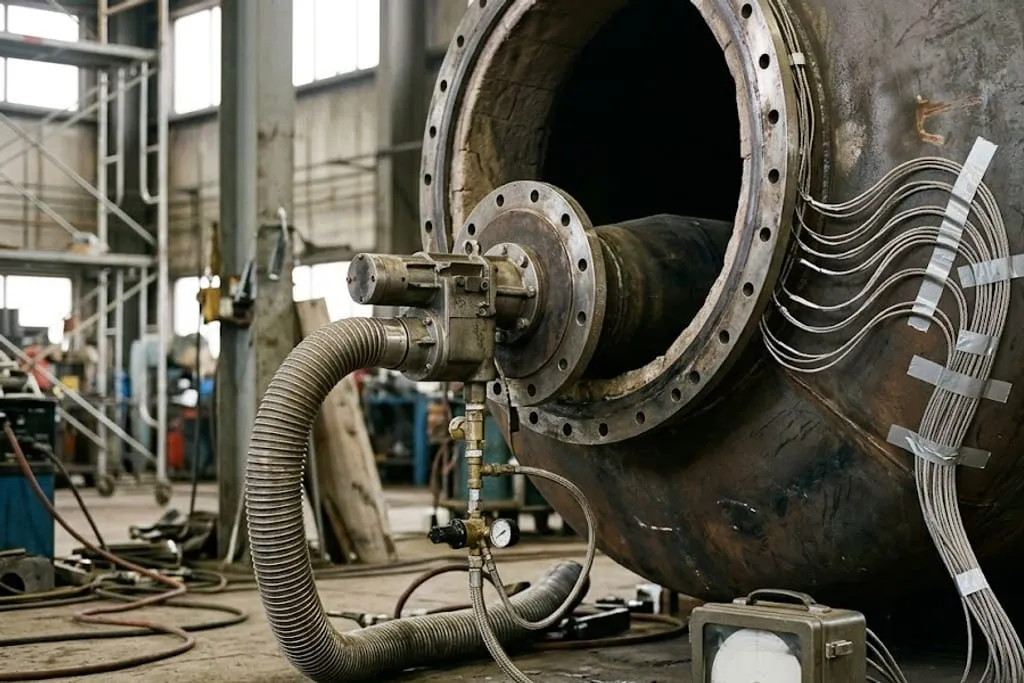
Temporary thermocouples are the normal arrangement, monitoring gas temperature throughout the lined area. Placement is specified: within about 13 mm (half an inch) of the refractory surface, positioned to catch stagnant areas and both the hottest and coldest regions.
Two rules follow that are worth holding onto:
- Heating rates are monitored by the hottest thermocouples — the ones that will exceed the ramp first.
- Hold temperatures and durations must be achieved to at least 90 % of the plan at all thermocouples, including those at gas exits. Hitting the schedule at the burner while a far corner never gets there is a dryout that happened in one part of the vessel.
Applying the heat
- Temporary equipment — portable burners or electric heating elements — is the normal means. Process heating devices are acceptable where temporary ones are impractical.
- Flame impingement and radiant heating are avoided. Both put energy into one spot far faster than the schedule intends, which is steam spalling delivered locally.
- Cold wall components are heated from the refractory hot face only.
- Hot wall components may be heated from either surface, or placed in an oven and heated from both.
- Adequate flow of heated air over the entire refractory surface is part of the procedure, not an afterthought — it is what stops the stagnant areas the thermocouples are placed to find.
Check your understanding
7 questions. Nothing is recorded — this is just for you.