
Process
Installing refractory — casting, gunning, ramming and hand packing
The four ways monolithic refractory gets onto a wall, what decides quality in each, why rebound is never reused, why self-levelling castables must not be vibrated, and why plastic refractory may not have water added on site.
Standards referencedAPI 936
A bag of castable has properties the manufacturer can demonstrate in a laboratory. What ends up on the wall is a different material, because it was made on site.
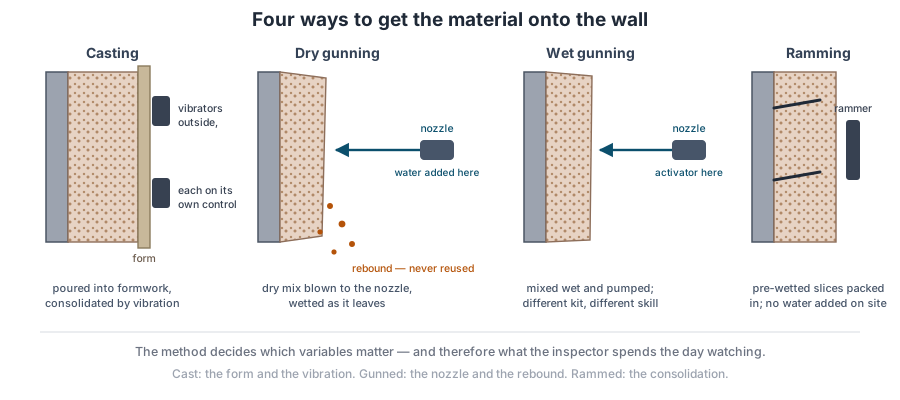
The installation method decides which variables stand between those two things — and therefore what an inspector actually spends the day watching.
Casting
Material is mixed with water, poured or pumped between the shell and a form, and consolidated.
The form is a structural component, not joinery. It has to carry the hydraulic head of wet refractory bearing against it and resist whatever mechanical load is imposed, vibration included. It must be waterproof and leak free — a form that leaks water is a form that is changing the water-cement ratio of the lining while you watch — and a manufacturer-approved release agent is used so it can be stripped without tearing the face off.
Mixer capacity is a quality control item, which surprises people. Mixing has to keep up: for casting and vibration casting the capacity must be enough that successive batches follow within about ten minutes, and for pump casting it must allow continuous operation without the pump stopping and starting while it waits for material. Every gap between batches is a potential cold joint.
Vibration is where casting is won or lost. Two or more vibrators are mounted externally on the equipment and attached by strapping or similar. They are explicitly not attached to nozzles, welded lugs or similar components, which were never designed to be shaken for hours. Each is independently controlled so vibration can be focused where material is still moving and withdrawn where it is already consolidated.
For pouring and pump casting, submersion vibrators or rodding may be used to help the material flow and fill the enclosure. That is a different thing from the external vibrators above, and it is the exception that makes the self-levelling rule worth remembering.
Dry gunning
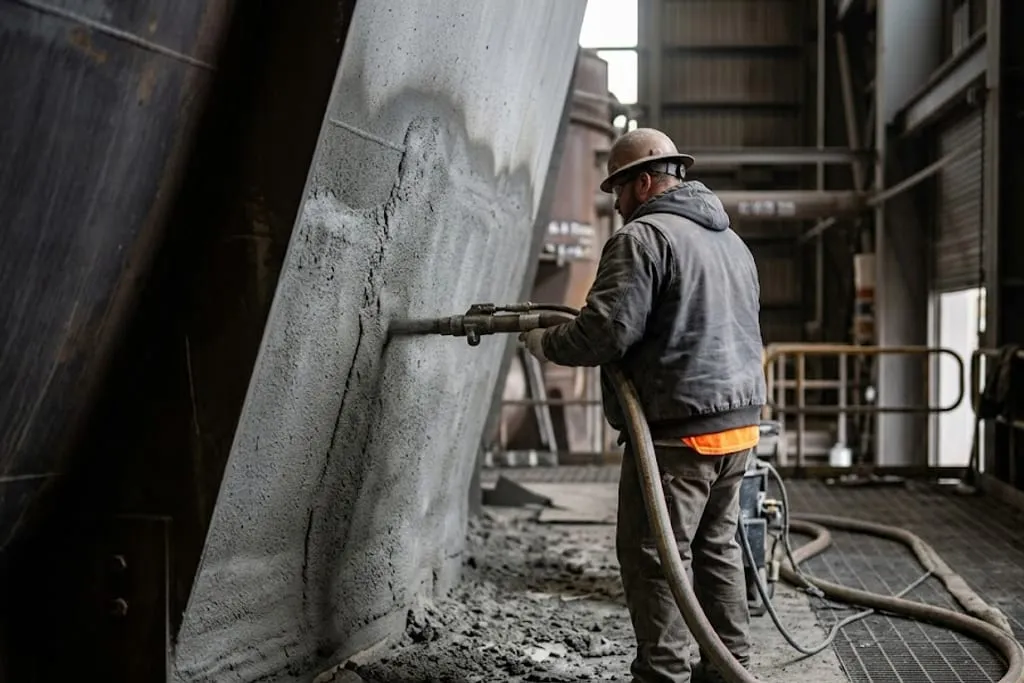
Dry or prewetted material is blown through a hose and water is added at the nozzle, so the mix is made in the last few inches before it hits the wall.
Prewetting before charging the gun reduces dusting and segregation and helps stop the feed hose plugging. How much water, how long it is mixed and how long it may age are set by the manufacturer and by the applicator’s qualification testing — not by the operator’s judgement on the day.
Rebound is the characteristic problem. Material that bounces off is not a random sample of the mix: the wetter, finer fraction tends to stick and the coarse aggregate tends to come back. So rebound is a different, poorer material, and it is not reused. Several rules follow from that one fact:
- Gunning starts at the lowest elevation and works upward, so rebound falls onto surfaces not yet lined, where it can be cleared.
- Gunning where rebound entrapment is likely is prohibited — the material goes on by casting, hand packing, or by repositioning the work instead.
- Downhand gunning at 30 degrees below horizontal is reviewed before installation rather than simply done, because that is the geometry where rebound has nowhere to fall but into the work.
Thickness and finishing. Shotboards, depth gauges or both establish thickness. Once coverage is confirmed the surface is trimmed back with a serrated trowel or currycomb — and the timing is narrow, typically fifteen to twenty minutes after placement, late enough that cutting does not damage the surface and early enough to be before initial set.
Wet gunning
Also called shotcreting. The material is mixed wet and pumped to the nozzle, where a flocculating or activating agent is added to make it stiffen on contact.
It is treated as a distinct technique rather than a variation of dry gunning, because it needs specialised equipment and a different skill set. Where it is chosen, the contractor and the manufacturer together prepare a detailed installation procedure and put it to the owner for approval — and every quality control element in the standard still applies.
The variables move but do not disappear: water goes in at the mixer rather than the nozzle, and the rate of activator addition joins the list of things set by the manufacturer and the applicator qualification rather than by eye.
Ramming and hand packing
Plastic refractory arrives already wetted to a workable consistency, in sealed packaging, and is rammed into place against the anchors.
The water content is not yours to adjust. Plastics are installed at the manufactured consistency, and field water addition or reconditioning is not permitted. If material needs reconditioning, the manufacturer does it under controlled plant conditions and the result is requalified. And dry or crumbly material is not installed under any circumstances — there is no judgement call available.
That removes the biggest variable in castable work and replaces it with two others:
- Shelf life and storage, because a plastic stiffens as it ages. Material is taken out of its wrapping only when it is ready to be applied.
- Consolidation, because density here comes from ramming energy rather than from a cement bond. The work surface used for cutting slices is kept clean, so that dried-out crumbs from earlier cutting do not get worked into fresh material.
Hand packing into hexmetal or hexalt cells is the thin-layer relative of this, used where the lining is too thin for anything else to grip.
Check your understanding
7 questions. Nothing is recorded — this is just for you.