
Process
Refractory anchoring — holding a ceramic lining onto a steel wall
Why a lining needs anchors at all, the V, Y, hexmetal and ceramic arrangements and where each belongs, why anchor tips are coated before the refractory goes on, and why an anchor is the part of the system most likely to decide when the lining fails.
Standards referencedAPI 936
A refractory lining is a ceramic shell hung on a steel one. It is heavy, it is brittle in tension, and it is attached to something that changes dimension at a different rate.
The anchors are what hold the arrangement together, and they are the part of it most likely to decide when the lining comes down.
Why anchors are needed at all
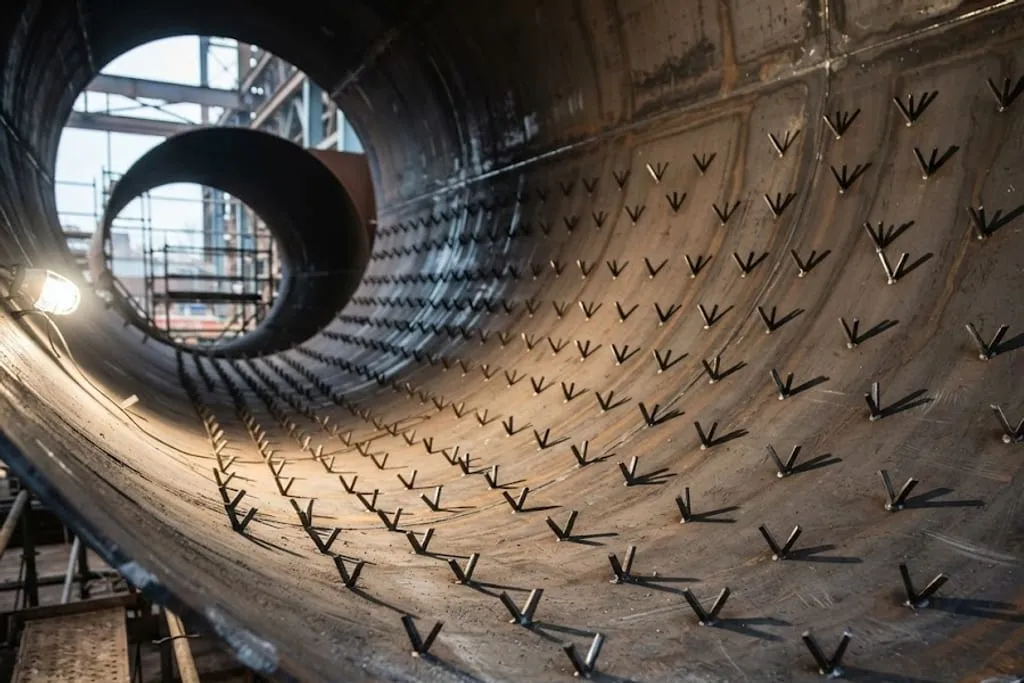
Refractory is strong in compression and weak in tension, which is fine for an arch and useless for a vertical wall or a roof. Four loads have to be carried back to the shell:
- Self weight, which on a roof acts straight down into nothing.
- Vibration, continuous on any unit with burners or moving gas.
- Pressure fluctuation, including the sharp ones from a trip or a purge.
- Differential thermal movement between a lining that wants to grow one amount and a shell that wants to grow another.
The common arrangements
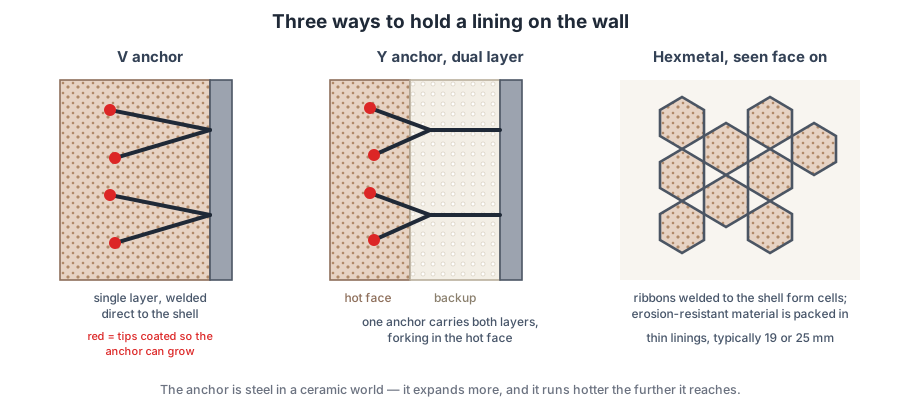
V anchors are the workhorse of single-layer linings — a bent bar welded to the shell at both ends, reaching into the refractory. Simple, cheap, and installed in enormous numbers.
Y anchors exist for dual-layer linings. A single stem crosses the insulating backup and forks into two legs within the dense hot face, so one anchor carries both layers and only one weld is made. The fork sits where the material can actually grip it.
Hexmetal solves a different problem. Where the lining is only 19 or 25 mm thick — a thin erosion-resistant layer in a cyclone or a transfer line — there is no depth for a conventional anchor to reach into. Ribbons of metal are welded into hexagonal cells and the material is packed into each cell, so the lining is held in small independent pockets rather than as one sheet. Hexalt anchors do the same job as individual pieces rather than a continuous mesh.
Ceramic anchors take over where metal cannot survive. Above the temperature at which the alloy softens or oxidises away, the anchor itself has to become refractory, and the usual case is a roof — the hottest place, carrying the lining directly against gravity.
Why the tips are coated
This one catches people out, because it looks like a bonding problem and is the opposite.
A steel anchor expands more than the refractory it sits in. Heated, it tries to grow into material that is not growing as fast, and a stiff anchor tip jacking against brittle ceramic cracks it from the inside.
So the tips are coated with something ablative or compressible — it burns off or crushes in service and leaves a small void. The anchor grows into that void instead of into the lining.
Note what is not done: the coating is kept to the tips. Coating the whole anchor would remove the grip that holds the lining in place, which is the anchor’s entire purpose. It is a deliberate, local allowance for movement, not a release agent.
Layout
Spacing follows the lining — thickness, material, orientation and temperature — and comes off the design drawings rather than from habit. Two patterns are worth knowing:
- Staggered rather than square. Anchors on a staggered grid avoid lines of weakness running continuously across the lining. A square grid gives shrinkage cracking a straight path to follow.
- Closer in roofs than in walls. A roof anchor carries the lining against gravity rather than merely holding it against a wall, so the spacing tightens — often substantially.
What the inspector is actually checking
Anchors are the last thing visible before the refractory covers them permanently, which concentrates a great deal of inspection into a short window.
Material. Each alloy anchor is identified by stamping, laser etching, or supply in sealed traceable packaging. Where that identification is absent, positive material identification before installation is what establishes the alloy — and the same applies to unmarked hexmetal sheet. The failure this prevents is a lower alloy than specified ending up where the temperature demands the higher one, which nobody discovers until the lining falls off.
Welds. Anchor welding is a production weld like any other: a qualified procedure, a qualified welder, and examination. Stud welding uses a resistance arc machine with a timer and a gun, which makes consistency a matter of machine settings as much as operator skill.
Geometry and pattern. Spacing, projection, orientation and the pattern itself, against the drawing.
Damage. If an anchor or its attachment weld is damaged, the anchor is replaced to the original requirements. Leaving it because the neighbours look sound ignores that the neighbours now carry its share.
Check your understanding
7 questions. Nothing is recorded — this is just for you.