
Process
Inspecting an installed refractory lining — and repairing it properly
What an inspector looks for once the material is on the wall, why hammer test criteria come from the specification rather than the standard, and the repair rules that matter most — cut out entirely, never build up over existing material, and get the method approved first.
Standards referencedAPI 936
Once the material is on the wall, most of what went into it is invisible. Water content, mixing time, consolidation, rebound — all of it is now inside a grey surface that looks much the same whether it was done well or badly.
Inspection at this stage is partly about finding defects and largely about having established, earlier, what a defect is.
What is being looked for
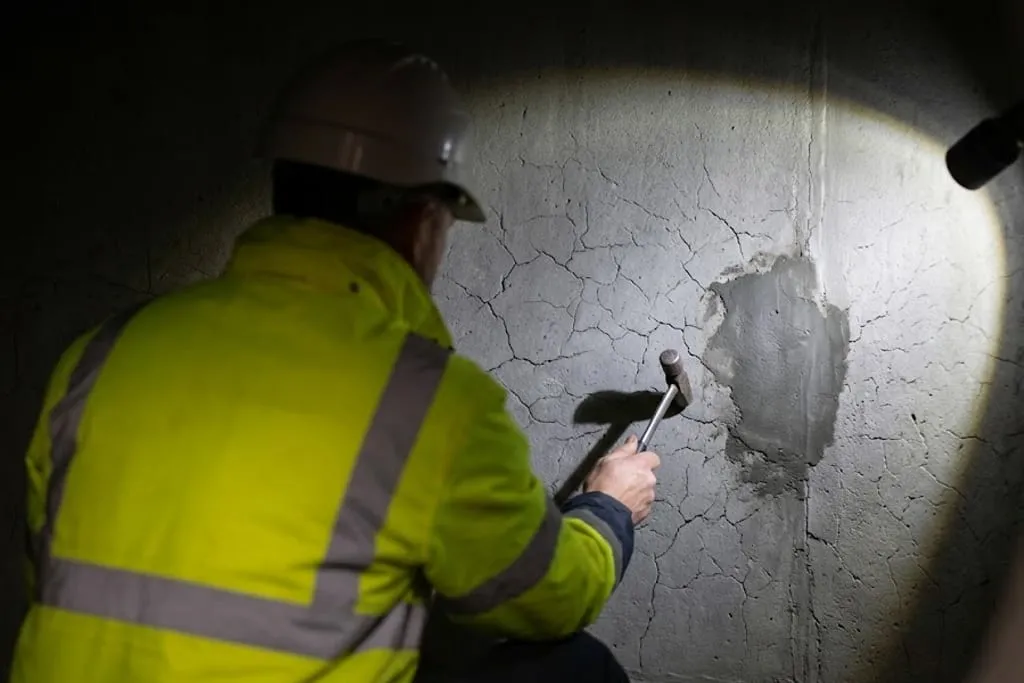
The defect types are the familiar ones, and each traces back to an installation variable:
- Voids — material that never filled, usually poor consolidation or a mix too dry.
- Laminations — layers that did not bond, the signature failure of interrupted gunning.
- Nonuniformities — density or appearance varying across an area.
- Entrapped rebound — the coarse fraction that bounced, buried by the next pass.
- Cracking — some of it expected, some of it not.
- Hollow areas — material that has lost contact behind the face.
These are exactly the things a qualification panel is sectioned and examined for before work starts. The same list applies to the real lining; the panel simply establishes that this crew, with this material, can avoid them.
The criteria do not come from the standard
This is the point that surprises people, and it is worth getting straight.
API 936 requires that criteria for hammer testing, and the extent of cracking and surface voids permitted, be specified — it does not tabulate them itself. They are a job specification matter.
The practical consequence is blunt: an inspector who does not have that part of the specification cannot accept or reject anything. Not because they lack judgement, but because acceptance against a personal standard is not acceptance against the contract.
Hammer testing itself is simple and informative: tap the lining and listen. A sound lining rings; a hollow one gives a dull response that tells you material has lost contact behind the face. What it cannot tell you is how deep or how extensive the problem is, which is why it screens rather than measures — a hollow response directs further investigation rather than settling the question.
Some cracking is normal. Shrinkage cracks form a distributed network as a lining dries and fires, and that network is the system’s expansion allowance. The question is never “is there cracking” but whether the cracking is distributed as expected or concentrated where it should not be.
Repairing properly
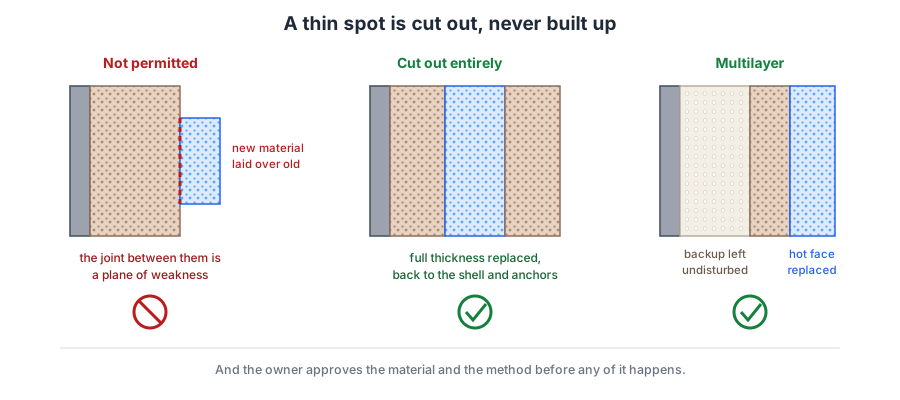
Four rules carry most of the weight:
Below minimum thickness means cut out entirely. Not trimmed back, not made up — the section comes out and is replaced.
Material is never placed over previously applied material to build up thickness. Fresh refractory does not bond to set refractory the way a continuous placement bonds to itself, so what you create is two layers with an interface between them. That interface will separate, and it will do so at the point the lining was already thin.
In a multilayer lining, the hot face comes off without disturbing the backup. Removing sound backup makes work, risks damaging serviceable anchors, and commits the whole system to being cured and dried out again.
The owner approves the material and the method before the repair is made. Before — a repair already executed is far harder to refuse than a proposal on paper.
Preparing the repair area
Immediately before new material goes in, the sound refractory adjacent to the repair is:
- cleaned of debris,
- roughened, and
- completely prewetted — with potable water, enough to dampen thoroughly without running down or puddling, or with membrane curing compound, phosphate-bonded mortar, or a weak phosphoric acid.
The prewetting is not cosmetic. Dry existing refractory is absorbent and will pull water straight out of the new placement, starving the bond exactly where it is most needed.
Anchors and shell are cleaned of refractory and debris, and new anchor leg coverings are installed where applicable — the old tip allowance has been used up or destroyed. And if an anchor or its attachment weld is damaged, it is replaced in accordance with the original installation.
The record
The contractor prepares records identifying and locating all repaired areas and field joints, typically as a map, including:
- the reason for each repair,
- the means of repair, and
- the refractory used.
That last item is not bookkeeping. Where the repair material differs from the surrounding lining, its installation procedure, curing and dryout requirements may differ too — so the next person to heat that vessel needs to know there is a different material in it, and where.
Check your understanding
7 questions. Nothing is recorded — this is just for you.