
Process
Testing refractory — the five quality control tests and what each proves
Density, cold crushing strength, permanent linear change, abrasion loss and workability index — what each measures, why the testing laboratory must be independent of the refractory contractor, and why a gunned specimen is crushed in a different direction from a cast one.
A refractory specification is a list of numbers the material must achieve. Testing is how anybody finds out whether it did — and, more importantly, whether what was installed still resembles what was specified.
That second question is the whole point. The manufacturer can demonstrate properties in their own laboratory. What matters is the material that came out of a site mixer, through a site hose, at site water content.
The five tests
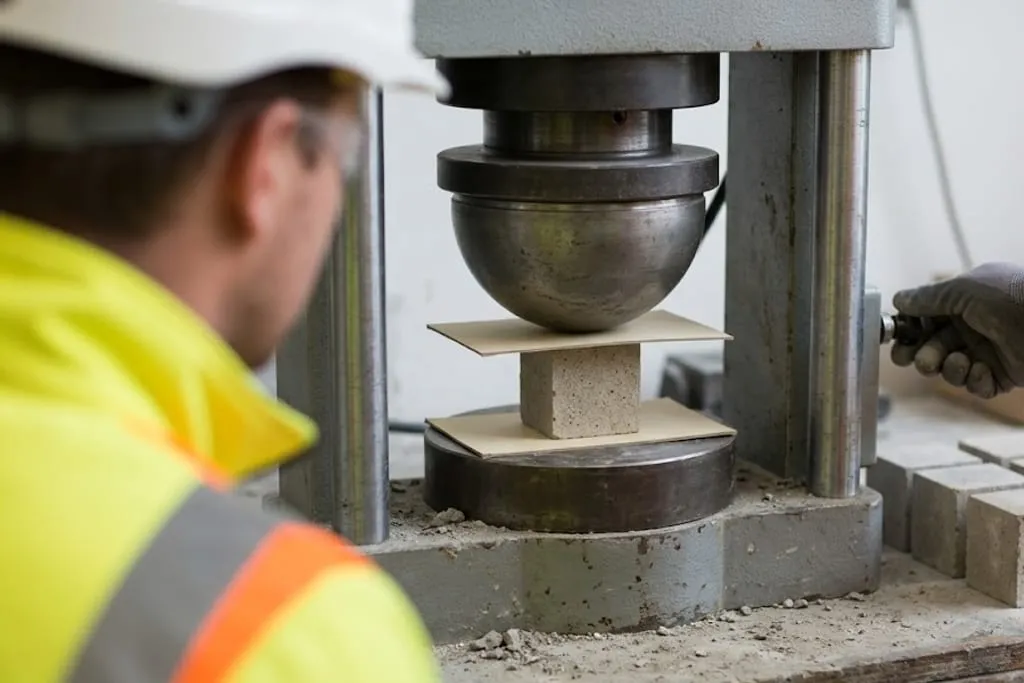
Quality control testing is a defined set rather than a judgement call:
| Test | What it answers |
|---|---|
| Density | Did the material consolidate as it should? |
| Cold crushing strength | How much compressive load does it carry? |
| Permanent linear change | Does it stay the size it was after firing? |
| Abrasion loss | How well does it resist moving solids? (where applicable) |
| Workability index | Is the plastic in usable condition? (plastics only) |
Anything beyond those is an owner requirement and belongs in the owner’s specification. If a test is wanted and is not on that list, it has to be asked for in writing — it will not happen by default.
Density is the quiet one. It looks like a materials property and is actually an installation report card. A low density on a production sample usually means too much water, poor consolidation, or both — the two commonest site failures, caught by the simplest test.
Who does the testing
The laboratory is subject to audit and approval by the owner, and must not be affiliated with the refractory contractor.
That is an independence requirement, and it is there for the same reason the inspector does not report to the installer: the party whose work is being judged should not be grading its own homework. Accreditation alone does not satisfy it — a perfectly competent accredited laboratory that belongs to the contractor is still the wrong laboratory.
Which ASTM method is which
Four methods are named, and the exam expects them straight:
- C133 — cold crushing strength and modulus of rupture. Two different strengths in one method: crushing is compressive, modulus of rupture is in bending.
- C113 — reheat change of refractory brick, the permanent linear change measurement.
- C181 — workability index, for fireclay and high-alumina plastics.
- C704 — abrasion resistance at room temperature.
Testing is in strict accordance with the ASTM procedure, as modified by API 936 where the standard says so. The modifications are not optional refinements; they are what makes the result comparable between laboratories and jobs.
How a cold crushing strength cube is set up
This is where the modifications bite, and where the detail is worth knowing.
Flatness. The loading surfaces must be parallel to within about ±0.8 mm and perpendicular to within about one degree, whether the specimen was cast or gunned. A cube out of square takes its load on an edge.
The spherical bearing block on the loading head exists for the same reason — it lets the platen seat itself against a face that is never perfectly true.
Bedding. Noncorrugated cardboard shims go between the specimen and the loading surfaces, roughly 75 × 75 × 1.5 mm, and new shims are used for every cube. Reusing a shim that has already been crushed flat in one place defeats the purpose.
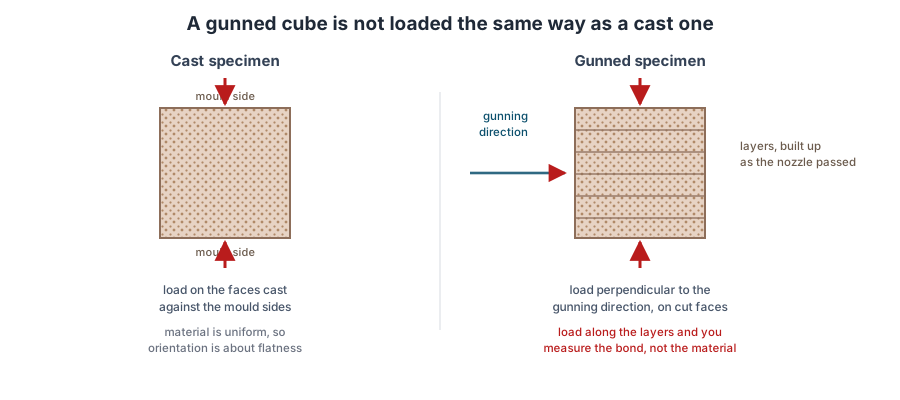
Orientation, which matters most.
- For cast or hand packed specimens, load is applied to faces that were cast against the sides of the moulds. Where a specimen is cut from a larger panel, an open face is not used as a loading face.
- For gunned specimens, load is applied perpendicular to the gunning direction, on cut faces perpendicular to the panel face.
Specimens are also fired before the crushing test, to a temperature and in a manner the standard defines, so the figure reported is for material that has seen heat rather than for green material straight out of the mould.
Reading a result
Three habits make test results useful rather than decorative:
- Compare against the manufacturer’s compliance value, not against a general expectation. The specification is a particular material, not refractory in general.
- Treat a low density as an installation question first. It is more often water or consolidation than a bad batch.
- Ask what the specimen was. A production sample from the work tells you about the lining. A specimen made in ideal conditions beside it tells you about the material. They are different questions and both get asked.
Check your understanding
7 questions. Nothing is recorded — this is just for you.