
Process
Refractory materials — castable, plastic, gunning mix and fibre
What each monolithic refractory family is, why a lining is usually two layers rather than one, the properties that trade against each other when a material is chosen, and why strength and insulation pull in opposite directions.
Standards referencedAPI 936
Refractory is the lining that lets a steel vessel contain something far hotter than steel can survive. A fired heater firebox runs well above 1000 °C; the shell outside it is ordinary carbon steel with a service limit a few hundred degrees lower. The refractory is what makes that arrangement possible.
It does two jobs at once, and they are worth separating because they pull in opposite directions:
- Protect the steel from heat, from flame, from abrasion and from chemical attack.
- Keep the heat where it is wanted, rather than losing it through the wall.
Why a lining is usually two layers
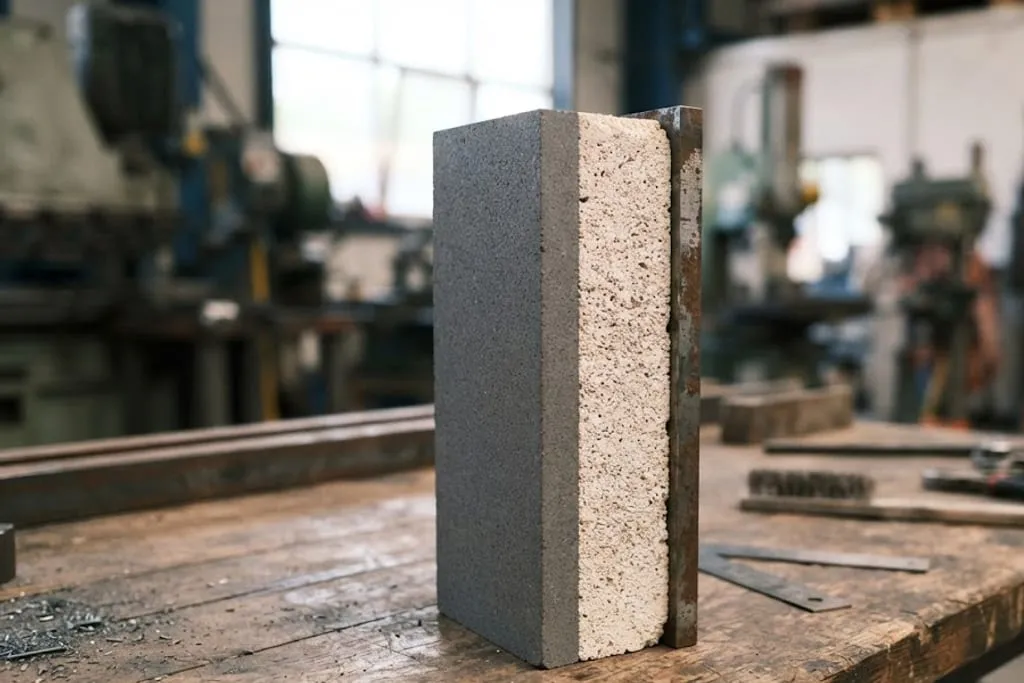
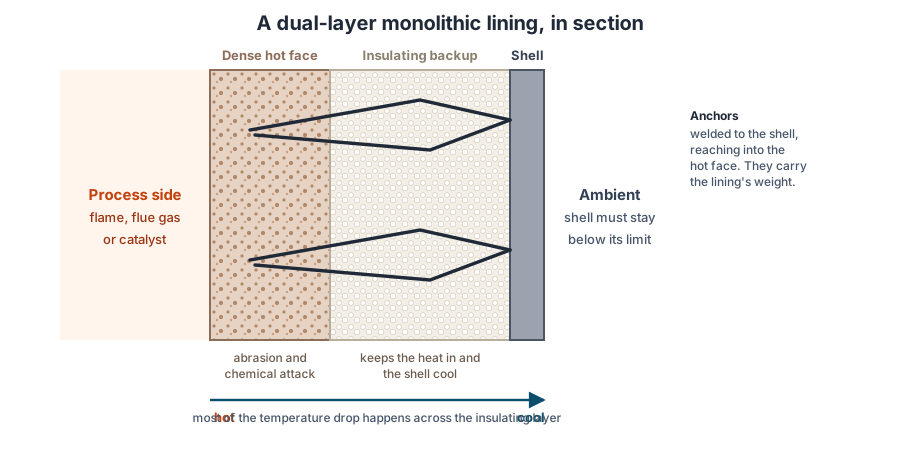
No single material is good at both jobs, because the property that gives strength is the same property that conducts heat.
Density is the hinge. A dense material has solid, well-bonded grains touching each other — and that continuous solid path is exactly what conducts heat. Make the material porous and you break the path, so heat struggles to cross; but you have also removed most of the material that was carrying load.
So:
- A dense refractory resists abrasion and chemical attack well, and insulates poorly.
- An insulating refractory does the reverse.
Putting a thin dense layer at the hot face and a thicker light layer behind it gives both. The hot face takes the mechanical and chemical punishment; the backup takes the temperature gradient.
The monolithic families
API 936 is about monolithic refractory — material installed as one continuous mass rather than built from pre-fired shapes. That distinction matters more than it sounds.
With brick, the material’s quality was settled in a factory under controlled conditions, and the site work is bricklaying. With a monolithic, the material is manufactured on site, out of a bag, by whoever is holding the hose or the trowel. Water content, mixing time, placement and curing are all decided there — which is precisely why there is a certification for the people who inspect it.
Castables
Supplied dry, mixed with water on site, placed by pouring or pumping into formwork and consolidated by vibration. The workhorse of refractory linings.
They divide by how much calcium aluminate cement they contain:
- Conventional castables carry the most cement, need the most water, and are the most forgiving of rough handling. The water is the price — it leaves porosity behind when it is driven off, so strength and abrasion resistance suffer.
- Low cement and ultra-low cement castables replace much of the cement with fine reactive powders. Less cement means less water, which means a denser, stronger, more abrasion-resistant lining. They are also far less tolerant of being mixed wrong or dried out badly.
- Self-flowing castables are formulated to fill a form under their own weight with little or no vibration, which is valuable where a vibrator cannot reach.
Plastics and ramming mixes
Plastic refractories arrive already wetted, in a stiff putty-like condition, usually as slabs in sealed packaging. They are rammed into place against anchors with a pneumatic hammer or by hand.
Because the manufacturer set the water content, one of the big site variables is removed. The trade is shelf life — a plastic stiffens as it ages and eventually becomes unworkable, so storage conditions and age at installation genuinely matter.
Ramming mixes are similar in placement but drier and stiffer, relying almost entirely on mechanical compaction rather than any cement bond to develop density.
Both are favoured where thermal shock and mechanical abuse would crack a cast lining, because a rammed lining has no formwork-induced cold joints and tends to be tougher.
Gunning mixes
Gunning blows dry or semi-dry material through a hose and adds water at the nozzle, firing it at the surface where it builds up in place.
What it buys is speed and access. No formwork, no vibration, large areas and awkward overhead geometry covered quickly, and repairs possible without dismantling anything.
What it costs is consistency:
- Rebound — material that bounces off rather than sticking — varies with angle, distance and pressure, and the rebounded fraction is not the same mix that stuck.
- Water is added by an operator at the nozzle, by eye, continuously.
- Nozzle distance and angle change the density of what lands.
That is why gunning is the method where operator qualification carries the most weight, and why production samples are taken from the work itself rather than from the bag.
Ceramic fibre
A low-density mat or blanket of ceramic filaments, supplied as blanket, board, or stacked modules anchored to the shell.
Nothing insulates better for the weight. It is also almost entirely air, so it has essentially no strength, no abrasion resistance, and it will erode where gas moves across it fast. It is a backup and a lightweight-lining material, not a hot face in an abrasive duty.
It also shrinks on first heating and can devitrify over time at high temperature, becoming brittle — which is why an old fibre lining that looks intact can crumble when touched.
Choosing between them
Four questions decide most selections:
- How hot does it get, and for how long? This sets the material class before anything else, and the figure that matters is the temperature at the hot face, not the process bulk.
- Is anything moving against it? Catalyst, ash, particulate or high-velocity gas pushes you toward a dense, abrasion-resistant hot face.
- Is anything attacking it chemically? Alkalis, sulphur, carbon monoxide and slag each have their own preferred material answers, and the wrong choice fails fast.
- Does it cycle? Equipment that heats and cools repeatedly punishes a rigid, strong lining more than a tough, slightly yielding one. Thermal shock resistance can matter more than peak strength.
What this means for the inspector
Everything above is why the API 936 certification exists in the form it does.
The material arrives in a bag with properties the manufacturer can demonstrate in a laboratory. What ends up on the wall is a different material — made on site, with site water, by site people, cured in site conditions. The gap between those two is where refractory failures live.
So the inspection effort concentrates on the things that move that gap: water, mixing, placement, curing and dryout. The laboratory tests exist to confirm that what was installed still resembles what was specified.
Check your understanding
7 questions. Nothing is recorded — this is just for you.