Mechanical
Welder qualification and continuity — the ranges a ticket covers, and the register nobody updates
What a welder performance qualification actually establishes, the ranges it carries in thickness, diameter, position and process, how continuity lapses at six months, and why the expired ticket is always found after the weld is made.
Standards referencedASME Section IXASME B31.3API 577AWS D1.1
The procedure qualification shows the recipe works. Reading a WPS and a PQR covers that. This one is about the other half: can this particular person follow it?
That is a manual skill, demonstrated by welding a coupon and testing it. It is not a knowledge test and it is not transferable by reputation.
What the ticket actually covers
A WPQ is not a general licence to weld. Like a PQR, the coupon establishes ranges, and the welder may work inside them and not outside.
| Variable | What the coupon establishes |
|---|---|
| Process | Essential. SMAW does not cover GTAW — the manual skills are genuinely different |
| Thickness | A band derived from the coupon thickness |
| Diameter | A range, with small bore treated separately |
| Position | Qualifying in one position may or may not cover others |
| Filler | By F-number group |
| Backing | Welding with backing does not necessarily qualify without it |
Continuity, and how it lapses
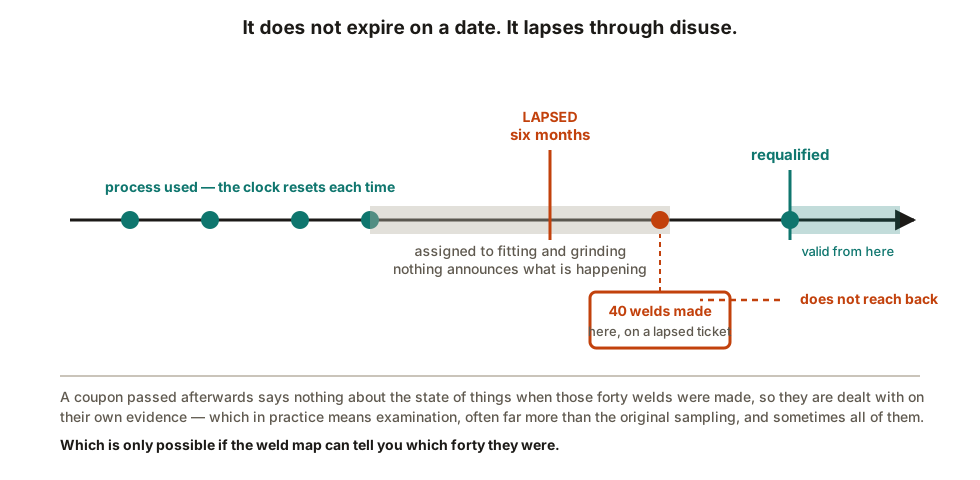
A WPQ does not expire on a printed date. It lapses through disuse: the usual trigger is six months without using the process.
Which means it can expire quietly in the middle of a long project, when somebody has spent half a year fitting, grinding or on another process entirely. Nothing announces it.
It is re-established either by rewelding and retesting a coupon, or — far cheaper — by a documented record that the welder used the process within the period. That record is the continuity register.
What a lapse actually costs
A renewed qualification does not retrospectively cover welds made while it was lapsed. The purpose of the record is that the skill was demonstrated before the work relied on it; a coupon passed afterwards says nothing about the state of things at the time.
So those welds have to be dealt with on their own evidence. In practice that means examination — often a much higher percentage than the original sampling, sometimes one hundred per cent of what that welder touched in the period. Which is only possible if you can establish what they touched.
The weld map
Hence the weld map, which is the document that makes all of this tractable. It records, for every weld: the weld number, the welder, the procedure, the date, and the examination applied.
It works in both directions, and both matter:
- Backwards from a failed radiograph to a welder and a procedure — which is what progressive sampling needs to function at all.
- Forwards from a lapsed qualification or a suspect batch of consumables to every weld it touched.
Without it, both questions are unanswerable and the only safe answer is the expensive one.
The review before welding starts
Filing certificates proves they exist. The review that finds problems is a matrix:
- The joints in the package — process, material, thickness, diameter, position.
- The procedures that cover them.
- The welders available, and for each, the ranges their WPQ established and their continuity status.
- Map welders onto procedures onto joints, and find the gaps.
Done at mobilisation, a gap is a planning problem — bring in another welder, qualify somebody, resequence. Done at document review, the same gap is a weld already in the line.
What to take away
- A WPQ evidences this person’s manual skill, not the procedure and not their knowledge.
- It carries ranges — process, thickness, diameter, position, filler, backing — and process is essential.
- 6G covers the most, because a fixed inclined pipe forces every position in one joint.
- Continuity lapses at six months of disuse, not on a date.
- The cheapest renewal is a documented record of use — which requires a register somebody actually keeps.
- A renewed ticket does not cover work done while lapsed.
- The weld map is what makes traceability work in both directions.
- Review as a matrix before welding, not as a filing exercise afterwards.
Check your understanding
10 questions. Nothing is recorded — this is just for you.