
Civil & Structural
Frost heave and sub-soil heating
Frost heave is not water expanding by nine per cent. It is ice lenses growing by sucking water towards the freezing front, which is why heave can be hundreds of millimetres and why silt is far more dangerous than clay. Under a cryogenic tank the freezing front never goes away.
Most engineers meet frost heave as a line in a textbook: water expands by nine per cent when it freezes, so the ground lifts a bit.
That explanation accounts for almost none of the damage. If nine per cent of the pore water were the whole story, a saturated soil with 30% moisture content freezing through a metre would heave by about 3 mm, and nobody would build heating systems to prevent it.
Real frost heave reaches hundreds of millimetres, because the ice does not stop at the water that was already there.
What actually happens: ice segregation
Picture a freezing front advancing slowly down through a fine-grained soil.
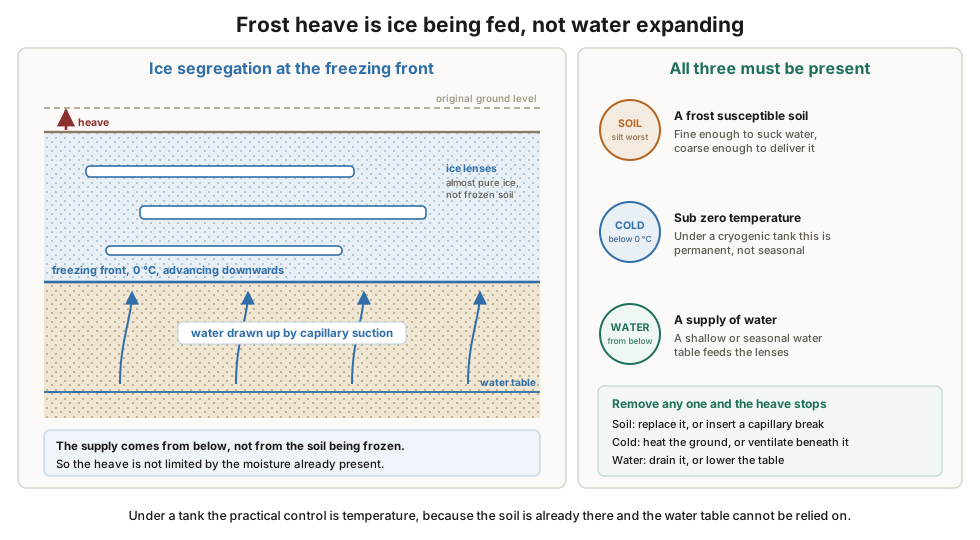
At the front, water turns to ice. Removing liquid water from the soil at that point lowers the pore water pressure there, and that creates a suction — exactly the same capillary suction that draws water up through a fine soil above the water table.
That suction pulls more water towards the front from the unfrozen soil below. The new water arrives, freezes, and adds to the ice already there. The suction persists, so more water comes.
The result is not frozen soil with slightly expanded pore water. It is a layer of almost pure ice — an ice lens — growing inside the soil, lifting everything above it. And because the water supply comes from below rather than from the soil being frozen, the heave is not limited by the original moisture content at all.
Why silt is the dangerous soil
Ice segregation needs two things from the soil, and they pull in opposite directions:
- Capillary suction, to pull water towards the front. Suction rises as the pores get finer.
- Permeability, to actually deliver that water fast enough to feed a growing lens. Permeability falls as the pores get finer.
| Soil | Suction | Permeability | Frost susceptible? |
|---|---|---|---|
| Clean sand and gravel | Negligible | High | No — nothing pulls the water up |
| Silt | High | Moderate | Severely — it has both |
| Clay | Very high | Very low | Mildly — the water cannot arrive fast enough |
This is why the design question is never “is the ground wet and cold” but “is there silt”. It is also why a frost-susceptible layer can be dealt with by replacing it with a clean granular fill, which has no suction, or by inserting a capillary break that the water cannot cross.
Under a cryogenic tank it is a different problem
Seasonal frost heave in a cold climate is bounded. The front reaches a certain depth, winter ends, and it thaws out again. Buildings are founded below the frost line and the problem is over.
A cryogenic tank is a permanent cold source. The front does not reverse at the end of the season; it keeps advancing, and the frozen bulb beneath the tank keeps growing, for as long as the tank is in service.
Three consequences follow:
- The heave accumulates over years rather than cycling.
- It is never uniform. The ground varies, the cold is strongest at the centre, and the resulting lift is a dome — out-of-plane distortion, which is the one movement a tank cannot tolerate. See tank settlement surveys.
- It does not reverse quickly. A frozen bulb tens of metres across holds an enormous amount of latent heat. Thawing it out takes years even with heating restored, and the thawed soil comes back weaker and wetter than it started.
Keeping the ground warm
Two arrangements, covered in detail in LNG tank foundations and base mats:
A ventilated void under an elevated base, which uses ambient air and no energy at all. This is the preferred solution wherever the height and layout allow it, for the simple reason that there is nothing to fail.
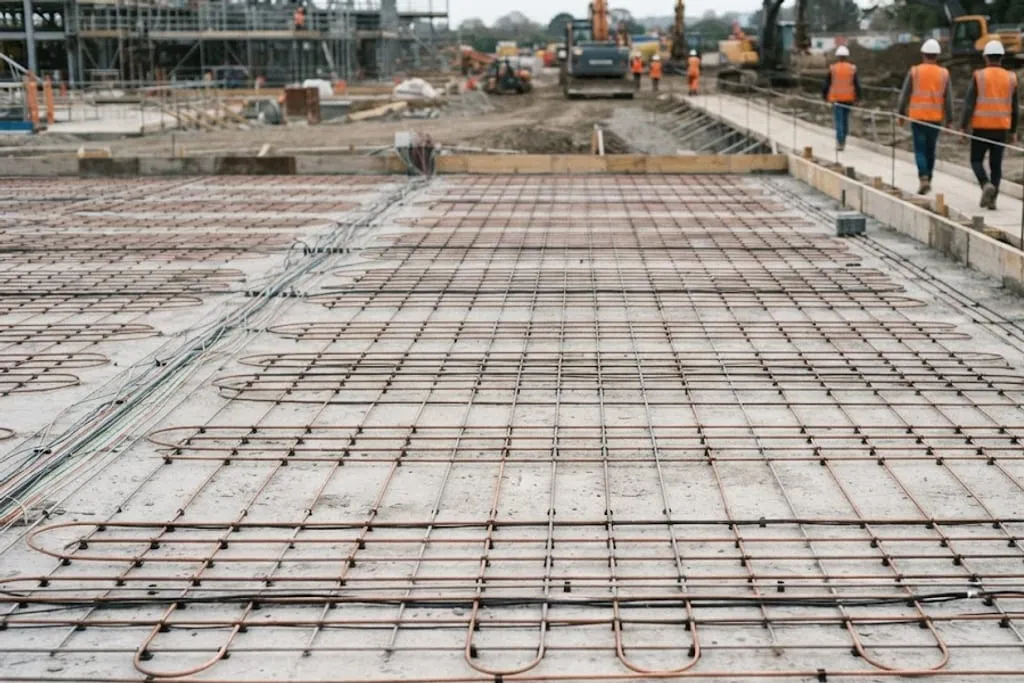
A heating system cast into an on-grade base, which is what the photograph at the top of this page shows. Either electric resistance cables or circulating glycol loops, designed to hold the soil above freezing with a margin — a design target of around +5 °C at the coldest point is typical, not 0 °C, because the margin covers prediction error and local variation.
The design features that matter:
- Full redundancy. Cast-in cables cannot be replaced. Systems are built with duplicate circuits, each able to carry the whole duty, and often with spare cables installed and left unconnected.
- Replaceability where it can be had. Glycol circulated through conduits cast into the slab can be withdrawn and replaced; the conduit stays. Several operators specify glycol for that reason alone.
- Hazardous area compliance. The heating is electrical equipment in a classified area, so it carries the appropriate protection concept — see hazardous area basics.
- Uniform coverage. Heat is applied across the whole footprint and more densely at the perimeter, where the ground loses heat sideways as well as upwards.
Monitoring is the part that actually fails
Thermocouples or RTDs are cast into the slab and installed in the ground beneath, at several depths and several radii, and they are read for the life of the tank.
The value is leading indication. By the time a tank has visibly lifted, a large frozen bulb already exists and the problem is years old. A downward trend in the deep sensors is visible long before anything moves.
Which means the failure mode is almost never the instrumentation. It is organisational:
- A heating circuit trips and is reset without anyone asking why it tripped.
- A nuisance alarm is inhibited “temporarily” and stays inhibited.
- The readings are logged faithfully for a decade and never plotted, so a slow trend that is obvious on a graph is invisible as a column of numbers.
- The ventilated void under an elevated tank is gradually blocked by cable trays, stored materials or landscaping, and nobody owns it because it is not a system.
Where else this bites on a plant
Frost heave is not only a tank problem. Anywhere cold reaches the ground for long enough:
- Cryogenic pipe supports and sleepers, where an uninsulated support conducts cold straight into its plinth and the ground below. The photograph on what cold does to concrete shows exactly this.
- Vaporiser and cold box foundations, which run cold continuously.
- Buried cryogenic lines, which drag a frozen cylinder along with them and can lift a road or a paved area above.
- Liquid nitrogen and oxygen storage, which is colder still than LNG and frequently sits on a simple slab because the quantities are smaller.
What to take away
- It is ice segregation, not expansion. The water comes from below, so the heave is unbounded by the moisture already present.
- Silt is the dangerous soil, because it alone has both suction and permeability.
- Under a tank the front is permanent, so heave accumulates and is never uniform.
- Thawing it out leaves weaker ground than before. The heave is followed by a settlement.
- Three conditions, three controls. Change the soil, keep it warm, or cut off the water.
- The system that fails is the monitoring regime, not the sensors.
Check your understanding
6 questions. Nothing is recorded — this is just for you.