
Civil & Structural
Tank settlement surveys
A tank can go down a long way without complaint, and tilt without much trouble, but it cannot take being bent. The survey exists to separate those three things, because only one of them actually threatens the shell.
A large storage tank is a thin steel shell standing on soft ground. It is one of the few structures routinely built with a settlement expectation measured in hundreds of millimetres and a distortion tolerance measured in tens.
Both of those statements are true at once, and the survey exists to tell them apart.
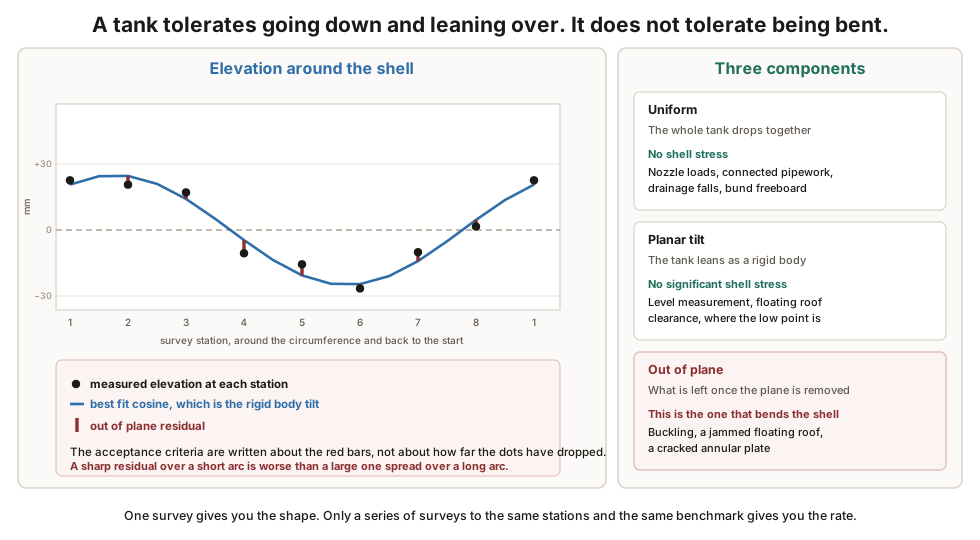
Three movements, only one of which matters to the shell
Take elevations at points around the base of the shell and the result decomposes into three parts.
Uniform settlement. The whole tank drops together. The shell does not change shape, so it sees essentially no stress from this at all. What it does affect is everything attached to the tank — nozzle loads, connected pipework, platform and stair connections, the drainage falls, and the freeboard left in the bund. A tank that has gone down 300 mm has very likely taken its inlet pipework with it.
Planar tilt. The tank leans. Again this is a rigid-body motion, so the shell itself is largely unbothered. The consequences are operational: the level gauge no longer reads the volume you think it does, a floating roof runs closer to one side, the drain sump may no longer be at the low point, and in extreme cases the overturning check needs revisiting.
Out-of-plane settlement. This is what is left when the best-fit plane has been removed, and it is the one that distorts the shell. The base is being forced into a shape that is not a plane, so the shell has to deform to follow it. Enough of it and the shell buckles, the floating roof jams, the bottom-to-shell weld is overstrained, and the annular plate cracks.
How the survey is actually done
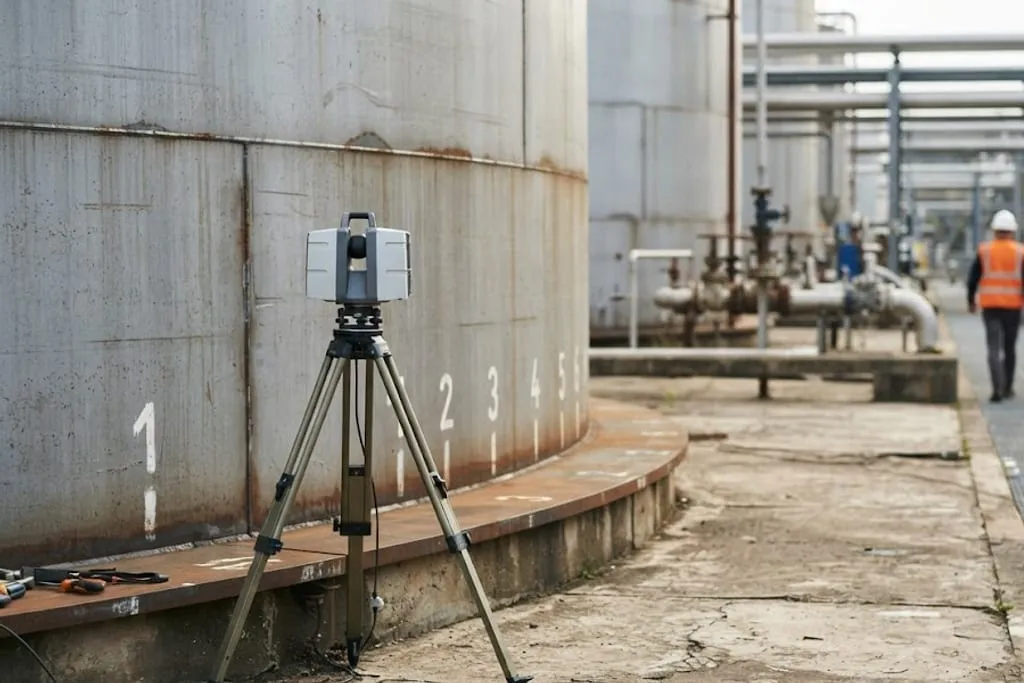
The stations. A minimum of eight points around the circumference, spaced no more than about 10 metres apart, so a bigger tank gets more points rather than the same eight stretched further. They are marked permanently on the shell — the painted numbers in the photograph — and they do not move for the life of the tank. A survey taken at different points is a different survey.
The datum. A benchmark on stable ground outside the tank’s zone of influence. Not the bund wall, which settles with the tank. Not a nearby foundation, for the same reason. Its position and description go into the record, because the next survey has to use the same one and may be twenty years away.
The instrument. A precise optical or digital level with an invar staff remains the reference method and is perfectly adequate. A total station or a laser scanner, as in the photograph, is faster, records far more than the eight points, and gives a shell profile as a by-product — but it does not change the criteria, and it introduces its own registration errors that have to be controlled.
The conditions. Record the fill state, the date, the instrument, the benchmark and the operator. The elastic component of movement comes back when a tank is emptied, so comparing a full-tank survey with an empty-tank one mixes recoverable deflection into what is supposed to be a settlement trend.
Judging the result
The acceptance criteria for out-of-plane settlement are set out in API 653, Annex B, and the calculation should be done from the annex rather than from memory. The shape of the rule is worth understanding, though:
- The permissible out-of-plane deflection increases with the spacing between points — a gentle dip over a long arc is far less damaging than a sharp one over a short arc.
- It increases with the allowable stress of the shell material.
- It decreases as the tank gets taller, because a taller shell has more to lose by buckling.
Which is the engineering point in one line: sharpness matters more than depth. A tank that has settled 250 mm smoothly is in better condition than one that has settled 60 mm with a kink in it.
Rate, not just magnitude
Settlement is not a number, it is a trend. Plotted against the logarithm of time, primary consolidation settlement usually produces something close to a straight line, which is why a few surveys over the first years let you project what the tank will eventually do.
| Pattern | What it usually means |
|---|---|
| Large settlement, decaying rate | Normal consolidation. Projectable, usually benign |
| Small settlement, steady rate | Secondary creep. Watch it, but rarely urgent |
| Any settlement that is accelerating | Something has changed. Investigate before anything else |
| A step change between two surveys | Suspect an event, a leak, or a survey error |
| Rising rather than settling | Heave. See frost heave and sub-soil heating |
That last row is not a curiosity on a cryogenic facility. A tank that goes up is the signature of a frozen bulb forming beneath it, and the settlement survey is often the first place it shows.
When the answer is that it has moved too much
There are three broad responses, in increasing order of pain:
- Derate. Reduce the maximum fill height so the shell stresses come down. Cheap, immediate, and it costs storage capacity for the rest of the tank’s life.
- Relevel. Jack the tank and re-shim or rebuild the foundation under the low region. A major operation, requiring the tank out of service and empty, but it restores the geometry.
- Rebuild the foundation. Where the cause is the ground rather than the tank, and it will simply happen again otherwise.
Choosing between them depends on why it moved, which is why the survey is the beginning of the investigation rather than the end of it. The foundation arrangements that produce or prevent these problems in the first place are covered in LNG tank foundations and base mats.
What to take away
- Three components: uniform, tilt and out-of-plane. Only the third one bends the shell.
- The best-fit cosine is the tilt. What is left over is what gets judged.
- Eight points minimum, permanently marked, never moved.
- A stable benchmark away from the tank, described in the record for the next surveyor.
- Sharpness beats depth. A kink is worse than a large smooth settlement.
- Rate matters as much as magnitude, and accelerating or upward movement is the finding that should stop everything else.
Check your understanding
6 questions. Nothing is recorded — this is just for you.