
Civil & Structural
What cold does to concrete
Concrete gets stronger as it gets colder, which is the most misleading fact in cryogenic civil engineering. Strength is not the governing property — contraction, brittleness and the loss of toughness in the reinforcement are, and all three move the wrong way.
Ask most engineers what happens to concrete at −165 °C and they will say it gets brittle and weak. Half of that is right.
Concrete gets stronger as it gets colder — considerably stronger. That single fact, taken on its own, has produced more bad cryogenic reasoning than any other, because it invites the conclusion that cold is a benign condition. It is not. Strength was never the thing that was going to fail.
Why cold concrete tests stronger
Concrete is a porous material and its pores hold water. Cool it below zero and that water freezes. The ice fills the pore space, bonds to the walls and stiffens the whole matrix, so the material behaves as though its porosity had been partly removed.
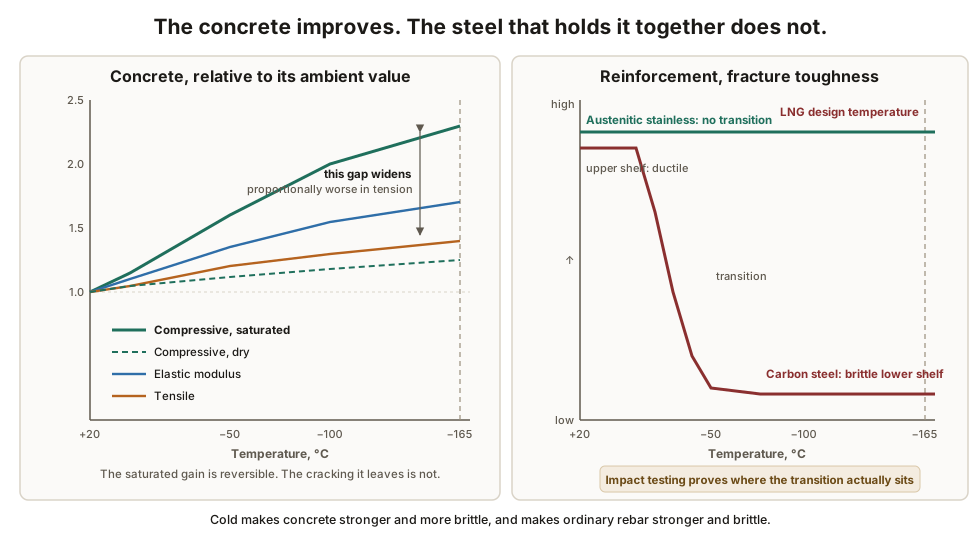
The result is a compressive strength that can be 50 to 150 per cent above the ambient value at −165 °C, along with a higher elastic modulus and very much reduced creep.
Three qualifications, each of which matters more than the headline:
- It depends entirely on moisture content. The gain comes from freezing pore water, so a dry element gains little. Any cryogenic test result that does not state the moisture condition of the specimen is not usable.
- It is reversible. Rewarm the element and the strength goes back to roughly what it was. Nothing has been permanently improved.
- The cracking it leaves behind is not reversible. Which is the whole problem.
The property that governs: contraction
Concrete has a coefficient of thermal expansion of roughly 10 × 10⁻⁶ per °C. Cool it from ambient to −165 °C and the free contraction strain is:
ε  =  α × ΔT
   =  10 × 10⁻⁶ × 185
   =  1.85 × 10⁻³   ( 1850 microstrain )
For comparison, concrete cracks in direct tension at somewhere around 100 to 150 microstrain. The free contraction from a cryogenic excursion is more than ten times the cracking strain.
So the question is never whether the concrete would like to contract more than it can. It is always: what is restraining it, and what are we going to do about the tension that restraint produces?
There are only three answers, and real designs use all three:
| Approach | How it works | Where it is used |
|---|---|---|
| Let it move | Movement joints, sliding bearings, release details | Paving, bunds, pipe support plinths |
| Pre-compress it | Post-tensioning puts the section into compression so thermal tension never takes it below zero | Containment tank outer walls |
| Insulate it | Keep the concrete warm enough that the gradient never develops | Tank base, thermal corner protection |
Post-tensioned containment walls is the second of these in detail.
The thermal gradient is the real load case
A uniform temperature drop across a free element produces no stress at all — it just gets smaller. Stress comes from restraint and from gradients, and the leakage case produces both at once.
Picture the outer concrete wall of a full containment tank the moment after the inner tank has failed. The inner face is suddenly at −162 °C. The outer face is still at ambient, say 35 °C in the Gulf. The wall is perhaps 800 mm thick.
The inner face wants to contract by 1850 microstrain. The outer face wants to contract by nothing. They are the same wall, so neither gets its way, and the inner face goes into severe tension while the outer face goes into compression.
Brittleness: the property nobody tests for
Cold concrete is stronger and stiffer, and it is also more brittle. Its stress–strain curve becomes steeper and shorter: it reaches a higher peak stress and then fails with much less warning and much less energy absorbed.
In practical terms:
- Less redistribution. A warm, ductile structure sheds load from an overstressed region to its neighbours. A cold brittle one does not, so local overstress becomes local fracture.
- Less tolerance of detailing errors. A congested bar zone or a poorly compacted pour is forgiven at ambient and is a crack initiator at −165 °C.
- Tensile strength does not rise in step with compressive. Both increase, but compressive increases far more, so the ratio between them widens and the material becomes proportionally worse in tension than it was warm.
What happens to the reinforcement
This is the part that catches people, because steel also gets stronger as it gets colder and that sounds like good news.
Ordinary carbon steel reinforcement at −165 °C has a higher yield strength, a higher tensile strength — and has passed through its ductile-to-brittle transition. Below that transition it has very little fracture toughness. It will snap rather than stretch, at a load above its rated yield, with no warning.
A reinforced concrete section depends on its reinforcement being ductile. That is the assumption behind every under-reinforced design, every moment redistribution and every expectation that a structure will crack and sag before it falls down. At cryogenic temperature, for ordinary rebar, the assumption is false.
So the zones that can actually go cold get either:
- Reinforcement with specified impact properties — Charpy tested at or below the design temperature, so the transition is proven to sit lower than the service condition; or
- Austenitic stainless reinforcement, which has a face-centred cubic structure and therefore no transition at all. It stays ductile down to liquid nitrogen temperature. It is expensive, so it goes where the cold definitely reaches: the thermal corner protection, the secondary bottom, the lower wall.
Aggregates and the mix
Over a 185 °C temperature drop, a mismatch between the thermal expansion coefficient of the aggregate and that of the cement paste becomes an internal stress at every interface in the concrete.
- Limestone and dolomitic aggregates have a low coefficient, typically 6 to 8 × 10⁻⁶ per °C, reasonably close to that of paste. These are the usual choice.
- Siliceous aggregates — quartzite, some granites — run 11 to 13 × 10⁻⁶ per °C and open up a larger mismatch.
The paste itself wants to be dense and low in permeability, which means a low water–cement ratio and usually a supplementary cementitious material. That is the same requirement that durability imposes anyway, so the two pull in the same direction. See concrete mix design for the mechanics of getting there.
Air entrainment deserves a note. It is the standard answer to freeze–thaw damage in ordinary cold-climate concrete, where it gives freezing water somewhere to expand into. In cryogenic service it is much less useful, because at −165 °C essentially all the freezable water has already frozen and the damage mechanism is thermal contraction rather than ice expansion. It is specified where the element also faces ordinary freeze–thaw cycling, not for the cryogenic case itself.
Cycling is the severe duty
A single excursion to cryogenic temperature is an extreme event. Repeated excursions are worse than their number suggests, because each cycle leaves microcracking that the next cycle opens further.
This distinction runs right through the design:
- The spill case is a one-off ultimate event. The outer wall must survive it and stay liquid-tight. It does not have to survive it repeatedly, and it does not have to be fit for further service afterwards.
- Routine cold exposure is a durability problem. A cryogenic line that frosts a plinth every time it runs, a transfer line over a paved area, a vaporiser slab — these see hundreds of cycles and are designed for cumulative damage, usually by keeping the concrete out of the cold altogether with insulation, drip trays or a sacrificial topping.
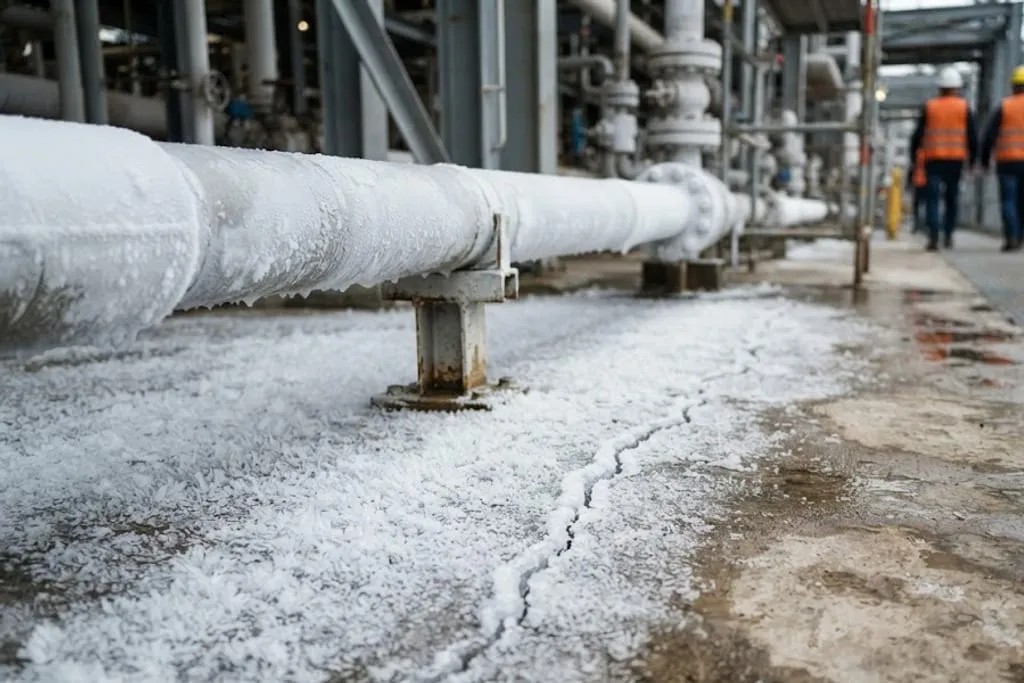
The photograph at the top of this page is the second case, not the first. The frost bloom is routine. So, by now, is the crack.
What to take away
Five things, in the order they bite:
- The strength gain is real and irrelevant. Do not design to it; do not be reassured by it.
- Contraction is the governing action. 1850 microstrain against a cracking strain of 150.
- The gradient, not the uniform drop, produces the stress. Restraint is the mechanism.
- The reinforcement loses toughness exactly when the concrete needs it most.
- Cycles accumulate damage that a single excursion does not.
Where this goes next: LNG full containment tanks for the arrangement that manages all of it, and LNG tank foundations and base mats for what happens underneath.
Check your understanding
6 questions. Nothing is recorded — this is just for you.