Civil & Structural
Concrete and reinforcement — why the mix is the easy part
What concrete grade actually means, why the water-cement ratio decides almost everything, what cover is protecting, and why curing is the most neglected step on site.
The foundations topic was about deciding what to build. This one is about the material you build it from, and about a fact that surprises people:
Concrete rarely fails because the mix was wrong. It fails because of what happened on site in the first 24 hours and the following week.
What concrete is
Four ingredients:
- Cement — the binder. It reacts chemically with water in a process called hydration.
- Aggregate — coarse stone and fine sand, which is most of the volume and most of the strength-bearing skeleton.
- Water — needed for the chemical reaction, and for workability.
- Admixtures — chemicals that change behaviour: plasticisers for workability, retarders to slow setting in hot weather, accelerators, air entrainers for frost resistance.
Concrete does not “dry”. It hydrates — a chemical reaction that consumes water and keeps going for weeks. That distinction is the whole basis of curing.
Grade is strength, measured a specific way
| M10 | C8/10 | 10 | Lean concrete blinding under foundations | Not structural — a clean working surface |
|---|---|---|---|---|
| M15 | C12/15 | 15 | Mass fill, levelling, kerbs | Non-structural fill |
| M20 | C16/20 | 20 | Light structural work, paving, drains | Minimum for most reinforced work in mild exposure |
| M25 | C20/25 | 25 | General plant foundations and structures | The common default for plant civil work |
| M30 | C25/30 | 30 | Equipment plinths, pipe rack footings, exposed structures | Often the durability minimum, not the strength minimum |
| M35 | C28/35 | 35 | Machine foundations, marine and aggressive exposure | Denser and less permeable — chosen for durability |
| M40 | C32/40 | 40 | Heavily loaded columns, precast, prestressed elements | Needs careful mix design and curing |
| M50 | C40/50 | 50 | Special structural elements, prestressed beams | High cement content brings heat and shrinkage problems |
No rows match that filter.
The M number is the characteristic compressive strength in N/mm² at 28 days, measured on cubes. European C designations quote two numbers — cylinder strength then cube strength — so C25/30 and M30 describe similar concrete by different tests. Never assume the numbers are interchangeable.
M30 means a characteristic cube strength of 30 N/mm² at 28 days. “Characteristic” means 95% of samples must exceed it, so the mix is actually designed for a mean well above the stated number.
Note the note against M30 and M35 in that table: on plant work the grade is very often set by durability, not strength. A foundation might only need M20 to carry its load, yet be specified M30 because the exposure conditions demand a denser, less permeable concrete.
The water-cement ratio decides almost everything
If you take one thing from this page, take this.
The ratio of water to cement by weight governs strength, permeability and durability simultaneously. Lower ratio, stronger and denser concrete. Higher ratio, weaker and more porous.
The reason is physical. Only a limited amount of water is consumed by hydration. Everything beyond that eventually evaporates and leaves capillary pores behind — a connected network of voids through which water, chloride and carbon dioxide reach the reinforcement.
Slump is the site test for workability — a cone of concrete is filled, the cone is lifted, and the amount it sags is measured. It is a consistency check, not a strength test, and its real value is spotting a load that does not match what was ordered.
Reinforcement
Concrete is strong in compression and weak in tension — roughly a tenth as strong. Steel is excellent in tension. Reinforced concrete puts each material where it does its best work.
Two things make the combination work at all:
- They expand and contract at almost the same rate with temperature, so they do not tear themselves apart.
- Fresh concrete is strongly alkaline, and that alkalinity passivates the steel — forms a protective film so it does not rust, despite being surrounded by moisture.
Grades are stated by yield strength: Fe415 and Fe500 in Indian practice (IS 1786), Grade 60 in American. Bars are deformed — ribbed — so concrete grips them mechanically rather than relying on adhesion.
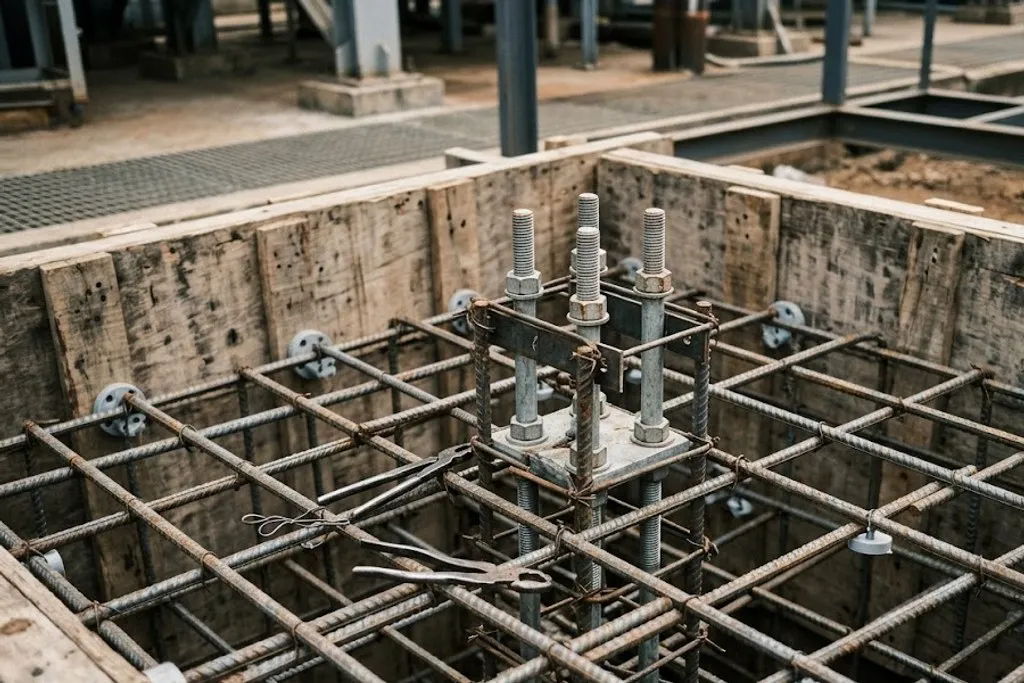
Detailing matters as much as quantity. Laps must be long enough to transfer force from one bar to the next; bends need a minimum radius or the bar is damaged; spacing must let concrete and vibrator poker actually get through. Congested reinforcement that concrete cannot flow into produces a weaker member than fewer bars would have.
Cover: the most important dimension on the drawing
Cover is the concrete thickness between the outside face and the nearest reinforcement.
It is not a tolerance. It is the barrier keeping water, oxygen, chloride and carbon dioxide away from the steel, and it is the entire reason reinforced concrete lasts.
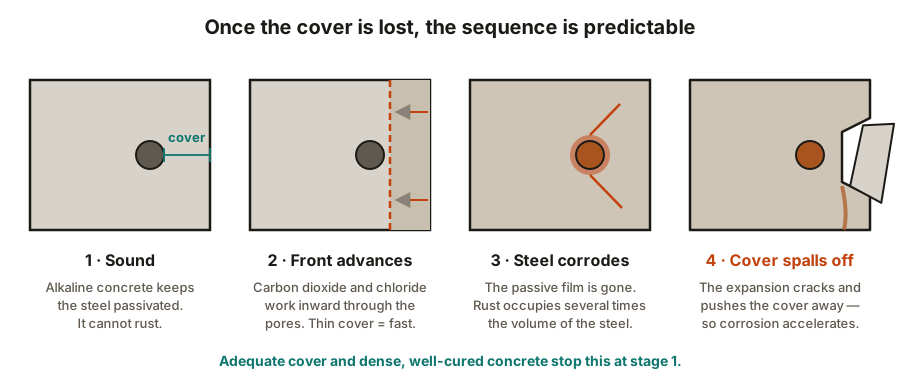
When cover is lost — too little specified, or spacer blocks omitted so the cage sags onto the formwork — the sequence is predictable:
- Carbonation or chloride reaches the steel and destroys the passive film.
- The steel corrodes.
- Rust occupies several times the volume of the steel it came from.
- That expansion cracks and spalls the cover off.
- With the cover gone, corrosion accelerates.
Typical cover for plant foundations in normal soil is around 40 mm, rising to 50–75 mm where sulphates or chlorides are present.
Curing is not optional and is usually shortchanged
Hydration needs water and it needs time. Concrete that dries out early stops gaining strength permanently — it does not resume when it next rains.
Worse, the part that suffers most is the surface layer, because that is what dries first. That layer is the cover. So poor curing attacks precisely the concrete protecting the steel.
Curing means keeping it wet and at a reasonable temperature for typically seven days: ponding, wet hessian, sprayed curing compound, or leaving formwork in place.
Reading the defects
| Honeycombing | Concrete not compacted into place; congested reinforcement blocked the flow | Rebar is exposed to air and water, so it corrodes and the section is weak | Proper vibration, workable mix, realistic bar spacing |
|---|---|---|---|
| Plastic shrinkage cracking | Surface dried faster than bleed water could reach it, within hours of the pour | Cracks give water and chloride a direct path to the steel | Curing immediately after finishing; windbreaks and shading |
| Thermal cracking | Heat of hydration in a thick pour, with the core hotter than the surface | Through-cracks that compromise both strength and watertightness | Lower cement content, pour in lifts, cooled aggregate, temperature monitoring |
| Spalling with rust staining | Reinforcement corroding and expanding, pushing the cover off | Section is losing steel and the damage accelerates once started | Adequate cover, dense low-permeability concrete, correct exposure class |
| Cold joint | The next batch arrived after the previous one had begun to set | A plane of weakness through the member, and a leak path | Continuous pour planning, retarder, agreed construction joints |
| Segregation | Concrete dropped too far, or over-vibrated, so aggregate separated from paste | Inconsistent strength through the depth of the member | Drop height limits, tremie or chute, correct vibration time |
| Crazing | Surface layer shrank slightly relative to the body beneath | Usually cosmetic only — but it is often a sign of over-trowelling | Avoid working water to the surface during finishing |
| Efflorescence | Water migrating through the concrete and depositing salts at the surface | A signal that water is moving through the member | Lower permeability, proper waterproofing and drainage |
No rows match that filter.
Almost every defect in this table traces back to one of three things: too much water in the mix, inadequate compaction, or curing that was cut short. None of them is a materials problem — all three are site discipline.
Trace the cause column: nearly everything reduces to too much water, inadequate compaction, or curing cut short. None of those is a materials problem. All three are site discipline.
Aggressive ground
The geotechnical report gives soil chemistry for a reason.
Sulphate attack — sulphates in groundwater react with hydrated cement, expand, and disintegrate the concrete from within. The defence is sulphate-resisting cement, or a cement replacement such as fly ash or slag, plus lower permeability.
Chloride attack — chloride penetrates to the steel and destroys the passive film even where the concrete is otherwise sound. Coastal and marine sites, and anywhere de-icing salt is used. The defence is cover, density, and sometimes coated or stainless reinforcement.
Both are addressed by the exposure class in the specification, which then dictates minimum grade, maximum water-cement ratio, minimum cement content and minimum cover together. They are a package; meeting one and ignoring the others does not work.
Testing
Cube or cylinder tests — samples cast at the pour, cured under controlled conditions and crushed at 7 and 28 days. The 7-day result is an early warning, typically around two-thirds of the 28-day strength.
Slump — workability at the point of placing.
Cover meter — a non-destructive scan confirming actual cover on the finished member.
Core testing and rebound hammer — used when something is in doubt on concrete already in place.
Cube results are the formal record of compliance. They are also, notoriously, cured far more kindly than the structure they represent — which is why a passing cube result does not prove the pour was cured properly.
What to take away
- Concrete hydrates, it does not dry. That is why curing matters.
- The water-cement ratio governs strength, permeability and durability together. Never add water on site — use a plasticiser.
- Grade is often set by durability, not by load.
- Cover is what keeps the reinforcement passivated. Spacer blocks are structural components.
- Curing is the first thing dropped and the most expensive thing to lose.
- Almost every defect traces to excess water, poor compaction or short curing — all of them site discipline, not materials.
Check your understanding
10 questions. Nothing is recorded — this is just for you.