
Civil & Structural
Crane gantries and runway beams
How an overhead travelling crane loads the building it runs in — wheel loads, impact, surge and thrust, the runway beam and its fatigue problem, rail fixings and wear, and the alignment tolerances that decide whether the crane lasts.
Standards referencedEN 1991-3EN 1993-6EN 1993-1-9IS 807AISE Technical Report 13
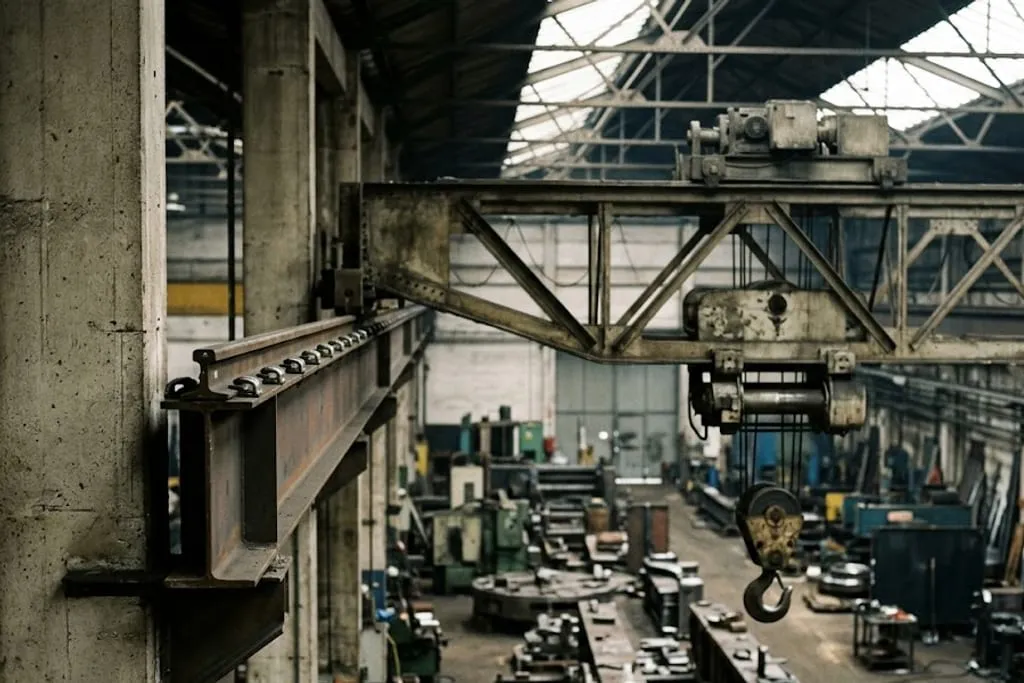
An overhead travelling crane is the most demanding thing most industrial buildings ever carry — not because the loads are large, but because they move, they are dynamic, and they repeat millions of times.
That combination makes a runway beam one of the few parts of an ordinary building where fatigue, not strength, sets the design.
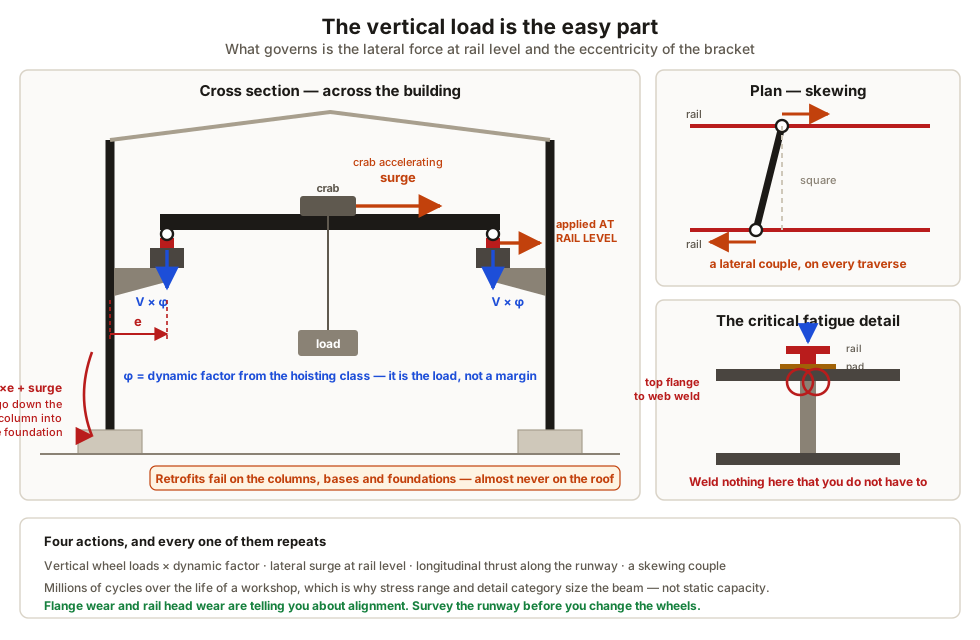
What the crane actually does to the building
| Action | Where it comes from | Applied |
|---|---|---|
| Vertical wheel loads | Crane self weight + hoist load, × dynamic factor | Down through each wheel |
| Surge (lateral) | Crab accelerating or braking across the bridge | Sideways, at rail level |
| Thrust (longitudinal) | Crane starting and stopping along the runway | Along the building |
| Skewing | The crane not running square | A lateral couple, every traverse |
The fatigue problem
An office floor beam sees its full design load rarely. A runway beam is loaded and unloaded every time the crane passes — millions of cycles in a busy workshop.
Fatigue life depends on:

  the stress RANGE Δσ   (not the peak stress)
  the number of cycles N
  the DETAIL CATEGORY of the weld or connection

Halving the stress range increases life by roughly a factor of eight.Lateral load is the other half of the structural problem. An I-section is very poor about its weak axis, so on anything but a small crane the surge is taken by a surge girder — a horizontal truss or a channel welded to the top flange, spanning between columns in plan. Small cranes get away without one. Large ones cannot.
Rails and fixings
The rail is a wearing part. It gets replaced, several times, over the life of the building.
- Clipped, not welded. Clips allow longitudinal movement under thermal and braking effects and can be released for replacement. Welding the rail down would also lay a continuous weld along the most highly stressed, most fatigue-loaded fibre of the beam — precisely where one should not be.
- Resilient pad under the rail spreads the wheel load and damps impact.
- Rail joints are where the damage happens.
Alignment
The crane bridge is effectively a rigid measuring stick spanning between the two rails. If the geometry is wrong, the crane cannot run square — and it will tell you.
| Check | Why |
|---|---|
| Span between rail centres | Varying span forces the wheels to crab |
| Straightness of each rail in plan | Lateral deviation drives the flanges into the rail |
| Level of each rail and relative level between them | Cross-fall makes the crane run downhill and skew |
| Rail joint step and gap | Impact |
| Rail to beam centreline eccentricity | Puts torsion into the beam |
Where this connects
The shed it lives in is portal frames and pre-engineered buildings, the detail classification and crack behaviour is fatigue and fracture in steel, the connections are steel connections and erection, and finding the cracks is structural NDT and inspection access.
What to take away
- A crane applies four actions — vertical wheel loads, lateral surge, longitudinal thrust and a skewing couple — and all of them repeat.
- Dynamic factors are the load, derived from the crane’s hoisting class, not a safety margin.
- The bracket eccentricity plus surge is what governs the column and the foundation, which is why retrofitting a crane fails there.
- Runway beams are fatigue-governed; stress range and detail category decide the section.
- Do not weld attachments near the top flange — that is the critical detail.
- Rails are clipped, not welded, because they are a wearing part and a weld there is in the worst possible place.
- A step at a rail joint is an impact on every pass, damaging beam and crane alike.
- Skew wear is a survey problem; replacing wheels without checking alignment buys new worn wheels.
Check your understanding
10 questions. Nothing is recorded — this is just for you.