
Automotive
Bolted joint loosening and locking
Why bolts come loose, the difference between losing preload and actually unwinding, what the Junker test proved about spring washers, and which locking methods work for which mechanism.
Standards referencedISO 16130ISO 2320DIN 65151ISO 898-1ISO 16047
A bolt that is loose after six months in service was almost certainly tightened correctly. That is the uncomfortable part. Something took the clamp force away afterwards — and there are two quite different things it could have been, with two quite different cures.

Two mechanisms, not one
| Preload loss | Self-loosening | |
|---|---|---|
| Does anything rotate? | No | Yes |
| Cause | Embedment, creep, thermal relaxation | Transverse slip at the faces |
| Timescale | Mostly the first hours | Cycles, so miles |
| Cure | Joint design, longer bolt, fewer soft layers | Preload, then a locking device |
| Evidence | Low residual torque, marks unmoved | Witness marks moved, nut backed off |
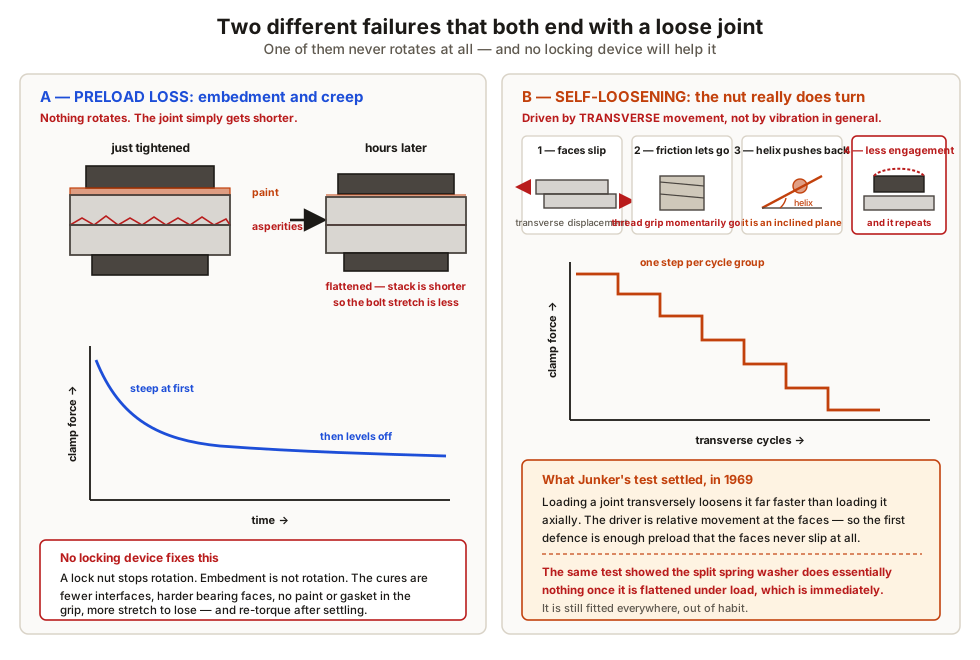
Preload loss is the joint getting shorter. Surface asperities flatten under enormous local pressure, paint layers squash, gaskets creep. The bolt has not turned; it has simply been allowed to relax. Most of it happens quickly, and it is worst where there are many soft or painted interfaces under a short bolt.
Self-loosening is the nut genuinely unwinding, and its driver is not what most people assume.
What Junker actually showed
A thread is an inclined plane held in place by friction. Gerhard Junker’s transverse vibration test established two things that changed fastener practice:
- Transverse displacement at the joint face — not axial vibration — is what drives self-loosening. Sideways slip momentarily releases the friction holding the helix, and the helix angle does the rest.
- Once the faces slip, a conventional split spring washer contributes essentially nothing.
The first cure is preload, not hardware
If the joint faces never slip, the loosening mechanism is never triggered at all. So the most effective single measure against self-loosening is a high, correctly achieved preload — which is a tightening control question, covered in threaded fasteners and torque.
A correctly preloaded joint with no locking device routinely outlasts an underpreloaded joint with one. Reaching for a lock washer before fixing the tightening is treating the symptom.
Locking devices, and which mechanism each addresses

| Device | Stops rotation | Stops preload loss | Reusable |
|---|---|---|---|
| Prevailing torque nut (polymer insert, deformed thread) | Yes | No | Limited |
| Wedge locking washers (cam pair) | Yes | No | Yes |
| Thread locking adhesive | Yes | No | Controlled process |
| Serrated flange nut | Yes, into the face | No | Marks the surface |
| Split spring washer | No | No | — |
| Longer bolt, fewer soft layers | — | Yes | — |
Prevailing torque nuts put friction on the thread itself, so torque is needed to turn them even at zero clamp load. That is the point: if preload is entirely lost, the fastener still does not fall out. It does not prevent the loss.
Wedge locking washers use a cam angle greater than the thread helix angle. A nut trying to rotate backwards would have to climb the cams and stretch the bolt further, which it cannot. This is why they survive the Junker test — the mechanism does not rely on residual spring force.
Thermal relaxation
A joint that runs hot loses clamp force for two reasons at once: differential expansion between the bolt and what it clamps changes the stretch, and at temperature both materials creep under sustained load.
Neither is a tightening error, so neither is fixed by tightening harder — and retightening hot then leaves it overloaded cold. The answer is in the design: compatible materials, and a longer, softer bolt that absorbs the movement with a smaller change in load. The same reasoning appears in pipe supports and expansion, where the movement is larger and the argument identical.
Diagnosing a loose joint
The two mechanisms leave different evidence, and it is worth looking before deciding:
- Witness marks — a clean ring where the washer sat, offset from where it is now, means it rotated.
- Residual breakaway torque with the marks still aligned means preload was lost without rotation.
- Bright rubbed patches on the joint faces mean the faces were slipping, which points to insufficient preload whatever else was fitted.
- Fretting debris at the interface says the same thing more loudly.
What to take away
- Preload loss and self-loosening are different failures. Identify which one you have.
- Embedment and creep shorten the stack; nothing rotates, and most of it happens early.
- Transverse slip, not axial vibration, drives self-loosening.
- The split spring washer does not work, and the Junker test showed it.
- The best defence is a high, correct preload so the faces never slip.
- Prevailing torque nuts resist rotation at zero clamp load — they do not restore clamp load.
- Wedge washers work because the cam angle exceeds the thread helix angle.
- No locking device fixes embedment. That is a joint design problem.
- Thermal relaxation is design, not assembly — use a longer bolt and compatible materials.
- Witness marks tell you which mechanism you are looking at.
Check your understanding
10 questions. Nothing is recorded — this is just for you.