
Automotive
Fits, limits and clearances
How the ISO 286 system of shaft and hole letters and IT grades produces clearance, transition and interference fits, what H7/g6 and H7/p6 actually mean on the bench, and how to choose one.
Standards referencedISO 286-1ISO 286-2IS 919ISO 1101ASME B4.1
A shaft goes into a hole. Whether it spins freely, needs a light tap, or requires a press and a heat gun is decided by two letters and two numbers on a drawing — and getting them wrong is one of the more expensive ways to be slightly careless.

Reading the designation
⌀ 40 H7 / g6
     │  │  │ └── IT grade — how WIDE the shaft band is
     │  │  └──── lower case = SHAFT, letter = where its band sits
     │  └─────── IT grade — how WIDE the hole band is
└────────── UPPER CASE = HOLE, letter = where its band sits- The letter fixes the position of the tolerance band relative to nominal.
- The number — the IT grade — fixes its width.
H is the hole whose lower limit sits exactly at nominal. h is the shaft whose upper limit
sits exactly at nominal. Everything else is defined by moving away from those two.
Hole basis, and why the shop insists on it
Reamers, broaches and drills come in set sizes. Changing a hole size means buying a tool. A shaft can be turned or ground to any size you like on the machine that is already running.
So the hole is fixed at H and the fit is changed by moving the shaft letter. That is the
hole basis system, it is what almost every drawing you meet will use, and the reason is
purely economic.
The three families
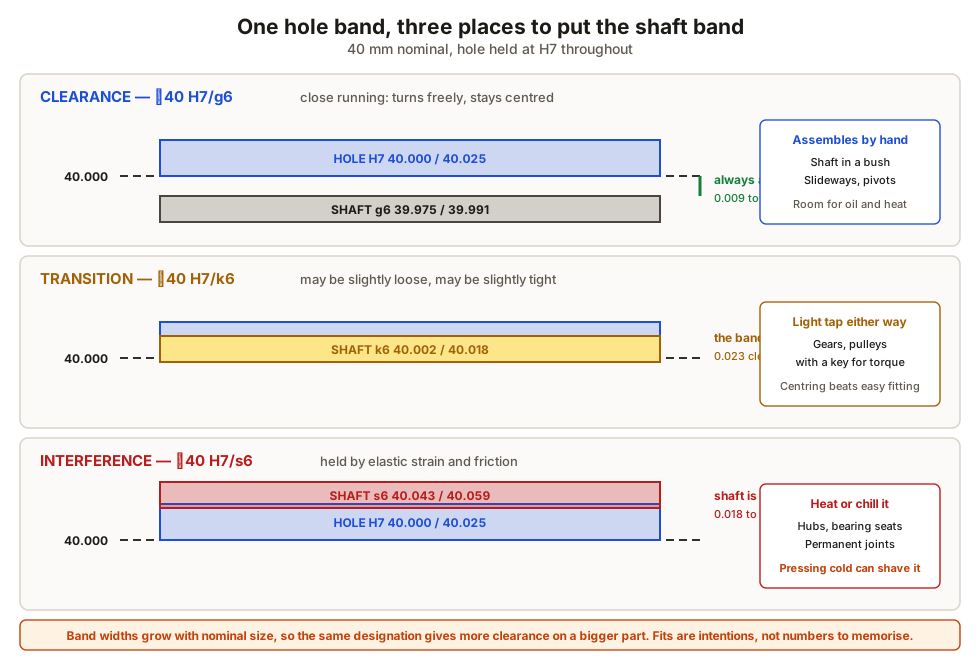
| Family | Example | What it does | Typical use |
|---|---|---|---|
| Clearance | H11/c11 | Loose, easy assembly, generous play | Covers, non-critical pins |
| Clearance | H7/g6 | Close running — turns freely, stays centred | Shaft in a bush, slideways |
| Clearance | H7/h6 | Locational — slides by hand, no play to speak of | Located parts, spigots |
| Transition | H7/k6 | Light tap either way; may be slightly tight or slightly loose | Gears and pulleys with a key |
| Interference | H7/p6 | Light press | Bushes, locating dowels |
| Interference | H7/s6 | Heavy press or thermal assembly | Permanently joined hubs |
Clearance always leaves a gap. Transition overlaps, so some pairs go together with a whisper of play and others need a light press. Interference always requires force.
What actually holds an interference fit together
The shaft is bigger than the hole, so assembly stretches the hub and compresses the shaft. That stored elastic strain produces radial contact pressure, and pressure multiplied by friction is the torque and thrust the joint can carry.
Bearings, where this gets decided for you
And there is a second-order effect that catches people out: pressing the inner ring on stretches it, which grows the raceway and eats into the bearing’s internal clearance. On a tight fit or a hot-running application that is exactly why a larger clearance class such as C3 is specified. A bearing that closes up in service runs hot, and a bearing that runs hot does not run long.
Choosing one
Ask what the joint must do, in this order:
- Must it move? Then clearance —
H7/g6for close running, looser if there is dirt, heat or misalignment to swallow. - Must it stay put and be accurately centred? Transition, with a key or pin doing the torque.
- Must it transmit torque by itself? Interference, sized from the pressure needed — and then a thermal assembly method.
The tolerance you choose here feeds straight into the cost table in engineering drawings and tolerances, and into the loop in tolerance stacks.
What to take away
- Capital = hole, lower case = shaft. Letter sets position, number sets width.
- IT grade bands widen with nominal size, so the same fit gives more clearance on a larger part.
- Hole basis is standard because hole tooling is fixed-size and shafts are not.
- Clearance always gaps, transition may go either way, interference always needs force.
- An interference fit is held by elastic strain and friction, nothing else.
- Heat or chill heavy interference fits — pressing cold can shave away the interference.
- The bearing ring seeing a rotating load must be tight, or it will creep and destroy its seat.
- A tight inner ring reduces internal clearance — which is what clearance class C3 is for.
Check your understanding
10 questions. Nothing is recorded — this is just for you.