
Automotive
Rolling, extrusion and drawing
Where stock material actually comes from — hot and cold rolled sheet, extruded aluminium profiles, drawn bar and tube — what each process does to properties and tolerance, and why the supplied form shapes the design.
Standards referencedEN 10131EN 10051EN 755-9ISO 9445ISO 6892-1
Before anything is machined, formed, cast or forged, somebody made the stock. Whether it arrived as coil, as bar, as an extruded profile or as tube decides the tolerances available, the properties in each direction, and often the shape of the design itself.
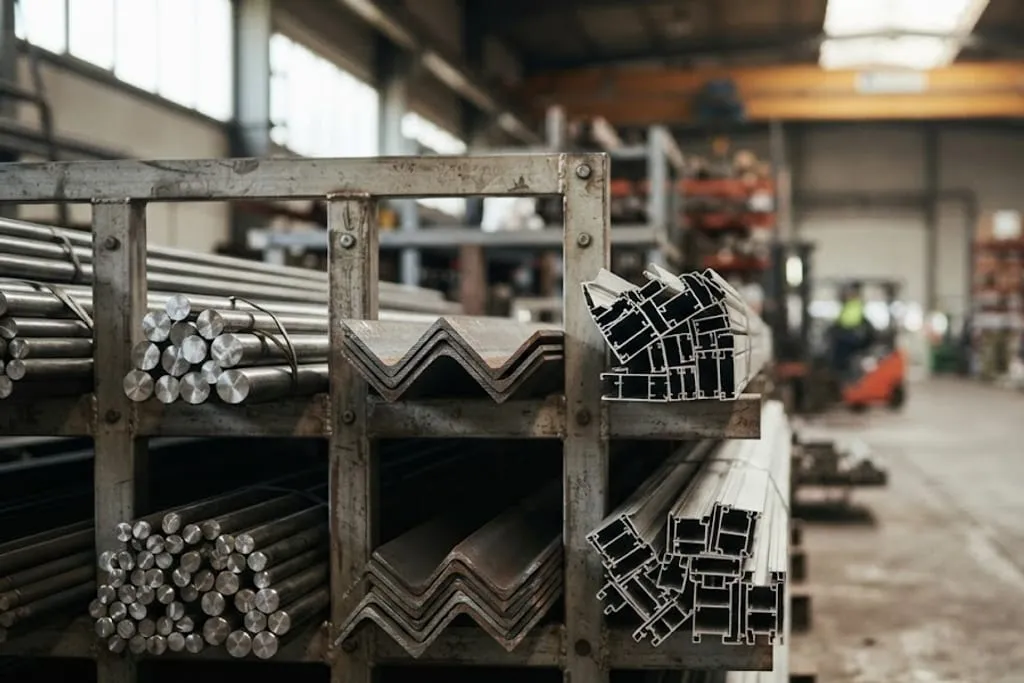
The three processes
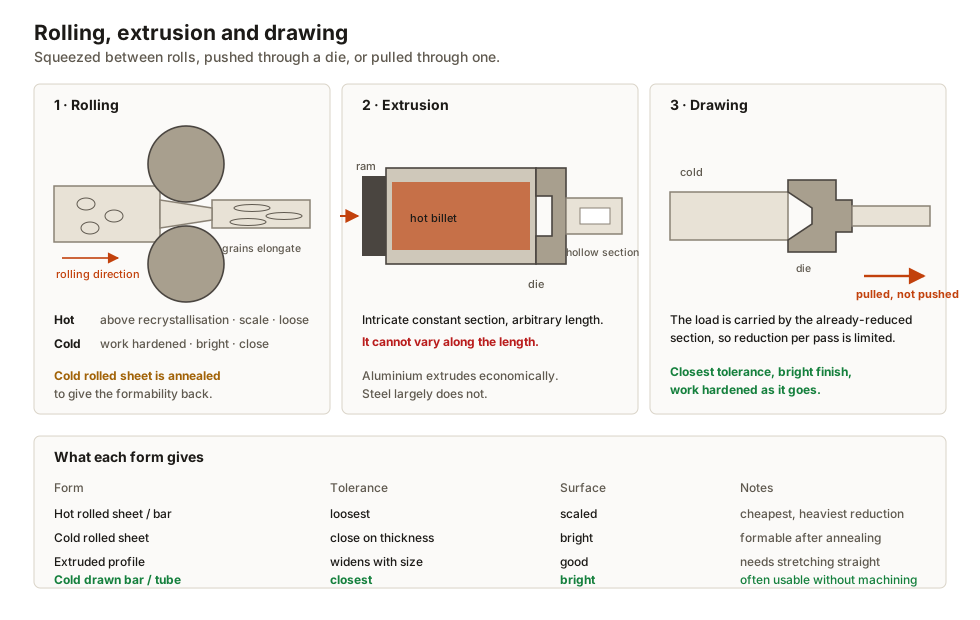
Rolling squeezes material between rolls to reduce its thickness.
- Hot rolled — above the recrystallisation temperature. Heavy reduction is easy, the metal reforms as it is worked, and what comes out has scale on it and loose tolerances.
- Cold rolled — below it. The metal work hardens, the surface is clean and bright, and the thickness is held far more closely. This is where visible panels and precision parts start.
Cold rolled sheet is usually annealed afterwards, because sheet left in the work hardened condition will crack in a draw. How far that anneal is taken is what the drawing and deep drawing quality designations describe — the r-value and n-value discussed in deep drawing and stamping come from it.
Extrusion pushes heated material through a shaped die. The section can be extremely intricate — internal webs, screw ports, hollow chambers — and the length is arbitrary. What it cannot do is change along the length.
Drawing pulls material cold through a die. Because the load is carried by the already-reduced section, only so much reduction is possible per pass. It gives close tolerance bar and precision tube, work hardened as it goes.
What tolerance each gives
| Form | Typical tolerance | Surface | Notes |
|---|---|---|---|
| Hot rolled sheet / bar | Loosest | Scaled | Cheapest, heaviest reduction |
| Cold rolled sheet | Close on thickness | Bright | Formable after annealing |
| Extruded aluminium profile | Widens with size and complexity | Good | Straightness needs stretching |
| Cold drawn bar / tube | Closest of the four | Bright | Often usable without machining |
Direction is a property
Rolling elongates grains and inclusions along the direction of travel, so strength, ductility and formability all differ along and across the sheet.
That is why blank layout in a press shop has to respect grain direction as well as material utilisation, and why a bend line running parallel to the rolling direction is more likely to crack — the point made in sheet metal bending and springback.
Designing an extrusion
Aluminium is extruded far more than steel simply because it flows at a modest temperature and pressure, so dies survive and the economics work. Architectural sections, heat sinks, crash structures and battery trays are almost all extruded aluminium for that reason.
Tube — seamless or welded
A welded tube is entirely satisfactory for most structural and fluid duties, and it is cheaper and often held more closely on diameter.
Seamless earns its cost where the weld itself would be the weakness: high pressure service, or a tube that will be substantially cold formed — hydroformed, bent tight, expanded — after it is made.
Check what actually exists
What to take away
- Hot rolled takes heavy reduction and gives scale and loose tolerance; cold rolled gives thickness, surface and strength.
- Cold rolled sheet is annealed to restore the formability that rolling removed.
- Extrusion gives an intricate constant section — and cannot vary along the length.
- Aluminium extrudes economically; steel largely does not.
- Drawing pulls cold through a die: closest tolerance, bright finish, work hardened.
- Drawn bar can remove a turning operation from every part.
- Rolling direction is a material property. Respect it in blank layout and bend lines.
- Uniform wall thickness matters in an extrusion for the same reason as in a casting.
- Welded tube for most duties; seamless where the weld would be the weak point.
- Check the stock form exists before the design depends on it.
Check your understanding
10 questions. Nothing is recorded — this is just for you.