
Automotive
Casting defects and design for casting
Shrinkage porosity, gas porosity, cold shuts, inclusions and hot tears — what each looks like, what actually causes it, and the design rules that prevent most of them before a mould is ever made.
Standards referencedISO 4993ISO 11971ASTM E446ISO 8062-3ISO 4990
Every casting contains something. The useful question has never been whether a casting has indications, but which ones, where, and how big — and the great majority of them are decided by the shape of the part long before the metal is melted.

The five that account for most of it
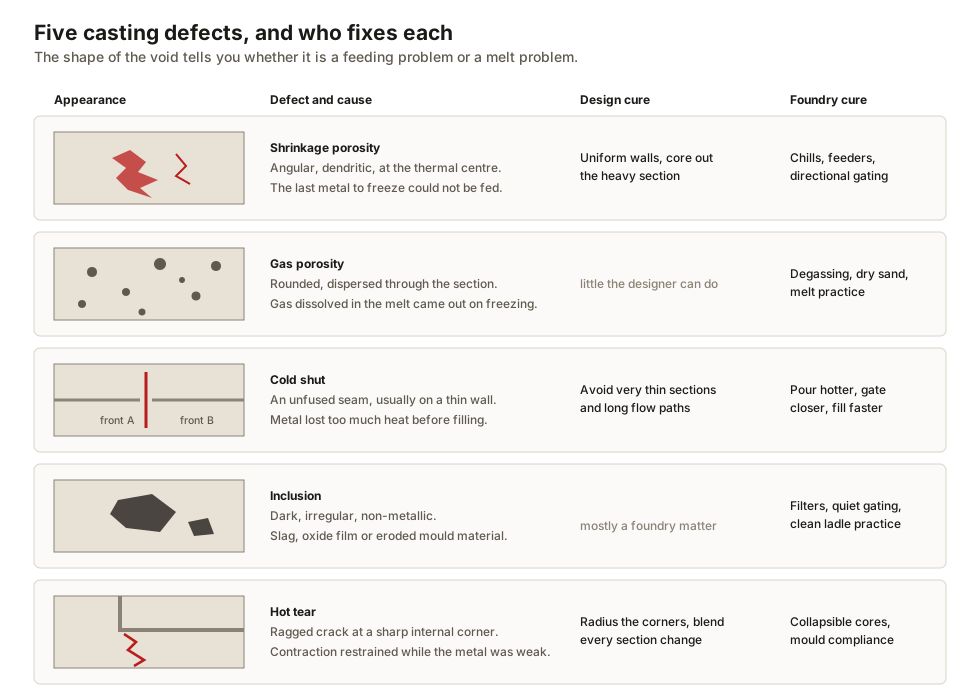
| Defect | Appearance | Real cause |
|---|---|---|
| Shrinkage porosity | Angular, dendritic, at the thermal centre | The last metal to freeze could not be fed |
| Gas porosity | Rounded, dispersed | Gas dissolved in the melt came out on freezing |
| Cold shut | An unfused seam, often on a thin wall | Metal lost too much heat before the cavity filled |
| Inclusion | Dark, irregular, non-metallic | Slag, oxide film or eroded mould material |
| Hot tear | Ragged crack at a sharp corner | Contraction restrained while the metal was still weak |
Hot spots, and the rule that removes most of them
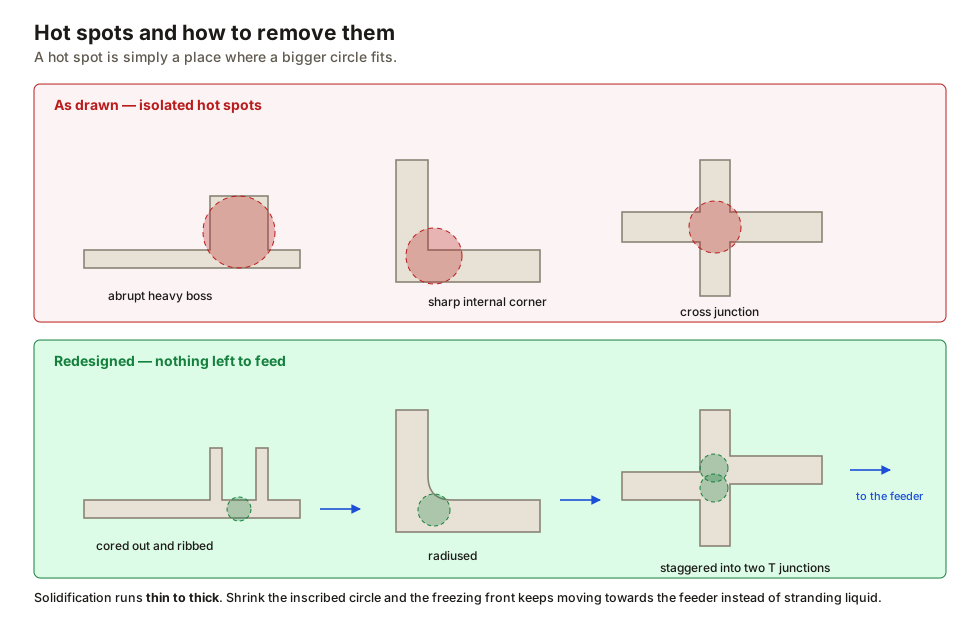
Solidification runs from thin to thick. So a heavy section surrounded by thin walls is left as an isolated pocket of liquid with nowhere for feed metal to come from, and it forms shrinkage porosity at its centre.
The rule that prevents most casting defects is a single sentence: keep the wall thickness uniform and blend every change gradually.
Where a heavy feature is unavoidable, the aim is to remove the thermal mass, not to feed it:
- Core out the boss and carry the load with ribs
- Stagger a cross junction into two offset T junctions
- Radius every internal corner — a sharp corner is both a hot spot and a hot tear site
- Taper sections so the freezing front runs towards the feeder
Getting the metal in without spoiling it
A liquid metal surface oxidises instantly. Turbulence folds that oxide film into the body of the casting, where it behaves as a crack that was cast in.
So a gating system is not judged on whether it fills the cavity. It is judged on whether the stream stays full and quiet: tapered sprue, bottom filling, filters, no free fall. A cavity filled turbulently is full of defects that did not have to exist.
Thin sections and long flow paths are where cold shuts appear — two fronts meeting after losing too much heat to fuse. The seam looks cosmetic. It carries no load whatsoever.
Inspecting, and agreeing what counts
The defects that matter in a casting are internal, and a perfect surface says nothing about the thermal centre. That is why radiography is specified on critical castings, with acceptance by comparison against reference radiographs at a stated severity level.
What to take away
- Angular voids at the thermal centre are a feeding problem; round dispersed ones are a melt problem.
- Hot tears come from restrained contraction at sharp corners while the metal is weak.
- Cold shuts are unfused seams on thin sections and carry no load.
- Inclusions are oxide film and slag folded in — usually by turbulent filling.
- The single best rule is uniform wall thickness with blended transitions.
- Handle a heavy boss by coring it out and ribbing it, not by feeding it.
- Stagger cross junctions; radius every internal corner.
- Gating is judged on a full, quiet stream, not on whether the mould filled.
- The defects that matter are internal — specify radiography where it counts.
- Agree acceptance by zone and severity before production.
Check your understanding
10 questions. Nothing is recorded — this is just for you.