
Automotive
PPAP and the submission package
What the eighteen elements are, why levels 1 to 5 change what you send rather than what you do, what a part submission warrant actually certifies, and the difference between interim approval and approval.
Standards referencedAIAG PPAPIATF 16949AIAG APQPAIAG MSAVDA 2
A PPAP is not a statement about the parts in the box. It is a statement about the process that made them — running at rate, on production tooling, in the production location, with production people. Good parts produced by heroic means prove nothing about what will be shipped next Tuesday.

The eighteen elements
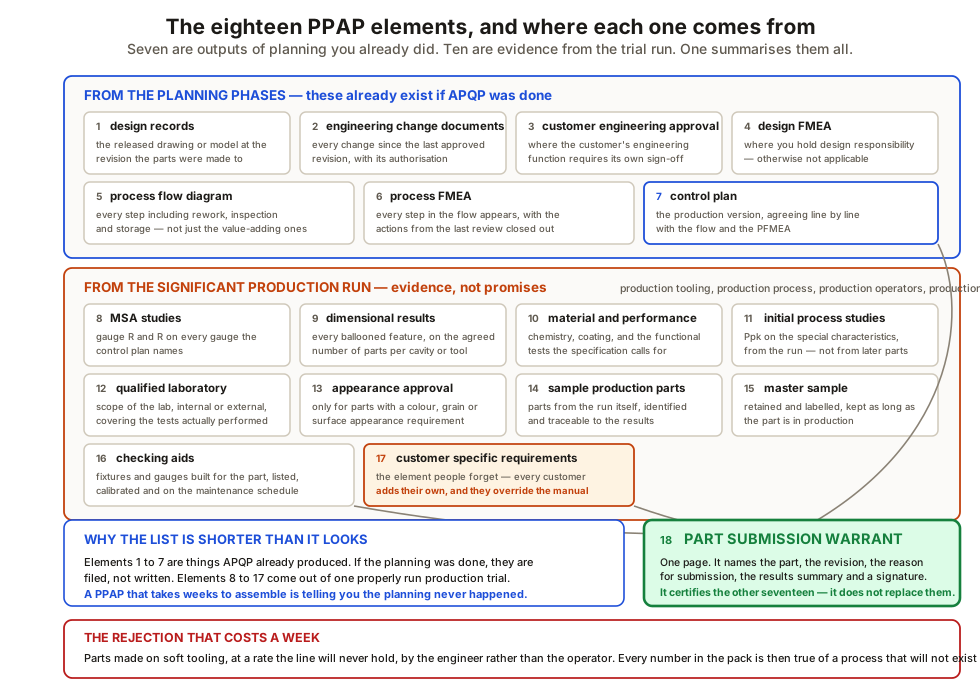
| Group | Elements |
|---|---|
| From planning | Design records, change documents, engineering approval, DFMEA, process flow, PFMEA, control plan |
| From measurement | MSA studies, dimensional results, material and performance tests, initial process studies, lab documentation |
| Physical | Appearance approval, sample parts, master sample, checking aids |
| Contractual | Customer specific requirements, part submission warrant |
Three of them are quietly the ones that fail review:
- Dimensional results — the drawing must be ballooned, every dimension numbered, and every balloon must have a result. A statement that the parts conform is not a dimensional result. The ballooning exists so nothing can be quietly omitted.
- MSA studies — every other number in the package was measured. An inadequate measurement system invalidates all of them simultaneously, which is why this element sits before the results it validates. See MSA and gauge R and R.
- Master sample — the physical reference for the approved condition. Months later, when there is a disagreement about what was approved, the drawing describes the intention and the master is the answer.
Levels change what you send, not what you do

| Level | Sent to customer |
|---|---|
| 1 | Warrant only |
| 2 | Warrant, samples, limited data |
| 3 | Warrant, samples, complete data — the default |
| 4 | Warrant plus whatever the customer defines |
| 5 | Reviewed at the supplier’s site |
What the warrant certifies
The part submission warrant is the supplier’s declaration, not something the customer issues. It says: the requirements are understood, the results conform, and the parts were made under production conditions.
Signing it while a dimension is out of tolerance, without recording that as a deviation, is a false declaration and is treated as one. It carries a name and a date.
| Status | Means |
|---|---|
| Approved | Ship normally |
| Interim approval | Ship a defined quantity or period under agreed containment, with a corrective action plan and an expiry date |
| Rejected | Do not ship; correct and resubmit |
Resubmission triggers
The list is deliberately broad, because each item changes the process that was approved:
- Design change
- Process or method change
- Tooling change, refurbishment or transfer
- Material or material source change
- Manufacturing location change
- Sub-supplier change
- Tooling inactive beyond a specified period
The two that get missed are moving tooling to another plant and changing the sub-supplier of something peripheral like a coating or a fastener. Both feel internal. Both are notifiable, and shipping after an unnotified change is among the fastest routes to a special status under IATF 16949.
Where the package comes from
What to take away
- PPAP demonstrates the process, at rate, on production tooling — not the parts in the box.
- All eighteen elements are completed and retained at every level.
- The level changes what you send, nothing else. Level 3 is the default.
- Balloon the drawing; every balloon needs a result.
- MSA comes first — a bad gauge invalidates every other number in the package.
- The warrant is the supplier’s declaration, with a name on it.
- Interim approval has containment, a plan and an expiry date.
- Repeated interims mean the problem was never being fixed.
- Tooling transfer and sub-supplier change are notifiable, and are the two most often missed.
- The master sample is the physical record of what was approved.
- A PPAP is a by-product of APQP done properly, not a task at the end.
Check your understanding
10 questions. Nothing is recorded — this is just for you.