
Automotive
APQP and new part introduction
The five phases of advanced product quality planning, what a gate review is actually deciding, why run at rate matters more than a good sample, and how a timing plan fails quietly long before launch.
Standards referencedIATF 16949AIAG APQPVDA Maturity Level AssuranceISO 9001AIAG PPAP
Every problem found at launch existed months earlier. It was cheaper then, and usually visible to somebody. APQP is the attempt to make that somebody’s observation land in a defined place, at a defined time, in front of people who can act on it — which sounds like bureaucracy until the first programme that skips it.

Five phases, and the one everybody drops

| Phase | Produces |
|---|---|
| 1. Plan and define | Design goals, reliability targets, preliminary process flow, feasibility review |
| 2. Product design and development | Design FMEA, drawings, prototype control plan — ends at design freeze |
| 3. Process design and development | Process flow, process FMEA, pre-launch control plan, floor plan, packaging |
| 4. Product and process validation | Trial run, MSA, capability study, run at rate, PPAP submission |
| 5. Feedback and corrective action | Lessons fed back into the FMEAs, control plans and standards |
Phase five is the one that quietly disappears once production starts and the team is moved to the next programme. It is also the only phase that makes the organisation better rather than the part — which is why the same failure modes keep reappearing in companies that do the first four well.
The feasibility review is the cheapest hour of the project
At quotation, a requirement can still be challenged. Afterwards it cannot, because the price is agreed and the alternative process is no longer available.
So the feasibility review asks a blunt question: can we actually make this, with the process we are proposing, to this specification? Accepting a tolerance the intended process cannot hold turns into a concession request eight months later, from a much weaker position.
Gate reviews decide on evidence
A gate review is not a progress meeting. It is a go or no-go on whether the phase’s defined outputs exist and are acceptable.
Design freeze and the float nobody counted
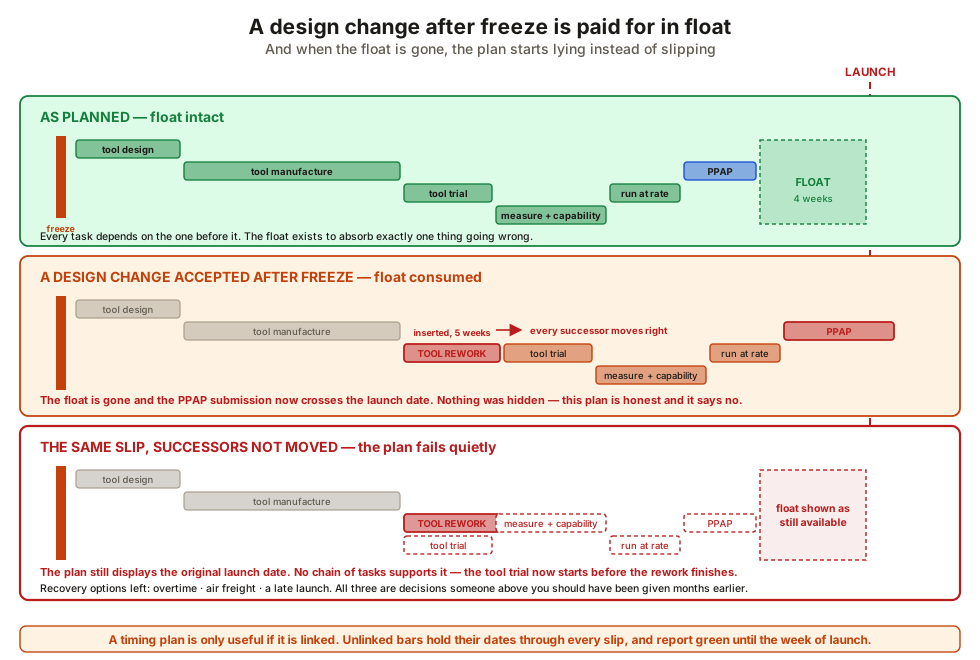
Tooling is cut from the frozen design. A change after freeze means modifying or remaking steel, and the time comes out of whatever float remained — which is the buffer that was protecting the launch, not some general slack in the middle of the plan.
The related failure is subtler. A task slips, and the dependent dates are not moved. The plan continues to display a launch date that nothing supports, and the discrepancy only becomes visible when the last task cannot start. By then the options are overtime, air freight, or a late launch.
Run at rate — three things at once
A trial that makes good parts proves the process can. Run at rate asks whether it will: the full contracted rate, sustained, with production tooling, production operators and production material.
All three conditions matter together, because the failures that appear only under the combination are the ones that ruin launches:
- Tool heating — dimensions drift once the die reaches its steady-state temperature, which never happens in a short trial.
- Operator fatigue and rhythm — cycle times that are achievable for twenty parts, not for eight hundred.
- Material handling and logistics — racks, containers, changeovers, and where the swarf goes.
- Changeover and restart, which a continuous trial never exercises.
Three control plans, on purpose
| Version | When | Character |
|---|---|---|
| Prototype | Phase 2 | Heavy dimensional and material verification |
| Pre-launch | Phase 3–4 | Tighter and more frequent than production |
| Production | After capability is demonstrated | Relaxed with evidence |
Before capability is proven, the process is protected by extra inspection. Once data shows it is capable and stable, that inspection is reduced — with the data as justification. Skip the pre-launch version and you either over-inspect forever or relax the controls on nothing but optimism. The documents themselves are covered in control plans and process flow.
What actually keeps a programme on time
- A cross-functional team from phase 1, including manufacturing and quality, not engineering alone.
- Named owners for each output. A deliverable owned by a function is owned by nobody.
- Honest replanning. Move the dependent dates when a task slips, even when the launch date then looks bad. Especially then.
- Long-lead items identified early — tooling, gauges, checking fixtures. A checking fixture ordered after the parts arrive is a guaranteed delay.
- Phase 5 resourced, before the team is dispersed.
What to take away
- APQP is front loading: find it in planning, not at launch.
- Five phases, and phase five — feedback into the FMEAs — is the one that gets dropped.
- The feasibility review is the last cheap chance to challenge a requirement.
- A gate review decides on evidence, and a gate passed on a promise is never revisited.
- Changes after design freeze consume the float that was protecting the launch.
- A plan whose successor dates are not moved reports a date nothing supports.
- Run at rate combines full rate, duration and production conditions deliberately.
- A hand-finished sample conceals exactly the variation being asked about.
- Three control plan versions exist so controls are relaxed with evidence, not hope.
- Long-lead gauges and fixtures are ordered in phase 3, not when parts arrive.
Check your understanding
10 questions. Nothing is recorded — this is just for you.