
Automotive
Locating schemes and functional build
Reference point systems and master locating points, why the same holes must be used from press shop to final assembly, and how functional build differs from building every part to nominal.
Standards referencedISO 5459ISO 1101VDA 4955ISO 10303-1ISO 2768
Two measurements of the same panel disagree. One says it is in tolerance, one says it is not, and both are correct — because they were taken from different origins. That argument consumes an extraordinary amount of engineering time, and it is entirely preventable by deciding, once, where the part is held.

One set of points, used everywhere
A reference point system — RPS in most European specifications, master locating points elsewhere — is an agreed set of locating features on a part. The value is entirely in the word agreed.
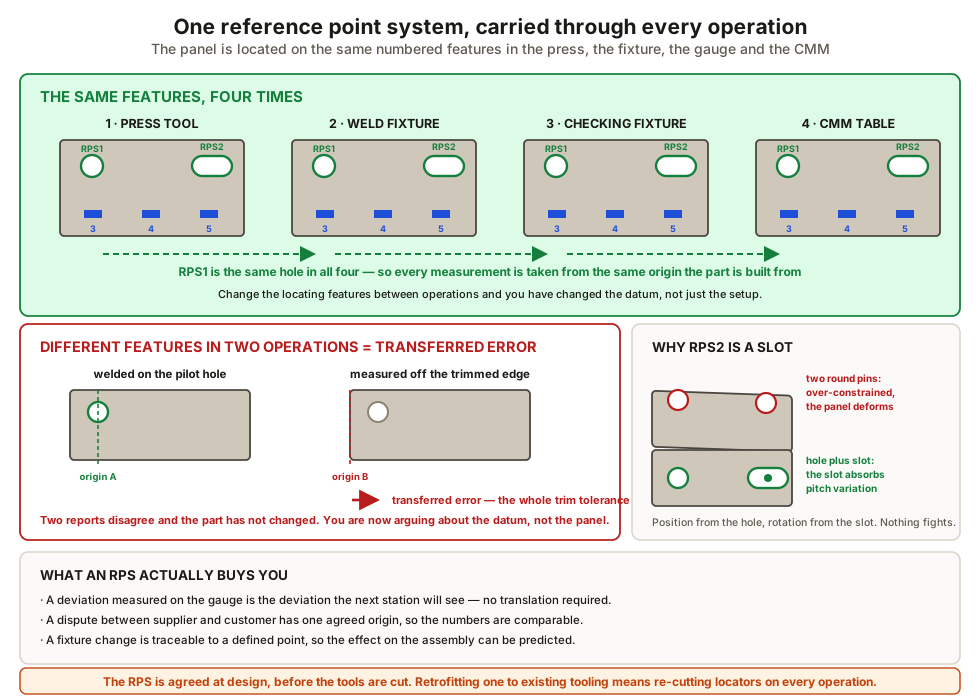
If the press tool locates on one set of features, the welding fixture on another and the CMM program on a third, then every operation is measuring from a different origin. Variation is always relative to something, so relocating a part imports the error between the old features and the new ones. Neither measurement is wrong. They are answering different questions.
Two practical rules follow:
- Pierce the locating hole in the press tool, ideally in the same station that forms the nearby surfaces. A hole added in a later operation carries that operation’s locating error on top of the forming variation.
- Make the locators coincide with the GD&T datums. If the drawing controls a feature relative to datums A, B and C but the fixture holds three different features, the tolerance being verified is not the tolerance specified. That relationship is the practical point of datums and datum reference frames.
Functional build
The instinctive approach to a body assembly is to build every part to nominal and expect the assembly to follow. In practice it does not work, because the number of parts and operations is large and the tolerances interact.
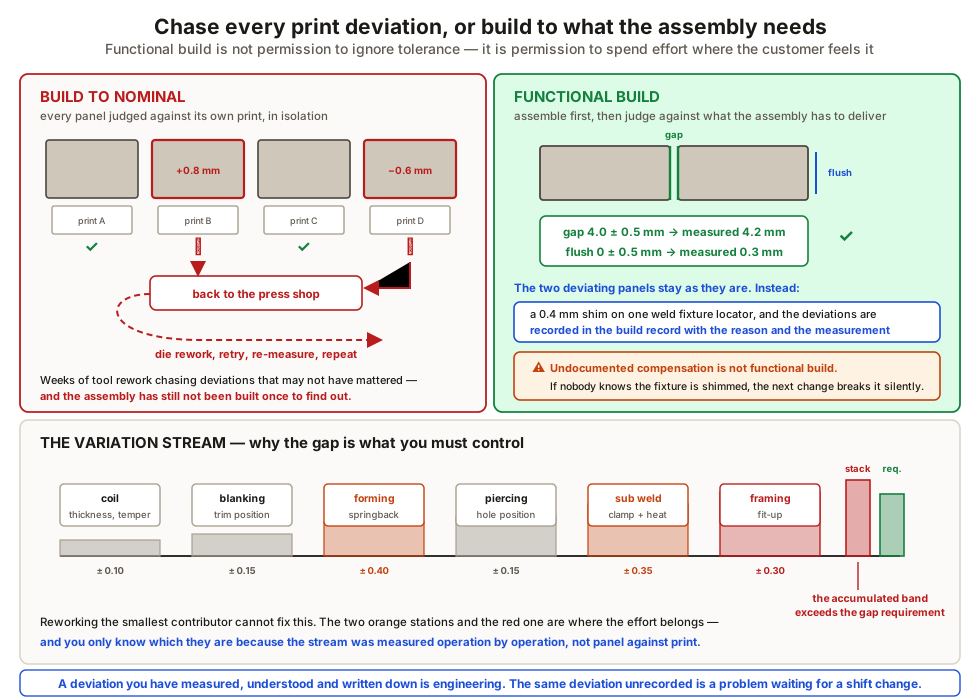
Functional build accepts a part that deviates from nominal if the assembly it produces meets its functional requirement. The deviations are measured, understood, and compensated in the tooling rather than chased back to the panel print.
| Build to nominal | Functional build | |
|---|---|---|
| Judged against | Each part’s own print | The assembly requirement |
| Response to deviation | Correct the part | Understand it, compensate the tooling |
| Speed to launch | Slow | Much faster |
| Risk | Rework loops on parts that were adequate | Accumulated corrections nobody can unpick |
This is why a gap-and-flush requirement is written at assembly level. A gap is the difference between two edges, so it depends on both panels and on how each was located, and many combinations of panel deviations give an acceptable gap.
Variation streams
Each operation adds its own variation and inherits everything upstream. The variation stream is that chain: coil, blank, form, pierce, subassembly, framing, final.
The reason to map it is that the intuitive response to an out-of-specification gap — tighten the tolerance on whichever part is easiest to change — is usually wrong. The dominant contributor is often an operation nobody was looking at, and tightening an innocent tolerance costs money and fixes nothing.
The arithmetic of how those contributions combine is tolerance stacks; the stream is what tells you which stack to compute.
Getting it right at the start
- Agree the RPS before the tooling is ordered. Retrofitting a locating scheme means new press tools.
- Put locators on stiff, formable, accessible features. A locator on a flexible flange measures the flange, not the part.
- Use the same numbering everywhere — drawing, press tool, weld fixture, checking fixture, CMM program. RPS1 must mean the same thing in all five.
- Specify the clamping order, because a part located and then clamped in a different sequence sits differently.
- Keep the scheme when the part changes. A design revision that moves a locating hole invalidates every downstream fixture.
What to take away
- An RPS is one agreed set of locating features, used at every operation.
- Relocating a part imports the error between the old origin and the new one.
- Hole and slot, not two round pins — the slot absorbs pitch variation.
- Pierce locating holes in the press tool, with the surfaces they relate to.
- Make the locators coincide with the GD&T datums, or the inspection verifies something else.
- Functional build judges the assembly, not each part print.
- A gap requirement belongs at assembly level, because a gap involves two parts.
- Functional build without documentation becomes corrections nobody can unpick.
- Map the variation stream to find the contributor that matters.
- Agree the scheme before tooling is ordered; retrofitting it means new tools.
Check your understanding
10 questions. Nothing is recorded — this is just for you.