
Automotive
Tolerance stacks
Worst-case against root-sum-square, when each one is honest, how to build a stack loop that does not lie, and why a design that only works on paper fails on the line.
Standards referencedASME Y14.5ISO 1101AIAG PPAPISO 22514-2
Every part in an assembly is in tolerance. The assembly does not go together. This topic is about finding that out with a pencil instead of on the line.
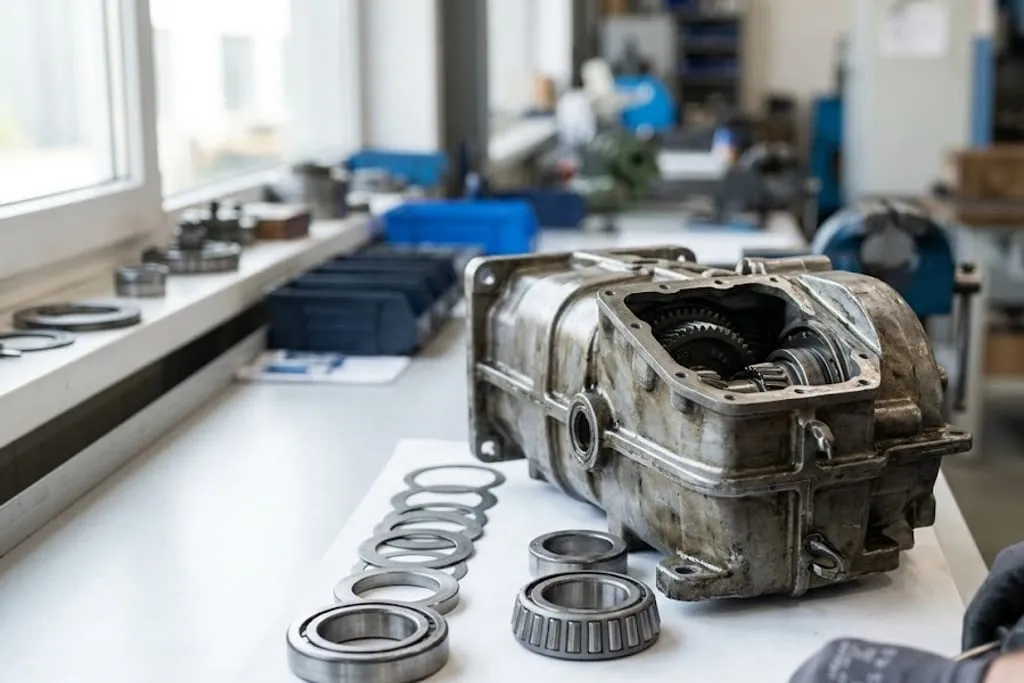
The loop
A stack is a closed chain of dimensions, starting at one face of the gap you care about, running through the parts by way of features that genuinely locate one another, and returning to the other face of the gap.
Two rules decide whether the answer means anything:
- The loop must close. Start and finish at the two faces forming the gap.
- It must pass only through real contacting features. A dimension that nothing actually locates from does not belong in the chain, however neatly it is drawn.
Two ways to add up

Worst case adds every tolerance in the loop:
4 contributors at ± 0.1
worst case  =  0.1 + 0.1 + 0.1 + 0.1  =  ± 0.4
No assembly can ever fail. It is an arithmetic guarantee, and that is why it is used on safety-critical items, low-volume builds and anything where a single failure is unacceptable.
Root sum square assumes the contributors vary independently and rarely conspire:
RSS = √(0.1² + 0.1² + 0.1² + 0.1²) = √0.04 = ± 0.2Half the stack, for nothing but a change of assumption. On a high-volume assembly that is usually the difference between a design that can be made and one that cannot.
Where the tolerance actually goes
| Lever | Typical effect | Cost |
|---|---|---|
| Remove a part from the loop | Removes a whole contributor permanently | Usually the cheapest of all |
| Attack the two largest contributors | Most of the gain, small change | Low |
| Tighten everything proportionally | Same gain, every part more expensive | High |
| Switch worst case to RSS | Halves the number on paper | Free, and sometimes dishonest |
Two things that are usually left out and should not be
Bonus tolerance. The bonus from a maximum material condition modifier appears only as a feature departs from maximum material — and the worst case is defined at maximum material, where the bonus is zero. Counting it in a worst-case stack claims tolerance that is absent exactly when it is needed.
Temperature. An aluminium housing on a steel shaft through a hundred-degree rise moves the gap by more than the entire manufacturing spread. A stack computed at 20 °C for an assembly that runs hot has answered a question nobody asked.
What to take away
- A stack is a closed loop through genuinely contacting features. If it does not close, it describes a different assembly.
- Worst case adds tolerances and guarantees fit. Use it for safety-critical and low volume.
- Root sum square combines them as √(Σt²) and recovers roughly half — when the contributors are independent, centred and numerous.
- Correlated tools, off-centre processes and small builds all break the RSS assumptions quietly.
- Removing a part from the loop beats tightening any tolerance in it.
- Exclude bonus tolerance from a worst-case stack; it is zero where the worst case lives.
- Include thermal effects on anything that runs hot or mixes materials.
- A negative minimum gap means some in-tolerance parts will not assemble. Believe it.
Check your understanding
10 questions. Nothing is recorded — this is just for you.