
Automotive
Heat treatment of steels
Annealing, normalising, quenching and tempering explained through what happens to the microstructure, why hardenability is not hardness, and why distortion and quench cracking decide the process route.
Standards referencedISO 683-1ISO 642ASTM A255ISO 6508-1SAE J404
Two parts, same steel, same drawing. One lasts the life of the vehicle and one snaps. The difference is not on the drawing’s dimension lines — it is the thermal history the part went through, and that is what heat treatment specifies.
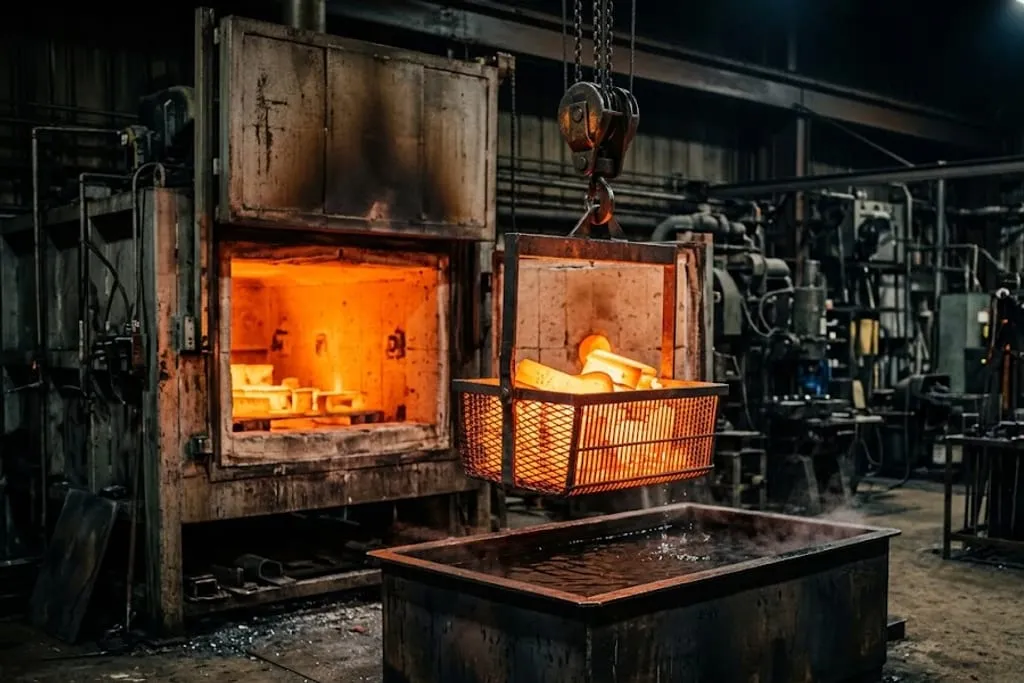
The one mechanism underneath all of it
Heat a steel above its transformation temperature and the carbon dissolves into austenite. What happens next depends entirely on how fast you cool it:
slow   (furnace)  ->  annealed     soft, coarse, very machinable
medium (still air) ->  normalised   uniform fine grain
fast   (oil/water) ->  martensite   very hard, very brittle, highly stressed
Cool slowly and the carbon has time to come out as soft carbides. Cool fast enough and it is trapped in a distorted lattice with nowhere to go. That trapped, strained structure is martensite, and it is hard for exactly that reason.

The four operations
| Operation | Cool how | Result | Used for |
|---|---|---|---|
| Annealing | Furnace, very slow | Softest, coarsest | Machinability, formability, supplied stock |
| Normalising | Still air | Uniform fine grain | Recovering from forging or casting |
| Quenching | Oil or water | Martensite — hard, brittle, stressed | Making it hard |
| Tempering | Reheat below transformation | Hardness traded for toughness | Making it usable |
Hardenability is not hardness
This is the distinction that separates people who specify steels from people who copy them.
- How hard it can get is set almost entirely by carbon content.
- How deep that hardness reaches is set by alloying — chromium, nickel, manganese, molybdenum — which slow the transformation and let a milder quench still form martensite.
That second property is hardenability. A plain carbon steel and an alloy steel with the same carbon can reach the same surface hardness and behave entirely differently in a 60 mm shaft: the plain steel is hard for a few millimetres over a soft core, the alloy steel is hard most of the way through.
Distortion and quench cracking
Martensite occupies more volume than the austenite it came from. So a surface that transforms while the core is still hot puts the part into severe internal tension — and the material at that moment is at its most brittle.
Which is why the machining comes first
The standard route for a hardened precision part is:
rough machine -> harden and temper -> grind the features that matterMachining hardened steel is slow and expensive, and hardening moves the part anyway. So the finishing allowance is planned before hardening and removed by grinding afterwards — see machining processes for why grinding is what takes over once the part is hard.
Where only the surface needs to be hard and the core must stay tough, the answer is a different family of processes entirely — case hardening and surface engineering.
What to take away
- All of it comes down to how fast the carbon is cooled out of austenite.
- Annealing softens, normalising refines grain, quenching hardens, tempering makes it usable.
- Never leave a part as quenched — it is brittle and stressed and can crack unattended.
- Tempering temperature is the hardness against toughness dial.
- Carbon sets how hard. Alloying sets how deep. That is hardenability.
- Choose the grade from the section thickness, not from the hardness number.
- Martensite expands, so quenching puts the part in tension where it is most brittle.
- Radii, mild quench, sensible fixturing — in that order of effect.
- Machine soft, harden, grind. Plan the allowance before the part goes in the furnace.
Check your understanding
10 questions. Nothing is recorded — this is just for you.