
Rotating Equipment
Gearboxes and couplings — the parts between the driver and the machine
Why a service factor is not padding, what a coupling is actually for beyond joining two shafts, why a flexible coupling does not forgive misalignment, and the failures that show up in the gearbox but started somewhere else.
Between the driver and the machine there are usually two components that nobody thinks about until one of them fails: a coupling, and sometimes a gearbox. Both are simple in principle, and both fail for reasons that started somewhere else.
Why a gearbox is there at all
Machines want different speeds. A motor runs at whatever the supply frequency and its pole count give it. A centrifugal compressor may want far more, a large agitator or a crusher far less. A gearbox is what reconciles them.
The gearbox does not change the power passing through it, only the trade between speed and torque — reduce the speed and the torque rises in proportion. That is worth holding onto, because it explains why the low-speed shaft of a reduction gearbox is so much heavier than the high-speed one.
Service factor: sizing for how the power arrives
A gearbox is not selected by transmitted power alone. It is selected by power multiplied by a service factor that reflects the character of what is on each end.
Starting matters for the same reason. A machine started direct-on-line applies a torque spike far above its running value, and a gearbox sized only for running torque sees that spike every start.
Couplings: what they are actually for
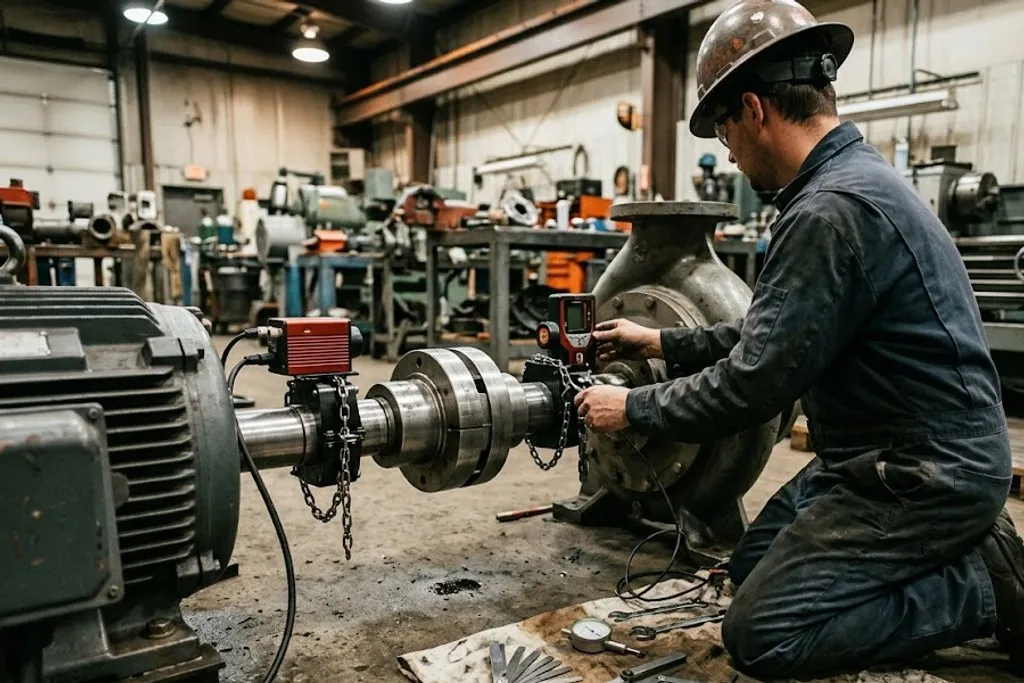
Two shafts have to be joined, and a rigid connection between them would be unforgiving of anything less than perfect alignment. So couplings are flexible.
That word causes most of the misunderstanding on this subject.
The two families
Gear couplings have external teeth on a hub meshing with internal teeth on a sleeve. Misalignment is accommodated by the teeth sliding against one another as the shaft turns.
That sliding is the whole story. Sliding under load needs a lubricating film, so a gear coupling must be greased or oil fed, and the lubricant must be changed. A gear coupling that has been allowed to run dry wears its teeth, loses its ability to accommodate anything, and starts behaving like a rigid connection — with the bearing consequences described above.
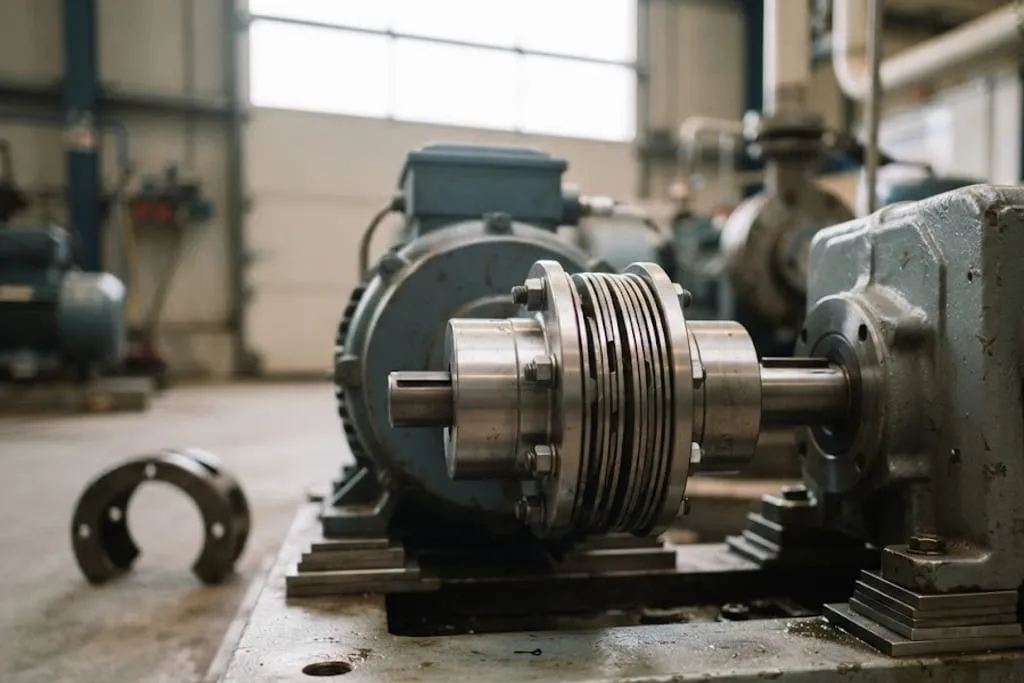
Disc and diaphragm couplings accommodate misalignment by flexing a pack of thin metal discs. Nothing slides, so nothing needs lubrication. They are lighter, they need no maintenance, and they have displaced gear couplings on most new machines. Their failure mode is different: discs crack, usually because they have been asked to flex more than they were designed to.
| Gear | Teeth slide against each other as the shaft turns | Grease or continuous oil — essential | Tooth wear once the film is lost, then behaves as a rigid joint | Older and high-torque installations; largely superseded on new machines |
|---|---|---|---|---|
| Disc pack | A pack of thin metal discs flexes elastically | None | Discs crack in fatigue when flexed beyond design | The default on new process machinery |
| Diaphragm | A contoured metal diaphragm flexes | None | Diaphragm fatigue cracking | High speed turbomachinery |
| Elastomeric | A rubber or polyurethane element deflects | None | Element hardens, cracks and loses torsional damping | Smaller general-purpose drives; damps torsional pulses |
| Grid | A serpentine steel grid flexes in slots | Grease | Grid fatigue, slot wear | General industrial drives with shock loading |
| Rigid | It does not — the shafts are effectively one | None | Bearing and shaft damage if alignment is imperfect | Vertical pumps and cases where the shafts share bearings |
No rows match that filter.
Every type accommodates only small residual misalignment. None of them corrects it — whatever is left after alignment is passed into the bearings on both sides.
Where gearbox trouble actually comes from
A gearbox converts a small and predictable fraction of what it transmits into heat. When it runs hotter than that fraction allows, work is being done somewhere it should not be.
The usual causes, in the order worth checking:
Misalignment, which loads the teeth across their face unevenly instead of across the whole width. Look at the tooth contact pattern — a band at one end rather than an even stripe tells the story immediately.
Overload, including a duty that has crept up since the gearbox was chosen, or a service factor that was optimistic to begin with.
Lubrication. Wrong grade, wrong level, water contamination, or an oil that has been in service far too long. A milky sample is water; a darkened one that smells burnt has been too hot for too long.
Soft foot and pipe strain, which distort the casing and take the bearings and the gear mesh out of their intended relationship. The gearbox reports a problem that was created by the pipework.
Torsional vibration: the one nobody is watching
Everything measured on a machine train is usually lateral — probes at the bearings, watching the shaft move sideways. Torsional vibration is different: the shaft line twisting back and forth along its own axis.
The guard
What to take away
- A gearbox trades speed for torque and passes the power through. The low-speed shaft is heavier because it carries the higher torque.
- The service factor sizes it for the character of the duty. Smooth, pulsing and shock loads of the same average power are not the same job.
- A flexible coupling accommodates residual misalignment — it does not correct misalignment, and the forces go into the bearings.
- Gear couplings slide and must be lubricated; disc couplings flex and need nothing. A dry gear coupling becomes effectively rigid.
- The spacer length exists so seals can be changed without moving the driver.
- A hot gearbox is reporting misalignment, overload, lubrication or pipe strain far more often than worn gears.
- Torsional vibration is invisible to lateral probes and breaks couplings and gear teeth without warning. Do not substitute a coupling type casually.
- The guard goes on before the machine turns, every time.
Check your understanding
7 questions. Nothing is recorded — this is just for you.