Rotating Equipment
Compressors — surge, staging and the machine you cannot replace quickly
Why gas is harder than liquid, what surge actually does to a centrifugal compressor, why compression is staged with intercooling, and why liquid in a suction line is catastrophic.
Pumps move liquid. Compressors move gas, and the difference is not a detail: gas is compressible. Squeezing it changes its density, its volume and — above all — its temperature.
Compressors are also usually the most expensive machines on a unit, with the longest replacement lead times. A destroyed compressor is frequently a destroyed year.
The two families, again
| Centrifugal | Dynamic | Falls as discharge pressure rises | High flow, moderate pressure ratio, continuous duty | Surge — the defining hazard of this machine |
|---|---|---|---|---|
| Axial | Dynamic | Very high, over a narrow range | Very large volumes at modest ratio — air separation, blast furnace air | Even narrower operating window than a centrifugal |
| Reciprocating | Positive displacement | Fixed volume per stroke, whatever the pressure | High pressure ratios, low to moderate flow | Pulsating flow, and valves are a constant maintenance item |
| Screw, oil flooded | Positive displacement | Fixed volume per revolution | Steady flow, dirty or wet gas, refrigeration duty | Oil carryover into the process needs separation |
| Screw, dry | Positive displacement | Fixed volume per revolution | Where oil must not contact the gas at all | Tighter clearances, so more sensitive to fouling |
| Diaphragm | Positive displacement | Fixed and small | Very high purity or toxic gas with no leak path | Low capacity, and the diaphragm is a wear item |
No rows match that filter.
The same split as pumps — dynamic machines whose output depends on the resistance they meet, and positive displacement machines that deliver a fixed volume regardless. The consequences are the same too, and just as unforgiving.
The same split as pumps, with the same consequences:
- A dynamic machine — centrifugal or axial — delivers flow that depends on the resistance it meets.
- A positive displacement machine — reciprocating, screw, diaphragm — delivers a fixed volume regardless of pressure.
And the same hard rule follows: a positive displacement compressor with a blocked discharge will raise pressure until something bursts. A relief valve on the discharge, upstream of any isolation valve, is not optional.
Compression makes heat
This is the constraint that shapes the machine.
Compressing gas raises its temperature substantially — enough that a single stage taking gas from suction to final pressure would often exceed what seals, lubricants and materials can take, and in some services enough to risk ignition.
So compression is staged, with an intercooler between stages. That does two things:
- Keeps discharge temperature within limits at every stage.
- Cools the gas, making it denser, so the next stage does less work for the same pressure rise.
Each intercooler usually has a knock-out drum after it, because cooling gas condenses liquid out of it — and liquid is what the next stage must not receive.
Surge
Surge is the defining hazard of a centrifugal compressor and has no equivalent in a pump.
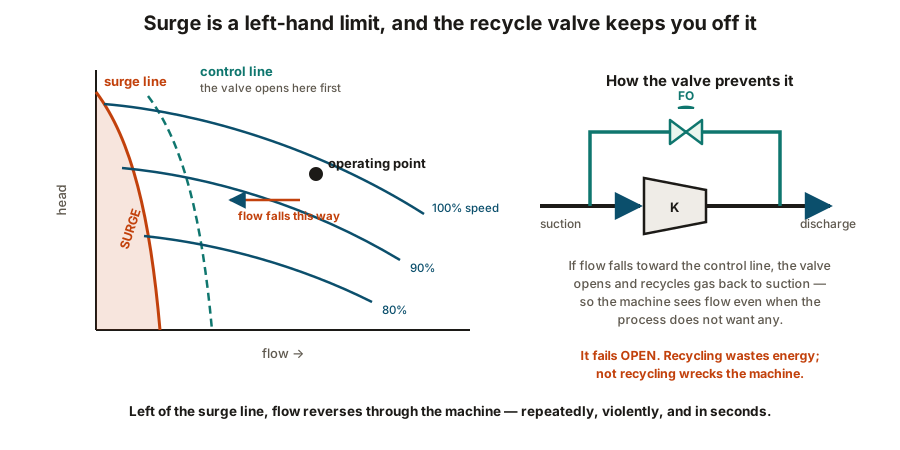
A centrifugal compressor develops head by accelerating gas. Below a certain flow it can no longer sustain the pressure it has already built against the system downstream — so gas flows backward through the machine, pressure collapses, forward flow resumes, and the cycle repeats.
That cycle happens several times a second, with full reversal of thrust each time.
Anti-surge control is what prevents it. A fast recycle valve returns gas from discharge back to suction, so the compressor sees flow even when the process does not want any.
The control line is set deliberately to the right of the surge line — the valve starts opening before the machine reaches its limit, because by the time it arrives it is too late.
Liquid is the other way to destroy one
| Surge | Flow reverses through the machine, repeatedly and violently | Anti-surge control with a fast recycle valve | Seconds of severe surge can wreck a rotor and its bearings |
|---|---|---|---|
| Liquid carryover | Incompressible liquid enters and destroys internals immediately | Suction knock-out drum with high level trip | On a reciprocating machine this bends rods and breaks valves |
| Loss of lube oil | Bearings fail within seconds | Low oil pressure trip, standby pump, accumulator run-down | The run-down accumulator covers the gap while the standby starts |
| Loss of seal gas | Process gas escapes along the shaft, or the seal is damaged | Seal gas differential pressure monitoring and trip | Dry gas seals need clean, dry gas at a controlled differential |
| Overspeed | Rotor stress rises with the square of speed | Independent overspeed trip on turbine drives | Separate from the governor, deliberately |
| Excessive vibration | Bearing damage, rub, eventual catastrophic failure | Proximity probes with alarm and trip levels | Trends matter more than absolute values |
| High discharge temperature | Compression heats the gas; too high damages seals and can ignite | Temperature trip, intercooling between stages | Temperature rise per stage is what drives multi-staging |
| Blocked discharge on a PD machine | Pressure rises until something bursts | Relief valve on the discharge, before any isolation valve | Exactly as for a positive displacement pump — not optional |
No rows match that filter.
A large compressor is often the single most expensive item on a unit and the one with the longest replacement lead time. That is why it carries more protection than anything else on the plant, and why almost none of it may be bypassed.
Gas compressors are built to compress gas. Liquid is effectively incompressible, and a machine that receives it has nowhere to put it.
On a reciprocating machine the result is immediate and mechanical — broken valves, bent rods, damaged cylinders. On a centrifugal machine liquid erodes impellers and unbalances the rotor.
That is why a suction knock-out drum sits ahead of every compressor, with a high level trip on it. It is also why that trip is among the least bypassable on a plant.
Seals, oil and the auxiliaries
A large compressor is surrounded by supporting systems, and most trips come from them rather than from the compressor itself.
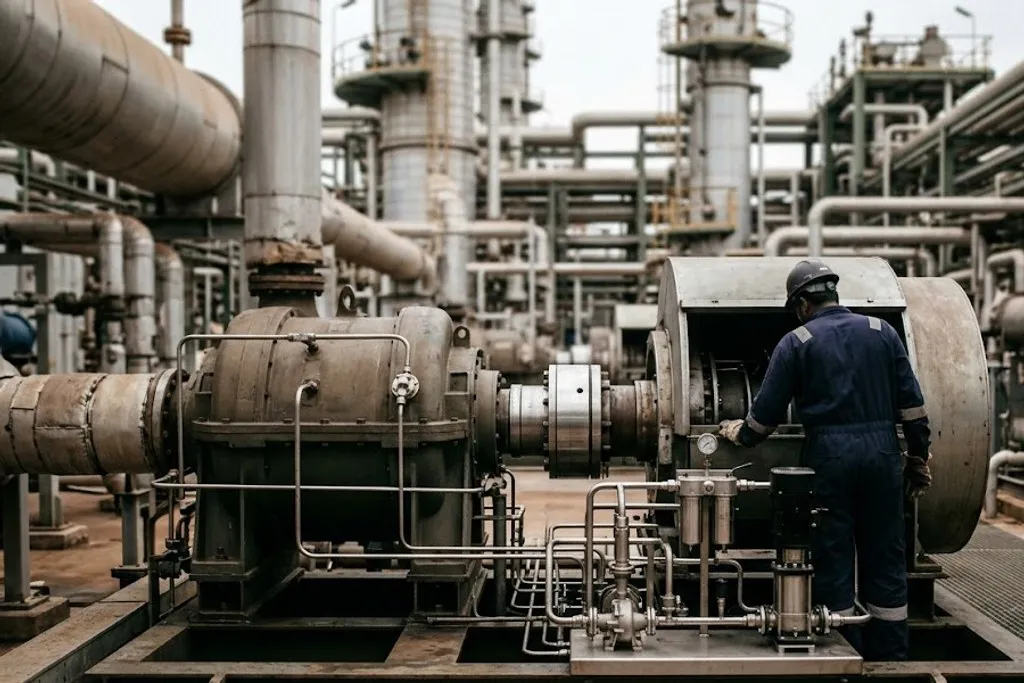
Dry gas seals are the modern standard for centrifugal machines — two very flat faces with a thin film of clean gas between them, keeping process gas from escaping along the shaft. They need clean, dry seal gas at a controlled differential pressure, and losing that supply is a trip.
Lube oil feeds the bearings, which fail within seconds without it. So there is a main pump, a standby pump, and usually an elevated tank or accumulator that keeps oil flowing during the seconds it takes the standby to start and build pressure.
Drivers are electric motors, steam turbines or gas turbines. Turbine drives carry their own governor plus a deliberately independent overspeed trip, because rotor stress rises with the square of speed.
Capacity control
Compressors rarely run at exactly the flow required, and how you turn them down matters:
- Speed control — the most efficient, via a variable speed drive or a turbine.
- Suction throttling — simple, moderately efficient, moves the operating point toward surge.
- Inlet guide vanes — on larger centrifugals, adjusting the angle gas enters the impeller.
- Recycle — always available, always the least efficient. You are compressing gas and then letting it back down.
- Unloaders and clearance pockets — on reciprocating machines, effectively disabling part of a cylinder’s capacity.
What to take away
- Gas is compressible, so compression makes heat. That is why stages and intercoolers exist.
- Dynamic machines depend on resistance; positive displacement ones do not and need a relief valve.
- Surge is flow reversing through a centrifugal machine, several times a second. It damages in seconds.
- The anti-surge control line sits to the right of the surge line, and the valve fails open.
- Liquid in the suction destroys a compressor. The knock-out drum trip is not a nuisance alarm.
- Most trips come from the auxiliaries — seal gas, lube oil, vibration — not the machine.
- Continuous recycling means something is oversized or has changed.
Check your understanding
10 questions. Nothing is recorded — this is just for you.