Process
What the plant actually does — the shape of a process
Every plant is built from the same short list of unit operations. How a refinery, a petrochemical complex and a pharmaceutical plant differ, and why the process engineer's decisions land on everyone else's desk.
Standards referencedASME B31.3API 560
Everything else on this site describes how a plant is built. This section is about what it is for — because a pipe specification, a foundation and a control loop all trace back to a process decision somebody made first.
Plants are assembled from a short list
However complex a flow scheme looks, it is made of repeated basic steps called unit operations.
| Distillation | Separates liquids by boiling point | Column with trays or packing, reboiler, condenser | Crude units, gas plants, solvent recovery |
|---|---|---|---|
| Heat transfer | Adds or removes heat | Shell and tube exchangers, air coolers, fired heaters | Everywhere — usually the largest equipment count on a plant |
| Reaction | Converts one chemical into another | Fixed bed, fluidised bed or stirred tank reactors | Crackers, reformers, polymerisation, API synthesis |
| Phase separation | Splits gas, oil and water that arrive mixed | Knock-out drums, three-phase separators, coalescers | Wellhead facilities, compressor suctions, flare systems |
| Absorption and stripping | Moves a component between a gas and a liquid | Packed or trayed columns | Amine treating, glycol dehydration, sour water stripping |
| Filtration and solids separation | Removes solids from a fluid | Filters, centrifuges, cyclones, hydrocyclones | Catalyst recovery, pharma isolation, produced water |
| Drying | Removes moisture from a solid or a gas | Tray and fluid bed dryers, molecular sieve beds | Pharma powders, polymer pellets, gas dehydration |
| Fluid transport | Moves liquid and gas where it needs to go | Pumps, compressors, blowers, piping | Every stream on the plant |
| Storage and blending | Holds inventory and mixes to specification | Tanks, spheres, bullets, in-line blenders | Tank farms, product despatch |
| Mixing and agitation | Keeps a vessel uniform, or disperses one phase in another | Agitated vessels, static mixers | Batch reactors, pharma formulation, chemical dosing |
No rows match that filter.
However complex a plant looks, it is assembled from a short list of repeated operations. Learn these and an unfamiliar flow scheme stops being intimidating — you are only ever looking at separation, reaction, heat transfer and moving things about, arranged in a particular order.
That is very nearly the whole vocabulary. An unfamiliar plant stops being intimidating once you realise you are only ever looking at separation, reaction, heat transfer and moving things about, arranged in a particular order for a particular feed.
A refinery, in outline
Crude oil is not one substance. It is a mixture of thousands of hydrocarbons, and a refinery does three things to it in sequence.
1. Separate
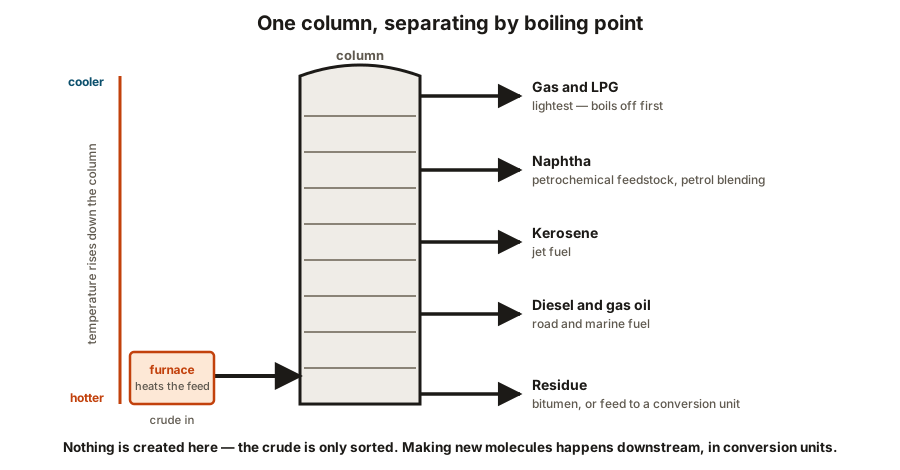
The crude distillation unit heats the crude and separates it by boiling point. Light material rises and is drawn off near the cool top; heavy material stays low.
2. Convert
Conversion units break heavy molecules into lighter, more valuable ones:
- Catalytic cracking (FCC) — cracks heavy gas oil into petrol and lighter products over a circulating catalyst.
- Hydrocracking — cracks in the presence of hydrogen, giving cleaner, more saturated products.
- Reforming — rearranges naphtha into higher-octane molecules, producing hydrogen as a by-product that other units then consume.
- Coking — takes the heaviest residue and forces it into lighter products, leaving solid petroleum coke.
This is where a refinery makes its margin, and it is why conversion units run hot, at pressure, often in hydrogen — which is exactly why alloy piping materials exist.
3. Treat and blend
Treating removes what the specification forbids — sulphur above all, using hydrotreating and amine systems. Blending then mixes streams to hit each product’s specification for octane, cloud point, flash point and sulphur.
The product leaving the gate is a blend, not a single stream from a single unit.
Petrochemicals: making materials rather than fuels
A petrochemical complex takes refinery streams — naphtha, ethane, LPG — and makes building block chemicals rather than fuel.
A steam cracker heats hydrocarbon feed with steam to around 850 °C for a fraction of a second, breaking it into ethylene, propylene and other olefins. Those feed polymerisation units that make polyethylene, polypropylene and the rest of the plastics chain.
The characteristic features, and their engineering consequences:
- Extreme temperatures in cracking furnaces — exotic alloys, and thermal expansion as a dominant design problem.
- Deep heat integration — the plant reuses its own heat many times over, so a change anywhere ripples everywhere.
- Cryogenic separation — olefins are separated cold, bringing low-temperature materials and insulation.
Pharmaceutical manufacture: a different set of priorities
The same unit operations again — reaction, separation, drying, filtration — with an entirely different thing being optimised.
| Oil and gas | Continuous, running for years between shutdowns | Containing large hydrocarbon inventories safely | Very large, single trains | Corrosion, sour service, temperature extremes |
|---|---|---|---|---|
| Petrochemical | Continuous, tightly integrated units | Reaction control, selectivity and energy efficiency | Large, heavily heat-integrated | High temperature, hydrogen service, catalyst compatibility |
| Pharmaceutical | Mostly batch, frequent product changeovers | Product purity, cleanability and documented traceability | Small volumes, very high value | Cleanability and non-contamination, not corrosion |
No rows match that filter.
The engineering vocabulary is shared across all three, but what the design is optimised for is not. Read the 'what dominates design' column — it explains most of the differences you will meet in specifications, and why an engineer moving between them finds the habits so different.
Pharma splits into two stages:
- API manufacture (the active ingredient) — chemical synthesis, closest in character to fine chemicals.
- Formulation — turning that ingredient into tablets, injectables or creams.
Three features shape the engineering:
Batch, not continuous. The same vessel makes product A this week and product B next. That drives changeover, cleaning validation and shared-equipment risk.
Cleanability over corrosion. In oil and gas the material fights the process; here it must not contaminate the product. Hence 316L, measured surface finish, full drainability, no dead legs — as covered in pipe materials.
Documentation as product. Under GMP, an undocumented batch is an unsellable batch. Qualification, calibration records and change control are part of the deliverable, not overhead.
Why this lands on every other discipline
Process decisions arrive first and propagate outward. A single change — say design temperature from 380 °C to 450 °C — moves through:
- Material selection, because carbon steel is no longer suitable
- Flange ratings, which fall with temperature
- Thermal expansion, so the supports and loops change
- Insulation, personnel protection and heat conservation
- Instrument selection, seals, impulse lines and tracing
- Structural loads, from the heavier pipe and larger supports
- Area classification, if the inventory or release characteristics change
This is why the PFD and P&ID are where every discipline meets, and why the P&ID topic matters to more people than instrument engineers. The process engineer defines the problem. Everyone else solves their part of it.
What to take away
- Plants are built from a short list of unit operations. Learn those and flow schemes become readable.
- A refinery separates, converts, then treats and blends. Distillation only sorts — conversion makes new molecules.
- Petrochemical plants make materials rather than fuels, at extreme temperatures and with deep heat integration.
- Pharma uses the same operations but optimises for purity, cleanability and documentation, usually in batches.
- Process decisions arrive first and land on every other discipline. The P&ID is where they all meet.
Check your understanding
10 questions. Nothing is recorded — this is just for you.