Process
Distillation columns — reflux, reboil and the operating window
Why one boiling stage is never enough, what reflux actually buys you, how trays and packing do the same job differently, and why a column has a narrow range it will work in.
Standards referencedAPI 660ASME Section VIII
What the plant does introduced distillation as the operation that sorts a mixture by boiling point. This page is about how a column actually achieves it.
One stage is never enough
Boil a mixture and the vapour comes off richer in the lighter component — but not pure. Condense that vapour and boil it again, and it gets richer still. Do it enough times and you approach a clean separation.
A distillation column is simply a way of stacking many of those steps into one vessel, and running them all continuously.
Vapour up, liquid down
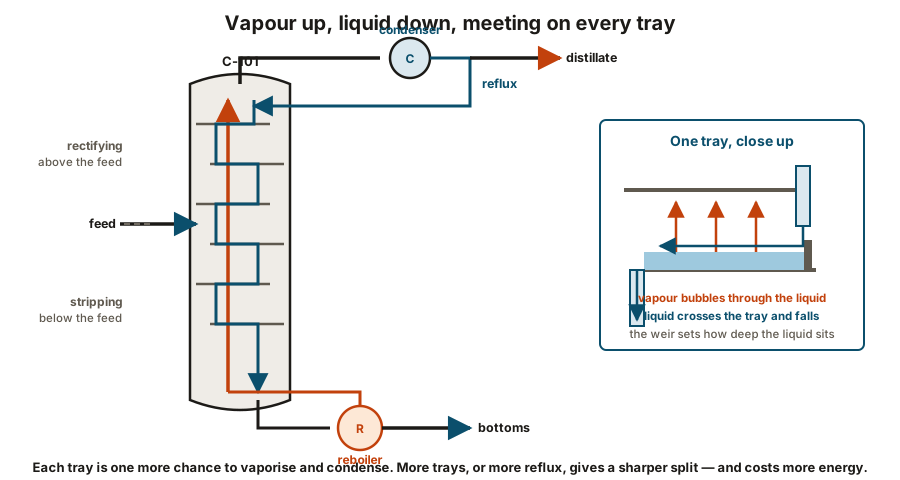
Two counter-current streams meet on every tray:
- Vapour rises from the reboiler at the bottom, getting richer in the light component as it goes.
- Liquid falls from the reflux at the top, getting richer in the heavy component.
Where they meet on each tray, they exchange: some of the light component evaporates out of the liquid, some of the heavy component condenses out of the vapour. That exchange, repeated up the column, is the separation.
The feed enters partway up, splitting the column into two sections:
- Rectifying, above the feed — enriching the overhead product.
- Stripping, below the feed — driving light material out of the bottoms.
The two things you actually adjust
Reflux. The overhead vapour is condensed, and only part of it is taken as product. The rest is returned to the top of the column as liquid. That returned fraction is the reflux, and the ratio of reflux to product is the reflux ratio.
More reflux means more liquid traffic, more contact and a sharper separation.
Reboiler duty. How much vapour is generated at the bottom. Together with reflux it sets the vapour and liquid traffic, and therefore the separation.
The two are linked — change one and the other follows — which is why column control is less obvious than it looks and why the two ends of a column interact.
Trays or packing
| Sieve tray | Vapour rises through perforations into liquid held on the deck | Cheap, simple, the default for clean service | Weeps at low rates — liquid falls through the holes |
|---|---|---|---|
| Valve tray | Liftable caps open and close with vapour rate | Much better turndown than a sieve tray | Valves can stick, corrode or be lost from the deck |
| Bubble cap tray | Vapour passes under a cap and bubbles through a liquid seal | Holds liquid on the tray at very low rates | Expensive, high pressure drop, largely superseded |
| Random packing | Dumped shaped elements give a large wetted surface | Low pressure drop, corrosive service, small columns | Liquid maldistribution, and channelling down the wall |
| Structured packing | Corrugated sheets arranged in ordered layers | Very low pressure drop, high efficiency, vacuum service | Fouls badly, and needs careful liquid distribution |
| Liquid distributor | Spreads liquid evenly over the packing below it | Not optional — packing only works if wetted evenly | Plugged distributor holes ruin the whole section's performance |
No rows match that filter.
Both do the same job: bring rising vapour and falling liquid into intimate contact, over and over. Trays do it in discrete steps on horizontal decks; packing does it continuously over a wetted surface. The choice turns on pressure drop, turndown and how dirty the service is.
Both bring vapour and liquid into contact repeatedly. Trays do it in discrete steps on horizontal decks; packing does it continuously over a wetted surface.
- Trays suit most services, tolerate some fouling, and handle a range of rates.
- Packing gives much lower pressure drop, which matters enormously in vacuum service where every millibar of drop raises the bottom temperature.
Pressure is a design decision
Column pressure is chosen, not inherited. It sets:
- Boiling temperatures, and therefore what heating and cooling media are needed. If the overhead can be condensed with cooling water rather than refrigerant, the plant is far cheaper.
- Relative volatility — components generally separate more easily at lower pressure, which is why difficult separations run under vacuum.
- Bottom temperature, which must stay below whatever the material degrades or cokes at.
Vacuum distillation exists because heavy hydrocarbon would crack before it boiled at atmospheric pressure. Dropping the pressure lets it boil at a temperature it survives.
The operating window
A column works between two limits, and both are physical.
Flooding is the upper limit. Push too much vapour up and it prevents liquid draining down the downcomers. Liquid accumulates, pressure drop climbs sharply, and the separation collapses.
Weeping is the lower limit. The vapour flowing up through the tray perforations is what holds the liquid on the deck. Below a certain rate the liquid simply falls through, bypassing the contact the tray exists to provide.
Between those sits the turndown range — and it is narrower than people expect, which is why a plant designed for one throughput often runs badly at half of it.
| Pressure drop rising sharply, separation collapsing | Flooding — liquid carried up the column instead of down | Vapour rate, reboiler duty, and whether the feed has changed |
|---|---|---|
| Separation poor at low throughput | Weeping or dumping — liquid falling through the trays | Whether the column is below its turndown limit |
| Erratic pressure drop and unstable levels | Foaming, often from surfactants or a contaminant in the feed | Feed quality; antifoam injection may be needed |
| Separation never recovers after an upset | Mechanical damage — trays lifted or collapsed by a pressure surge | Requires internal inspection; it will not come back on its own |
| Gradual loss of performance over months | Fouling of trays, packing or the distributor | Pressure drop trend against throughput over time |
| Off-spec product with normal pressure drop | Reflux ratio too low, or the feed composition has moved | Reflux and reboiler duty against the design case |
| Column pressure drifting up | Condenser losing duty — fouling, or cooling medium temperature | Cooling water or air cooler performance |
No rows match that filter.
A column has a narrow operating window. Push too much vapour up it and it floods; too little and the liquid falls straight through. Most of the problems below are the column being asked to work outside that window, or something inside it having failed mechanically.
What to take away
- One boil is not a separation. A column stacks many vaporise-and-condense steps into one vessel.
- Vapour rises, liquid falls, and they exchange on every tray.
- Reflux buys separation and costs energy, in direct proportion.
- Trays tolerate fouling; packing gives low pressure drop and needs even liquid distribution.
- Pressure is chosen — it sets the temperatures, the media, and how easy the split is.
- Flooding above, weeping below. The window is narrower than it looks.
- Mechanically damaged internals never recover. Stop adjusting and look inside.
Check your understanding
10 questions. Nothing is recorded — this is just for you.