Process
Inspection and quality control — ITPs, hold points and NCRs
How work gets inspected and accepted on an EPC project. What an inspection and test plan is, the difference between a hold point and a witness point, what a non-conformance report does, and why the disposition is an engineering decision rather than an inspector's.
Standards referencedISO 9001ISO 10005ISO/IEC 17025
Two crews build the same pipe rack to the same drawing. One of them has a folder at the end that proves what was built, who checked it and against what. The other has a pipe rack.
Only one of those can be handed over.
Quality control on a project is not about being careful. It is about producing evidence that the right thing was done, gathered at the moment it could still be gathered. Almost everything below follows from that single idea.
The inspection and test plan
An ITP is the agreement, written before work starts, about how an activity will be checked. One row per activity, and for each row: what is being done, what it is checked against, who checks it, what record comes out, and at what point anybody outside the working crew gets involved.
The last column is the one that matters, because it is the only one that changes what happens on site.
| H | Hold point | Yes | Work must not proceed past this step until the holder inspects and releases it in writing | A non-conformance in its own right, even if the work is perfect — the evidence can no longer be gathered |
|---|---|---|---|---|
| W | Witness point | No | The holder is notified and may attend. If they do not attend within the notice period, work continues | Failing to give notice is the non-conformance, not the work itself |
| S | Surveillance | No | The holder may drop in unannounced at any time during the activity | Nothing to miss — there is no notification to give |
| R | Review of records | No | No attendance at the work; the holder reviews the resulting certificate or report afterwards | Discovered at turnover, when the record is found to be absent or wrong |
No rows match that filter.
The letters differ between clients — H, W, S, R are the usual set but some projects use different marks. What never differs is the meaning of a hold point: work stops and does not resume until the party holding it releases it in writing. Everything else on this table is a notification, not a barrier.
The difference between the first two rows is the single most useful thing on this page.
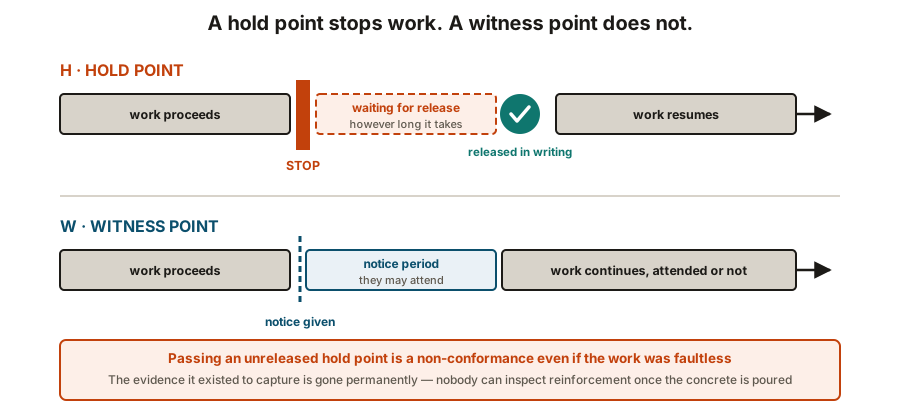
A hold point stops work. A witness point does not.
At a hold point, work does not continue until the party holding it has inspected and released it. At a witness point, they are told when the activity will happen and may attend; if they do not attend within the notice period, the work goes ahead.
Notice periods
A witness point is only meaningful if the notification arrives in time to act on. Projects set a notice period — often 24 or 48 hours — and it is measured in working time, not clock time.
Two failures are common and both are avoidable:
- Notice given too late. The activity proceeds legitimately, but the relationship takes the damage. Do this repeatedly and witness points start being converted into hold points.
- Notice given, activity not ready. The inspector travels out and stands in the sun while the crew finishes something else. Do this twice and the third notification is ignored.
When something is wrong
A non-conformance report records work that does not meet the specification. It is not a telling-off and it is not a punishment. It is a controlled way of writing down that reality and the requirement have diverged, so that somebody with the authority to act can decide what to do about it.
The deciding is called the disposition.
| Rework | Corrected so it meets the original specification | Conforming — no lasting record on the product | The rework itself needs inspecting; it is new work, not a correction to old work |
|---|---|---|---|
| Repair | Made acceptable for use, but not restored to the original requirement | Still non-conforming, accepted with a permanent record | Needs an approved repair procedure. A weld repair is a classic case |
| Use as is | Nothing is changed. The deviation is accepted as it stands | A concession, recorded against the item for its life | The most abused disposition. Requires engineering authority, never an inspector's signature |
| Reject | Scrapped, or returned to the supplier | Removed from the works | Must be physically segregated and marked, or it reappears in the job |
| Regrade | Accepted for a less demanding duty than it was made for | Conforming to the new, lower requirement | Only works if a genuine lower-duty use exists. Re-marking must be unmistakable |
No rows match that filter.
Only the party that owns the specification can decide a disposition. An inspector finds and records a non-conformance; an engineer with the authority to change the requirement decides what happens to it. Confusing those two roles is how a deviation gets accepted by somebody with no authority to accept it.
NCR, or deviation request?
They point in opposite directions in time, and the difference matters.
- A deviation request — also called a concession request — is raised before the work, asking permission to depart from the specification. The answer arrives before anything is built.
- An NCR is raised after, recording something already done that does not conform.
If you know in advance that you cannot meet a requirement, a deviation request is the honest route and it is far cheaper. Building it anyway and raising an NCR afterwards is how a project acquires a reputation.
Corrective and preventive action
Closing an NCR has two halves and the second is usually skipped.
- Corrective action fixes the item in front of you. The damaged sling is replaced.
- Preventive action stops it happening again everywhere else. How slings are inspected across the site is changed.
An NCR file full of corrective actions and no preventive ones describes a project that is finding the same problem over and over and fixing it one instance at a time.
Measuring instruments are part of the evidence
Every record that contains a number depends on the instrument that produced it. A pressure gauge, a torque wrench, a thickness meter, a lux meter, a holiday detector — all of them.
Three things are checked, and they are checked before the test rather than afterwards:
- Calibration is current. Certificates have dates and the dates run out.
- Calibration is traceable. An unbroken chain of comparisons back to a national standard. Without that chain, “calibrated” means only that somebody compared it to something.
- The range suits the measurement. A gauge reading at a tenth of its range carries an error that can approach the value being read, even though the gauge is within specification.
The material arrives before the work does
Receiving inspection is the cheapest inspection on the project, and it is the one most often reduced to counting boxes.
What it is actually for: identity, damage in transit, documentation, and conformity to what was ordered. A wrong item found in the warehouse costs a delivery. The same item found at commissioning costs a schedule, because by then it is installed, connected and buried behind other work.
Material certificates matter as much as the material. A certificate that cannot be tied to the item in front of you — by heat number, serial number or unique mark — proves that conforming material was purchased. It does not prove that this is it.
Turnover: what the folder is for
Everything above accumulates into the turnover package — the evidence that a system is complete, tested and fit to operate. Certificates, test records, as-builts, calibration records, the punch list and its status.
Compiling it as work proceeds rather than at the end is not administrative tidiness. A missing test found today can be repeated while access still exists and the system is dead. The same gap found at handover means remobilising, reinstating access, and re-isolating a system that is by then part of a live plant.
What to take away
- An ITP is agreed before work starts. It is the only document that says who gets involved and when.
- A hold point stops work; a witness point does not. Passing an unreleased hold point is a non-conformance regardless of how good the work was.
- An NCR records a divergence. The disposition — rework, repair, use as is, reject, regrade — belongs to whoever owns the specification, not to whoever found the problem.
- A deviation request comes before the work; an NCR comes after. Ask first, it is cheaper.
- Corrective action fixes this one. Preventive action stops the next one.
- A measurement is only evidence if the instrument was calibrated, traceable and of a suitable range. Check before the test.
- Compile the turnover package as you go. Everything is cheaper to fix while the system is still dead.
Check your understanding
6 questions. Nothing is recorded — this is just for you.