Process
Heat integration — why the plant reuses its own heat, and what that costs
Feed-effluent exchangers, the temperature approach trade-off, why steam comes at several pressures, and why a well-integrated plant is cheap to run and hard to start.
Energy is one of the largest operating costs on a process plant, and most of the heat a plant needs is not bought — it is recovered from somewhere else on the plant.
That single fact shapes a great deal of what a flow scheme looks like.
The basic move
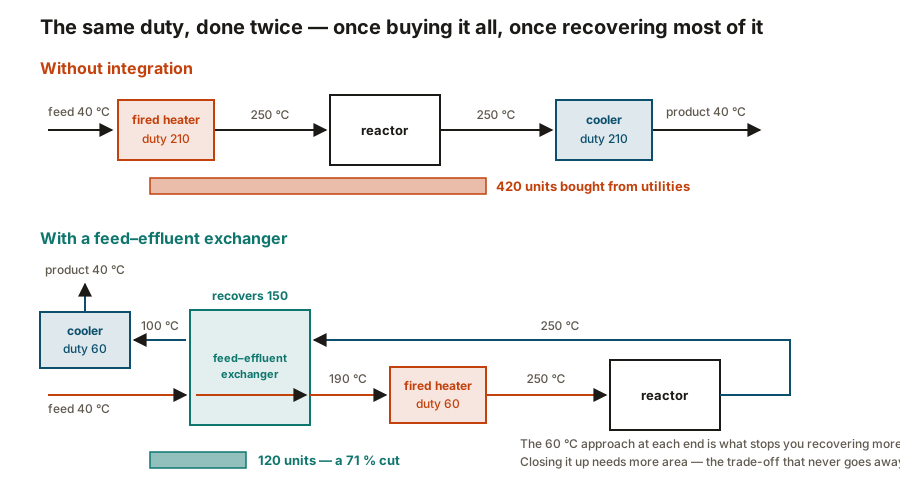
At any point a plant has hot streams that need cooling and cold streams that need heating. Rather than paying twice — fuel to heat one, cooling water to cool the other — you match them up.
The commonest case is the feed-effluent exchanger: hot product leaving a reactor or a column preheats the cold feed going in. One exchanger, two duties met, and it is frequently the single largest energy saving on a unit.
The trade-off nobody escapes
| Feed-effluent exchanger | Hot product preheats cold feed — often the single largest saving | The two streams are now coupled; an upset in one moves the other | Almost universal on reactor and column systems |
|---|---|---|---|
| Smaller temperature approach | More heat recovered from the same two streams | Much more exchanger surface, so more cost and more fouling area | The classic energy-versus-area trade-off |
| Waste heat boiler on hot flue gas | Steam raised from heat otherwise thrown up the stack | A pressure vessel sitting in a hot gas stream, with its own protection | Loss of feed water to it is a serious hazard |
| Air preheat on a fired heater | Directly reduces fuel consumption | Cold-end corrosion if flue gas drops below its acid dew point | There is a floor on how much heat can usefully be taken |
| Steam turbine drives | Work extracted on the way to a pressure level you needed anyway | The steam balance now depends on which machines are running | Stopping one machine can leave another steam level short |
| Tight overall integration | Lowest possible utility consumption | Difficult start-up, and upsets that propagate across the plant | Start-up needs utilities precisely because the integration is not yet running |
No rows match that filter.
Integration is not free efficiency. Every recovered megawatt ties two parts of the plant together, and the plant becomes cheaper to run and harder to operate in the same move. Knowing which side of that trade a decision sits on is most of the skill.
The one to understand properly is the temperature approach — how close the two streams get at the tight end of an exchanger.
Heat transfer needs a temperature difference to drive it. As the two streams approach each other, that driving force falls, and each additional kilowatt recovered needs disproportionately more surface area.
So a smaller approach means:
- more heat recovered, and lower fuel and cooling bills
- a bigger, more expensive exchanger
- more surface to foul, and more to clean
There is an economic optimum, and it moves with energy prices. Plants designed when fuel was cheap are often visibly less integrated than ones designed since.
Steam is an integration tool, not just a utility
A plant does not have one steam system. It has several at different pressures, and that is deliberate.
| HP steam | 40 – 100 bar | Turbine drives for large machines, high-temperature heating | Raised in fired boilers and in waste heat recovery |
|---|---|---|---|
| MP steam | 10 – 20 bar | Reboilers, process heating, medium turbine drives | Often arrives as turbine exhaust rather than from a boiler |
| LP steam | 3 – 5 bar | Low-temperature reboilers, stripping steam, tracing | Frequently in surplus — a sign the integration is unbalanced |
| Condensate | Atmospheric to low | Returned to the boilers as feed water | Treated and monitored; contamination is expensive to fix |
| Letdown station | Between any two levels | Making up a shortfall at a lower level | Letting down without doing work is wasted energy — it is a balancing tool, not a design intent |
No rows match that filter.
A plant does not have one steam system, it has several at different pressures. That is deliberate — steam raised at high pressure does useful work in a turbine on its way down to the pressure where it is actually needed for heating, so the same energy is used twice.
Steam raised at high pressure can do work in a turbine on its way down to the pressure where it is actually needed for heating. The same energy is used twice — once as shaft work, once as heat.
Because turbine drives both consume and produce steam, the steam balance depends on which machines are running. Stopping a large turbine-driven compressor can leave a downstream steam level short, and that connection is not obvious from any single drawing.
What integration costs you in operability
Here is the part that gets underweighted.
Every recovered megawatt ties two parts of the plant together. The feed to one unit is now heated by the product of another. When one moves, so does the other.
The consequences are real:
Upsets propagate. A disturbance in one unit travels through the exchanger network into its neighbours, and the control system has to handle interactions that would not exist in a simpler plant.
Start-up is harder. Before anything is running, there is no hot stream to recover from. The heat that normally comes free has to come from utilities instead, which is why start-up utility loads are sometimes larger than normal running loads, and why start-up heaters and bypass lines exist.
Turndown is harder. Exchanger networks are designed around a set of flows. At half rate the approaches change, and the network no longer behaves as intended.
Fouling degrades it slowly. As exchangers foul, recovery falls and the utilities quietly take up the slack. The plant still makes product, and it costs more to do it — which is why exchanger performance is trended rather than waited on, as covered in vessels and exchangers.
Waste heat
Beyond stream-to-stream recovery, heat is taken from places it would otherwise be lost:
- Convection sections in fired heaters, preheating feed or raising steam.
- Waste heat boilers on hot process gas or flue gas.
- Air preheat, which directly reduces fuel consumption.
All of them have a floor. Take flue gas too cold and it drops below its acid dew point — sulphur compounds condense as acid and corrode the cold end severely. There is a limit to how much heat can usefully be recovered, and it is set by chemistry rather than by economics.
What to take away
- Most of the heat a plant needs is recovered, not bought. Utilities are the top-up.
- The feed-effluent exchanger is usually the biggest single saving, and it couples two streams.
- A smaller temperature approach recovers more heat and needs disproportionately more area.
- Steam comes at several pressures so it can do work on the way down. A letdown valve throws that work away.
- The steam balance depends on which machines are running.
- Integration makes a plant cheap to run and hard to start, and makes upsets travel.
- Rising fuel at constant rate means fouling, not a faulty heater.
Check your understanding
10 questions. Nothing is recorded — this is just for you.