
Pharmaceutical
Clean steam and sterilisation — saturation, F0 and the load you cannot see
Why pure steam is a different utility from plant steam, why air in an autoclave is the thing that ruins a cycle, what F0 actually accumulates, and why depyrogenation and sterilisation are not the same process.
Standards referencedEN 285ISO 17665-1USP <1231>ASME BPVC Section VIII
Sterilisation is the one process in a pharmaceutical plant whose success cannot be confirmed by inspecting the product. You can look at a sterile vial for as long as you like and learn nothing. So the entire discipline rests on proving the process delivered the conditions, every time — which makes the instrumentation, the validation and the understanding of what the steam is actually doing the whole of the job.
Clean steam is a utility in its own right
Plant steam is made from treated boiler feed water and dosed with oxygen scavengers, amines and whatever else keeps a boiler and its condensate system alive. It is excellent at carrying heat and entirely unsuitable for touching product.
Clean steam — also called pure steam — contacts product, product surfaces and sterile equipment. Whatever is dissolved in it is deposited on those surfaces when it condenses.
Non-condensable gases get their own attention. Carbon dioxide and oxygen carried over from the feed do not condense, so they accumulate — in the top of a jacket, at the end of a header, in a filter housing. There they displace steam and create exactly the cold pocket that a sterilisation cycle must not have, so generators are designed to strip them and distribution is designed to vent them.
Saturated steam, and the one relationship that matters
Moist heat sterilisation works because saturated steam condenses on the load, giving up a large latent heat directly at the surface and heating it fast and evenly.
Saturated steam has exactly one temperature for each pressure. That relationship is the foundation of the whole process — the chamber is controlled on pressure and the load is assumed to be at the corresponding temperature. The classic reference condition is 121 °C, which corresponds to roughly one bar gauge.
Two things break the relationship, and both are failures.
Superheat. Steam heated above its saturation temperature behaves like a hot gas. It is drier, it does not want to condense, and dry gas is a far poorer steriliser than condensing steam — which is why dry heat needs much higher temperatures and much longer times to achieve the same thing. Reducing clean steam pressure through a valve superheats it, so the design has to account for that.
Air. This is the big one.
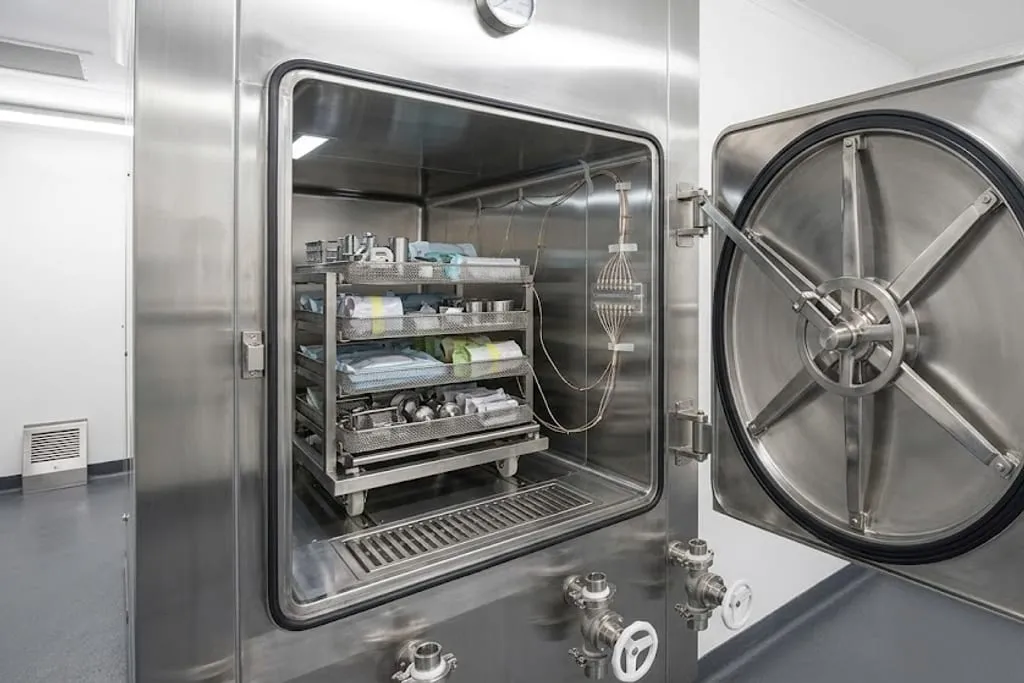
F0 — comparing cycles that are not square
A real cycle is not a rectangle. The load heats up over some minutes, holds, and cools down, and lethality is being delivered throughout — less at 110 °C than at 121 °C, but not zero.
F0 resolves that. It integrates the temperature history into the equivalent number of minutes at the reference temperature of 121.1 °C, using a z-value of 10 °C for the reference organism — meaning every 10 °C change alters the rate of kill by a factor of ten.
The convention of 15 minutes at 121 °C is an F0 of about 15, and a long gentle cycle can accumulate the same F0 at a lower peak temperature. That matters because plenty of products will not survive a square 121 °C cycle, and F0 is what lets a gentler one be shown to be equivalent. ISO 17665-1 sets out the development and validation framework.
Why sterility is a probability
Microbial death under heat is logarithmic. Each unit of lethality removes a fixed proportion of the survivors, not a fixed number. Start with a million spores, apply enough to kill 90%, and a hundred thousand remain; repeat and ten thousand remain. The curve approaches zero and never arrives.
So “sterile” is defined as a probability. The conventional target is a sterility assurance level of 10⁻⁶ — a residual probability of one surviving organism in a million items.
This is also why sterility testing cannot be how sterility is assured. A test on a sample of a batch has nowhere near the statistical power to detect a one in a million failure rate. The assurance comes from the validated process; the test confirms nothing went grossly wrong.
Biological indicators
A thermocouple proves the load reached a temperature. A biological indicator — a carrier inoculated with a known population of a heat-resistant spore, placed at the cold spot and incubated afterwards — proves the conditions were actually lethal.
Validation uses both, and the pairing is the point: the physical measurement is what you can monitor routinely, and the biological result is what connects it to the outcome.
Sterilisation in place
Equipment too large to put in an autoclave is sterilised where it stands — SIP, the sterilisation counterpart to CIP cleaning and its validation.
The same physics applies and the practical problems are harder, because the system was not designed as a chamber. Steam must reach every internal surface, every branch and every instrument pocket; air and condensate must be vented and drained from every high and low point; and the sequence of valve operations that achieves this becomes part of the validated process. A thermowell that traps condensate, or a branch the steam never reaches, is the same cold pocket problem in a different geometry — see thermowell integrity.
Depyrogenation is a different process
Killing organisms leaves their endotoxin behind, and endotoxin is remarkably heat stable — a steam cycle barely touches it.
Glass vials and ampoules destined for injectable product therefore go through dry heat depyrogenation, typically in a tunnel at a few hundred degrees, which both sterilises and destroys endotoxin. The classic laboratory condition of 250 °C for 30 minutes gives the idea of the severity involved, and production tunnels are validated on an endotoxin challenge rather than only on a spore one.
What to take away
- Clean steam is specified by its condensate, which must meet WFI quality — hence no dosing, dedicated generation and stainless distribution.
- Saturated steam has one temperature per pressure. The whole cycle depends on that, and superheat and air both break it.
- Air is the classic cause of a failed cycle. It cools the mixture, it hides inside the load, and it sinks — which is why cycles pulse, why leak tests are routine, and why the control sensor is in the drain.
- Loading pattern is part of the validated process. A differently packed load is an unvalidated cycle.
- F0 is equivalent minutes at 121.1 °C, accumulated by the slowest item in the load, and it is what lets a gentle cycle be proved equivalent to a harsh one.
- Sterility is a probability, conventionally 10⁻⁶, because death is logarithmic — so the process assures it and the test merely checks it.
- Biological indicators connect the physical measurement to the biological result. Use both.
- Depyrogenation is not sterilisation. Endotoxin survives steam, so sterile and pyrogen free are separate claims needing separate proof.
Check your understanding
7 questions. Nothing is recorded — this is just for you.