Mechanical
Valve types — picking one for the duty, not the drawing
Gate, globe, ball, butterfly and check valves explained by what each is built to do. Why throttling with a gate valve destroys it, what double block and bleed means, and how check valves slam.
Standards referencedASME B16.34API 600API 608API 609API 594API 607API 6D
A valve is the only part of a piping system that a human being operates. Everything else just sits there. That makes valves the point where a design decision meets an operator at three in the morning — and it is why picking the wrong type has consequences that outlast the project.
Start with the duty, not the type
There are only four things a valve is ever asked to do:
- Isolate — stop flow completely, so work can be done or equipment taken out of service.
- Regulate — control how much flows, continuously.
- Prevent reverse flow — automatically, with nobody present.
- Relieve pressure — protect equipment from overpressure. (A topic of its own; not covered here.)
The single most common valve error is using an isolation valve to regulate. It is worth understanding exactly why that damages the valve, because it explains the shape of everything else.
The types
| Gate | Isolate — fully open or fully shut | Multi-turn handwheel | Very low | NPS 2 – 24+ | API 600 | Never use it to throttle — the disc vibrates and the seat erodes |
|---|---|---|---|---|---|---|
| Globe | Throttle — regulate flow | Multi-turn handwheel | High | NPS 1/2 – 12 | BS 1873 / API 623 | The S-shaped path is what gives control, and what costs pressure |
| Ball | Isolate — fast, tight shut-off | Quarter turn | Very low (full bore) | NPS 1/2 – 24 | API 608 / API 6D | The default modern isolation valve; easy to actuate |
| Butterfly | Isolate, and coarse throttling | Quarter turn | Low to moderate | NPS 3 – 60+ | API 609 | Light and cheap in large sizes; the disc stays in the flow |
| Plug | Isolate, and divert flow | Quarter turn | Low | NPS 1/2 – 12 | API 599 | Sleeved or lubricated versions suit slurries and dirty service |
| Check (non-return) | Stop reverse flow | Automatic — no operator | Low to moderate | NPS 1/2 – 24+ | API 594 / API 6D | The only valve with no handle; it decides for itself |
| Diaphragm | Isolate and throttle, hygienically | Multi-turn | Moderate | NPS 1/2 – 8 | BS 5156 / ASME BPE | No crevices and fully drainable — standard in pharma |
| Needle | Fine throttling, small bore | Multi-turn | Very high | NPS 1/4 – 1 | Manufacturer | Instrument connections, sample points, gauge isolation |
| Control valve | Throttle continuously, under automatic control | Actuated, positioned | By design | NPS 1/2 – 24 | IEC 60534 | Sized on Cv for a duty range, not on line size |
No rows match that filter.
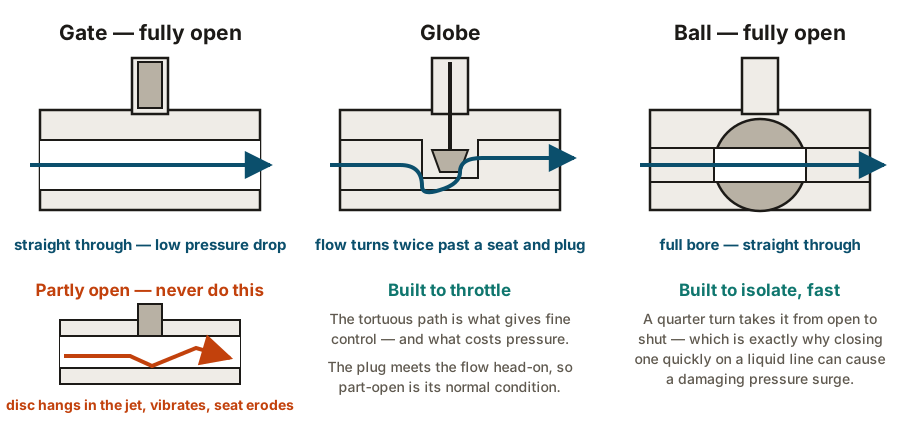
The first column of any valve decision is duty, not type. A valve built to isolate will be damaged by throttling, and a valve built to throttle wastes pressure when used to isolate. Read the duty column first and the rest follows.
Gate — the isolation workhorse
A sliding disc, a straight-through bore, almost no pressure drop when open. Multi-turn, so slow to operate, which is sometimes a feature: a slowly closing valve does not cause surge.
Look for OS&Y (outside screw and yoke) on hydrocarbon service: the stem rises visibly out of the yoke as the valve opens, so you can see the valve’s position from the ground, and the stem threads stay out of the process fluid.
Globe — the throttling valve
Flow makes an S-shaped turn through a seat and plug. That tortuous path is precisely what gives fine control, and precisely what costs pressure. Globe valves throttle well and isolate adequately; gate valves isolate well and throttle catastrophically.
Globe valves are also directional — there is a flow arrow on the body, and fitting one backwards makes it unstable.
Ball — the modern default
A bored sphere rotating a quarter turn. Fast, tight shut-off, and almost no pressure drop when full bore (the ball’s hole matches the pipe bore). Reduced bore is cheaper and smaller but restricts flow — and a full bore valve is mandatory if the line must be pigged.
Quarter-turn operation makes ball valves easy to actuate, which is why most automated shut-off valves are ball valves.
Butterfly — large and cheap
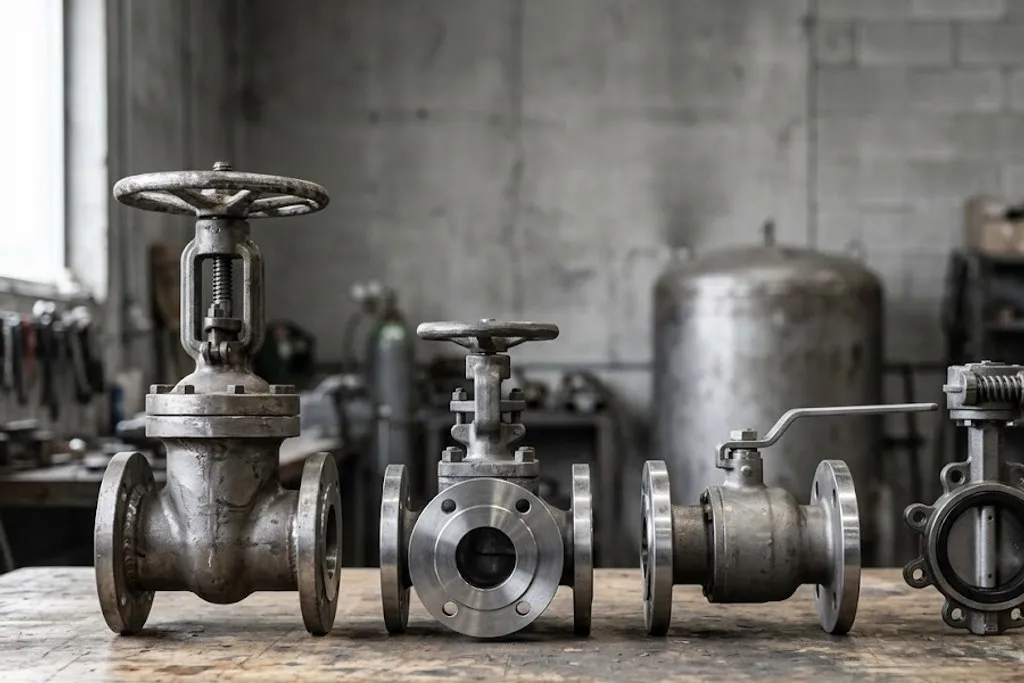
A disc rotating on a shaft across the bore. Very light and inexpensive in large sizes, which makes it the practical choice for big cooling water and utility lines where a gate valve would be enormous.
The disc stays in the flow even when open, so there is always some pressure drop, and it cannot be pigged through. Three body styles: wafer (clamped between flanges), lug (threaded lugs, so one side can be removed), and double flanged.
Diaphragm — the pharma valve
A flexible diaphragm pressed onto a weir. The process fluid touches only the body and the diaphragm, so there is no stem packing into the product, no crevice, and nothing to trap residue. Installed at a slight angle so it drains completely. This is the standard valve in hygienic process piping, for the same cleanability reasons covered in pipe materials.
Check valves and the problem of slam
A check valve has no operator. It decides for itself, and the mode that matters is not leakage — it is slam.
When a pump trips, flow stops and then reverses. If the check valve is still closing when the reverse flow arrives, it shuts hard against a moving column of liquid, and the resulting surge can be violent enough to rupture piping or tear supports off.
The answer is a valve that closes before reverse flow develops — short disc travel and spring assistance.
| Swing check | Disc swings shut under gravity and reverse flow | High | Low | General service where flow stops slowly | Long disc travel means it is still opening when reverse flow arrives |
|---|---|---|---|---|---|
| Dual plate (wafer) | Two spring-loaded half plates fold shut quickly | Low | Low | Pump discharge, compact installations, large sizes | Spring selection matters; a weak spring behaves like a swing check |
| Lift check | Disc lifts vertically off the seat and drops back | Moderate | High | Small bore, high pressure, clean service | Must be installed the right way up — orientation is not optional |
| Piston check | Damped piston, controlled closure | Low | High | Where surge must be limited and pressure drop is acceptable | The damping chamber fouls in dirty service |
| Nozzle / axial check | Spring-loaded disc on the axis, very short travel | Very low | Very low | Compressor discharge, large gas lines, critical surge control | Expensive, and needs correct spring for the actual flow |
| Ball check | Ball rolls back onto the seat | Moderate | Moderate | Viscous liquids, slurries, dosing lines | Ball wear in abrasive service |
No rows match that filter.
Check valves are the most commonly misapplied valve in a plant. The failure that matters is not leakage — it is SLAM: the disc closing hard after reverse flow has already started, producing a pressure surge that can rupture piping. A check valve that closes fast enough to shut before reverse flow builds does not slam.
Isolation is a system, not a valve
Here is where valves stop being a component choice and become a safety matter.
A closed valve is not an isolation. It is a valve that happens to be shut. It may pass, it may be opened by somebody else, and you cannot see inside it.
| Single valve | One closed valve | No — a passing valve gives no warning | Operational isolation only, never for entry or breaking containment |
|---|---|---|---|
| Single block and bleed | One closed valve with a small bleed downstream of it | Partly — an open bleed shows whether the valve is passing | Short-duration low-hazard work, where the standard allows |
| Double block and bleed (DBB) | Two closed valves in series with a bleed between them | Yes — the bleed between them vents any leak past the first valve | The normal standard for breaking into hydrocarbon lines |
| Double isolation and bleed (DIB) | Two valves each independently capable of sealing, plus a bleed | Yes, with redundancy — either valve alone is a full isolation | High hazard work, long duration, or high pressure differential |
| Spade or spectacle blind | A solid steel plate bolted into the line | Yes — and you can see it from the ground | Vessel entry, long shutdowns, anything requiring positive isolation |
| Physical disconnection | The spool piece removed and the open ends blanked | Absolutely — there is no longer a flow path | The strongest isolation available; used for the highest-hazard work |
No rows match that filter.
A closed valve is not an isolation. It is a valve that happens to be shut, and it can pass, be opened by someone else, or fail. The strength of an isolation is judged by what happens when one element fails — which is why the strongest methods put a physical, visible barrier in the line.
Double block and bleed (DBB) is the normal standard for breaking into a hydrocarbon line: two valves in series with a small vent between them. Open the bleed — if it flows, the upstream valve is passing and the isolation is not sound. That bleed is what converts a closed valve into evidence.
For vessel entry or a long shutdown, even DBB is not enough and a spade goes in: a solid steel plate bolted between flanges, visible from the ground. A spectacle blind is the same idea with the plate and a matching ring on one hinged piece, so it can be swung between open and blanked without finding a loose plate.
Things written on a valve spec that matter
Fire safe — tested to API 607 or API 6FA. The valve is burned, destroying its soft seats, and must still seal within defined limits afterwards on a secondary metal seat. A valve that fails in a fire feeds the fire.
Trim — the internal parts that contact the flow and do the sealing: seat, disc or ball, stem. Trim material is specified separately from the body, because it needs hardness and corrosion resistance the body does not. “13Cr trim” is a very common callout.
Body rating — governed by ASME B16.34, and it falls with temperature exactly like a flange rating. A Class 300 valve is not a 300-anything valve; look up the rating at design temperature, as in flanges and pressure classes.
Fugitive emissions — certification to ISO 15848 or TA-Luft limits how much the stem packing may leak to atmosphere. Increasingly mandatory on hydrocarbon service.
End connections — flanged, butt weld, socket weld, threaded or wafer. Set by the line class, not chosen per valve.
What to take away
- Decide the duty first. Isolate, regulate, prevent reverse flow — then pick the type.
- Gate valves isolate and must never throttle. Globe valves throttle. Ball valves isolate fast. Butterfly valves are for large, cheap duty.
- Full bore matters if the line is pigged; reduced bore is a restriction.
- Check valves fail by slamming, not by leaking. Match the closing speed to how fast flow can reverse.
- A closed valve is not an isolation. Double block and bleed proves it; a spade makes it visible.
- Fire safe, trim, body rating and emissions certification are all specified separately — and all of them come from the line class.
Check your understanding
10 questions. Nothing is recorded — this is just for you.